Adaptations to the abiotic environment at Higher Level: The same statement as SL. HL questions use a dune grass and a mangrove tree as named examples, and ask for each feature with the abiotic problem it solves.
Practise this as you read
- Explain adaptations of a dune grass to sand dunes.
- Explain adaptations of a mangrove tree to salt and waterlogged mud.
Free preview
This is the free notes preview
You're reading the free notes. Aimnova Pro unlocks the full study experience — and you can try it with your first topic free to keep:
- FlashcardsLock in vocabulary and key terms with spaced repetition.
- Practice questionsAnswer exam-style questions and get instant AI marking.
- Mock exams & past-paper vaultSit full mocks and see exactly how examiners award marks.
- Personalised study planA daily plan built around your exam date and weak areas.
The big idea: A plant cannot move, so it must survive whatever conditions its habitat throws at it — heat, drought, salt water or waterlogged mud.
What an adaptation is: An adaptation is a feature that helps an organism survive and reproduce in its environment. Plants from different habitats have different structural adaptations that solve the particular problem of that habitat.
Three habitat types are worth knowing:
| Habitat | Plant type |
|---|---|
| Dry deserts | Xerophytes |
| Salty / waterlogged swamps | Halophytes such as mangroves |
| Ordinary moist soil | Mesophytes |
- Adaptation
- A feature (structural, physiological or behavioural) that helps an organism survive and reproduce in its environment.
- Structural adaptation
- A physical feature of the body — such as the shape of a leaf or the type of root — that suits an organism to its habitat.
- Xerophyte
- A plant adapted to live where water is scarce, such as a hot desert (for example a cactus).
- Halophyte
- A plant adapted to live in salty conditions, such as a mangrove tree in a coastal swamp.
- Mesophyte
- A plant adapted to ordinary conditions with a moderate, reliable supply of water (most common garden and crop plants).
- Transpiration
- The loss of water vapour from a plant, mainly through the stomata in its leaves.
One problem, one adaptation: Every adaptation is the answer to a problem the habitat poses.
Desert plant → problem is losing water → adaptations reduce water loss.
Mangrove → problem is salt and no oxygen in the mud → adaptations deal with salt and get oxygen.
If you can name the problem, you can usually work out the adaptation.
Feeling unprepared for exams?
Get a clear study plan, practice with real questions, and know exactly where you stand before exam day. No more guessing.
The trick to this topic is to reason from the habitat's problem to the adaptation and then to how it helps — a clear cause-and-effect chain.
Let's work through the two habitats asked about most: hot deserts and mangrove swamps.
Xerophytes — built to save water: A xerophyte lives where water is scarce, so almost every adaptation works to reduce water loss by transpiration, or to store water for the dry times.
Xerophyte adaptations
- Thick waxy cuticle waterproofs the leaf.
- Reduced leaf area (spines, needles, rolled leaves) gives less surface to lose water from.
- Sunken stomata trap humid air so less water escapes.
- Some open their stomata only at night, when it is cooler.
- Succulent tissue stores water.
- Deep or wide-spreading roots reach what little water there is.
| Adaptation of a desert plant | How it helps the plant survive |
|---|---|
| Thick, waxy cuticle | Forms a waterproof layer that reduces evaporation from the leaf surface |
| Reduced leaf area (spines / needles / rolled leaves) | Less surface area means less water is lost by transpiration |
| Sunken stomata | Trap a layer of humid air in pits, lowering the water-vapour gradient so less water escapes |
| Stomata open at night (CAM) | Gas exchange happens when it is cooler, so less water is lost than in the hot day |
| Succulent (water-storing) tissue | Stores water taken up during rare rains for use in long dry periods |
| Deep and/or wide-spreading roots | Reach water deep underground, or quickly absorb a wide area of surface water after rain |
Mangroves — coping with salt and waterlogged mud: A mangrove is a halophyte: it grows in coastal swamps where the water is salty and the mud is waterlogged and low in oxygen. It faces two big problems at once.
Mangrove adaptations
- Aerial 'breathing' roots (pneumatophores) grow upward into the air so the tree can take in oxygen for root respiration, because the mud has almost none.
- Salt glands in the leaves excrete excess salt, keeping the plant's internal salt level low — so water can still be drawn in by osmosis instead of being pulled out.
| Problem in a mangrove swamp | Adaptation | How it helps |
|---|---|---|
| Mud is waterlogged and low in oxygen | Aerial 'breathing' roots (pneumatophores) grow up into the air | Take in oxygen from the air for root respiration |
| Sea water is very salty (high salinity) | Salt glands in the leaves | Excrete excess salt, keeping the internal salt level low so water can still be absorbed by osmosis |
| Soft, unstable, waterlogged mud | Wide prop / stilt roots that branch and spread | Anchor and support the tree in soft mud and tidal water |
Adaptations for pollination: Plants also adapt to attract animal pollinators so their pollen is carried to other flowers.
Flowers attract animals (bees, birds, insects) with bright, colourful petals, a scent, sugary nectar as a reward, and a shape that fits the pollinator.
These features are adaptations too — they raise the plant's chance of reproducing by improving pollen transfer.
Desert problem: losing water
- Thick waxy cuticle → waterproofs the leaf
- Reduced leaf area (spines) → less surface to lose water
- Sunken stomata → trap humid air, less escapes
- Succulent tissue + deep roots → store / reach water
Mangrove problem: salt + no oxygen
- Aerial roots (pneumatophores) → take in oxygen
- Salt glands → excrete excess salt
- Low internal salt → osmosis still works for water uptake
- Wide prop roots → anchor in soft mud
An easy way to remember: Xero = dry (think 'zero water') → everything saves water.
Mangrove → 'breathing roots above, salt glands out' — get oxygen up, push salt out.
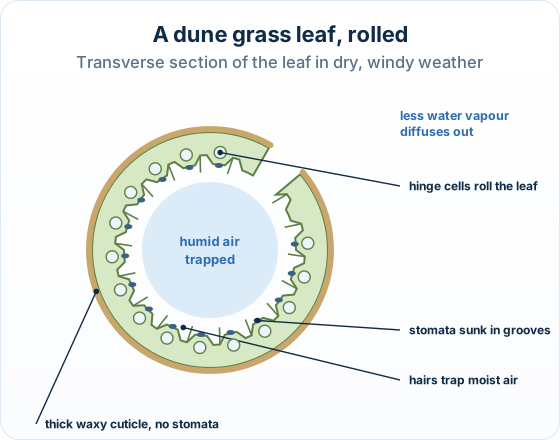
The big idea: Each adaptation answers one abiotic problem of the habitat. On a dune the problems are dry, salty wind and moving sand; in a mangrove swamp they are salt and mud with no oxygen.
The points to remember
- Marram grass grows on coastal sand dunes, where water drains away and the wind dries leaves.
- Its leaves roll up in dry wind, with stomata sunk in grooves inside and hairs that trap moist air.
- A thick waxy cuticle covers the outer surface; long rhizomes and deep roots reach water.
- Buried by blowing sand, it grows up through it, and its rhizomes bind the sand together.
Grey mangrove: a tree of mangrove swamps
- Pneumatophores, roots that grow upwards out of the mud, take in oxygen through lenticels.
- Salt glands on the leaves excrete excess salt, keeping the cytoplasm suitable for metabolism.
- Salt can also be moved into old leaves, which are then shed.
Remember it as: Dune: roll, sink, hairs, wax, roots. Swamp: air roots, salt out.
Real example: the grey mangrove. Grey mangroves grow on muddy tropical coasts from East Africa to Australia, surrounded by a forest of pencil-like pneumatophores.
Two traps: 'Thin' or 'spiky' leaves do not earn the mark for dune grass: say rolled leaves and why.
'Deep roots' do not earn the mark for mangroves: the mud has no oxygen, so name aerial roots or prop roots.
Memorize terms 3x faster
Smart flashcards show you cards right before you forget them. Perfect for definitions and key concepts.
How this is tested: Plant adaptation questions range from a long Describe to a 1-mark State, plus data questions. Each asks for something different.
| Question | What it asks | How to score |
|---|---|---|
| Describe (up to 7 marks), a favourite | The adaptations of plants in hot deserts | Each distinct adaptation, briefly explained, scores a mark |
| Shorter Explain | How one adaptation helps — for example a mangrove root adaptation, or how salt glands benefit the tree | Give the feature and its benefit |
| 1-mark State | One way a plant attracts pollinators | One clear way |
| Data question: Discuss or Predict | From a graph, which species is better adapted to a changing condition | Use the data in the graph |
Exam-style question — describe desert plant adaptations
Describe the structural adaptations that help plants survive in hot deserts. [6]
How to score full marks
- Waterproof the surface. A thick, waxy cuticle covers the leaves, reducing evaporation / water loss from the surface.
- Cut the surface area. Leaves are reduced to spines or needles (or are rolled), so there is less surface area for transpiration.
- Protect the stomata. Stomata are sunken in pits (and may open only at night), trapping humid air so less water vapour escapes.
- Store water. Succulent stems or leaves contain water-storage tissue that holds water taken up during rare rains.
- Reach the water. Roots are deep and/or wide-spreading to absorb water from a large area or from deep underground.
Final answer
Thick waxy cuticle; reduced leaf area (spines/needles); sunken stomata (open at night); water-storing succulent tissue; deep and/or spreading roots — each reducing water loss or improving water capture.
Why this scores full marks: Each point is a separate, distinct adaptation with a brief reason — exactly what a 6-mark Describe rewards.
Listing one idea several ways (for example 'thick cuticle… waxy cuticle… waterproof cuticle') would score only once. Aim for distinct features.
| Adaptation of a desert plant | How it helps the plant survive |
|---|---|
| Thick, waxy cuticle | Forms a waterproof layer that reduces evaporation from the leaf surface |
| Reduced leaf area (spines / needles / rolled leaves) | Less surface area means less water is lost by transpiration |
| Sunken stomata | Trap a layer of humid air in pits, lowering the water-vapour gradient so less water escapes |
| Stomata open at night (CAM) | Gas exchange happens when it is cooler, so less water is lost than in the hot day |
| Succulent (water-storing) tissue | Stores water taken up during rare rains for use in long dry periods |
| Deep and/or wide-spreading roots | Reach water deep underground, or quickly absorb a wide area of surface water after rain |
A 2-mark Explain on this statement, in the papers' style:
Explain two adaptations of marram grass leaves to life on sand dunes.
Model answer plan
See the answer broken into clear points, with guidance on how each point earns marks.