Arteries at Higher Level: The same statement as SL. HL papers ask for two adaptations of arteries, and later link artery pressure to the cardiac cycle and tissue fluid.
Practise this as you read
- Outline two adaptations of arteries for the transport of blood.
- Explain why pressure in the aorta falls less than in the ventricle.
Free preview
This is the free notes preview
You're reading the free notes. Aimnova Pro unlocks the full study experience — and you can try it with your first topic free to keep:
- FlashcardsLock in vocabulary and key terms with spaced repetition.
- Practice questionsAnswer exam-style questions and get instant AI marking.
- Mock exams & past-paper vaultSit full mocks and see exactly how examiners award marks.
- Personalised study planA daily plan built around your exam date and weak areas.
Start Studying Free Full access to Aimnova Pro · cancel anytime
The big idea: Arteries carry blood away from the heart at high pressure. Muscle and elastic tissue in the wall let it withstand that pressure and keep it high between beats.
The points to remember
- A thick wall withstands the high pressure; collagen in the outer layer stops it bursting.
- Elastic fibres stretch with each surge, then recoil, pushing blood on: pressure stays high and flow is smoother.
- Smooth muscle withstands the pressure and can narrow or widen the artery to control blood flow.
- A narrow lumen keeps the pressure high; a smooth endothelium cuts friction.
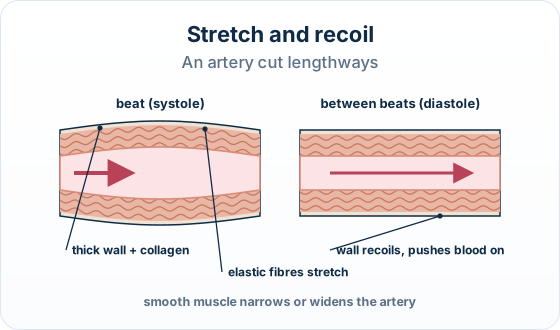
Remember it as: Stretch with the beat, recoil between beats.
Real example: the giraffe. A giraffe's heart must push blood about 2 metres up the neck to the brain, so its blood pressure is about twice ours, and its arteries have extra-thick muscular walls to withstand it.
Never wonder what to study next
Get a personalized daily plan based on your exam date, progress, and weak areas. We'll tell you exactly what to review each day.
Try Free Study PlanYour first topic is free to keep • No credit card required
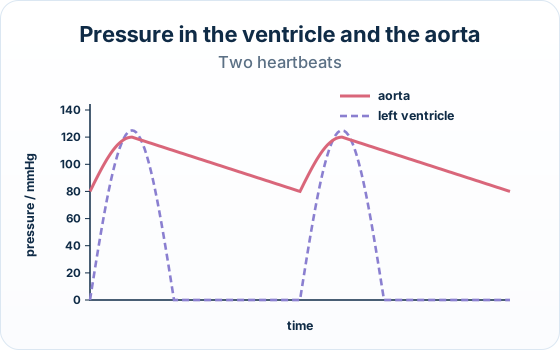
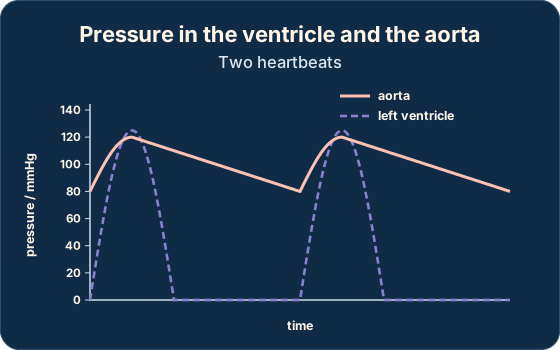
Reading the pressures: In the left ventricle pressure swings from about 0 to 125 mmHg. In the aorta it only swings between about 80 and 120 mmHg.
The points to remember
- During a beat the aorta's elastic wall stretches, so the peak pressure rises a little less.
- Between beats the wall recoils, so the pressure falls only to about 80 mmHg, not to 0.
- This recoil keeps blood moving all the time, not just in spurts.
Trap: The smaller swing is not caused by valves or by a thin wall. It is the stretch and recoil of the elastic wall.
How it is asked: Expect a pressure table or graph for the ventricle and the aorta, or 'outline two adaptations of arteries'. Always give the structure and what it does.
IB-style questionOutline[2 marks]
Outline two adaptations of arteries for the transport of blood.
Model answer plan
See the answer broken into clear points, with guidance on how each point earns marks.