Leaf gas exchange at Higher Level: The same statement as SL. HL papers ask for the role of each leaf structure in gas exchange, and use leaf images to test where each tissue is.
Practise this as you read
- Explain the roles of two leaf structures in gas exchange.
- Outline the route of carbon dioxide into a chloroplast.
Free preview
This is the free notes preview
You're reading the free notes. Aimnova Pro unlocks the full study experience — and you can try it with your first topic free to keep:
- FlashcardsLock in vocabulary and key terms with spaced repetition.
- Practice questionsAnswer exam-style questions and get instant AI marking.
- Mock exams & past-paper vaultSit full mocks and see exactly how examiners award marks.
- Personalised study planA daily plan built around your exam date and weak areas.
The big idea: A leaf is a flat organ built for gas exchange and photosynthesis. It must let gases move easily between the air and its inner cells.
How the leaf manages it
- Photosynthesis needs carbon dioxide (CO₂) from the air, and it releases oxygen (O₂)
- Small holes called stomata on the underside let gases in and out
- Inside, a loose, air-filled layer of cells called the spongy mesophyll carries gases to the cells
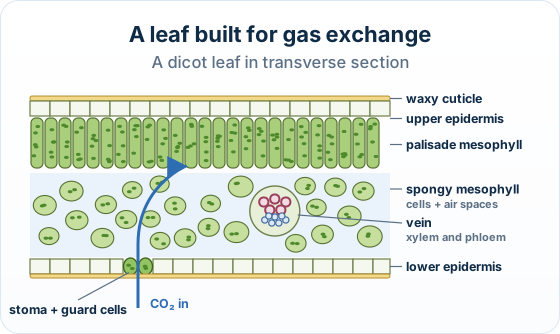
A leaf in cross-section. From the top: waxy cuticle, upper epidermis, palisade mesophyll (tall, chloroplast-packed cells), spongy mesophyll (loose cells with air spaces) and lower epidermis with a stoma between two guard cells. CO₂ diffuses in and O₂ plus water vapour diffuse out through the open stoma.
Interactive diagram
Explore the labelled diagram, charts and maps for this topic in full study mode.
- Gas exchange
- The movement of gases (here CO₂ in and O₂ out) between an organism and its environment by diffusion.
- Stoma (plural: stomata)
- A small pore (hole) in the leaf surface, usually on the underside, through which gases enter and leave the leaf.
- Guard cells
- The two cells either side of a stoma that change shape to open or close the pore, controlling gas exchange and water loss.
- Palisade mesophyll
- Tall, chloroplast-packed cells just below the upper surface that carry out most of the leaf's photosynthesis.
- Spongy mesophyll
- Loosely-packed cells with large air spaces between them, through which gases diffuse to and from the photosynthesising cells.
- Epidermis
- The single layer of cells covering the upper and lower surfaces of the leaf; it protects the leaf and (on the underside) holds the stomata.
Why a leaf is thin and flat: A leaf is thin so that gases have only a short distance to diffuse between the air and the inner cells.
It is flat and wide to give a large surface area for catching light and for gases to enter — both make gas exchange and photosynthesis faster.
Feeling unprepared for exams?
Get a clear study plan, practice with real questions, and know exactly where you stand before exam day. No more guessing.
Each layer of the leaf has a job, and its structure is adapted to that job.
Reading from the top surface down to the bottom, the layers work together so that light reaches the chloroplasts and gases reach (and leave) every cell.
| Leaf layer (top to bottom) | What it is | How it helps gas exchange / photosynthesis |
|---|---|---|
| Waxy cuticle | A clear, waterproof wax coating on the surface | Reduces water loss; being transparent, it still lets light through |
| Upper epidermis | A single layer of clear, tightly-packed surface cells (no chloroplasts) | Transparent, so light passes straight through to the cells below |
| Palisade mesophyll | Tall, column-shaped cells packed with chloroplasts, just under the upper surface | Does most of the photosynthesis — its chloroplasts catch the most light |
| Spongy mesophyll | Loosely-packed rounded cells with large air spaces between them | The air spaces let CO₂ diffuse to every cell and O₂ diffuse away |
| Lower epidermis | A single layer of surface cells on the underside, containing the stomata | Holds the stomata, where gases enter and leave the leaf |
| Stoma + guard cells | A pore (stoma) flanked by two guard cells, mostly on the lower surface | The guard cells open and close the pore, controlling gas exchange and water loss |
The two mesophyll layers do different jobs: One layer catches the light; the layer below it moves the gases.
Palisade mesophyll
- Sits near the top, where the light is brightest
- Cells are tall and packed with chloroplasts
- Does most of the photosynthesis
Spongy mesophyll
- Sits below the palisade layer
- Cells are loosely packed with big air spaces between them
- The air spaces let CO₂ diffuse in to every cell and O₂ diffuse out
- They are the leaf's internal 'corridors' for gases
Follow the carbon dioxide: A classic exam task is to trace the path of CO₂ from the air into a chloroplast. Follow it step by step.
The path of CO₂
In through a stoma
CO₂ in the air diffuses in through an open stoma.
Through the air spaces
It spreads through the air spaces of the spongy mesophyll.
Into a mesophyll cell
It diffuses across the cell wall and cell membrane of a mesophyll cell.
Into a chloroplast
It crosses the cytoplasm and enters a chloroplast, where photosynthesis uses it.
Stoma → air spaces → wall and membrane → chloroplast.
Follow the blue arrow: CO₂ enters through the open stoma, fills the air spaces between the spongy mesophyll cells, then diffuses across the cell wall and membrane into the cytoplasm and finally into a chloroplast — where photosynthesis uses it.
Interactive diagram
Explore the labelled diagram, charts and maps for this topic in full study mode.
| Step | Where the CO₂ is | What it does next |
|---|---|---|
| 1 | In the air outside the leaf | Diffuses in through an open stoma |
| 2 | In the air spaces of the spongy mesophyll | Spreads through the air spaces to reach the cells |
| 3 | At the surface of a mesophyll cell | Diffuses across the cell wall and the cell membrane |
| 4 | In the cytoplasm of the cell | Diffuses on into a chloroplast |
| 5 | Inside a chloroplast | Is used in photosynthesis |
CO₂ entering the leaf
- Moves in through an open stoma
- Spreads through spongy mesophyll air spaces
- Crosses the cell wall and membrane
- Ends up in a chloroplast to be used in photosynthesis
O₂ + water vapour leaving
- O₂ made in photosynthesis diffuses out
- Travels back through the air spaces
- Leaves through an open stoma
- Water vapour is also lost this way (transpiration)
An easy way to remember the pathway: Stoma → Spaces → Surface → Cytoplasm → Chloroplast.
Gases always move by diffusion, from where there is more of them to where there is less — no energy needed.
The big idea: Every part of a leaf helps gases reach the cells quickly while losing as little water as possible.
The points to remember
- Waxy cuticle: waterproof, so little water is lost. Gases cannot pass through it either, so they use the stomata.
- Epidermis: one layer of tightly fitting cells; the upper one is transparent, so light gets through.
- Spongy mesophyll: air spaces give a large internal surface; the cell walls are moist, so carbon dioxide dissolves before it diffuses in.
- Guard cells: a pair round each stoma. They open it to let carbon dioxide in and close it to cut water loss.
- Veins: xylem brings water that keeps the mesophyll moist; phloem carries the sugars away.
- Catching light: the palisade layer sits near the top, under a transparent epidermis.
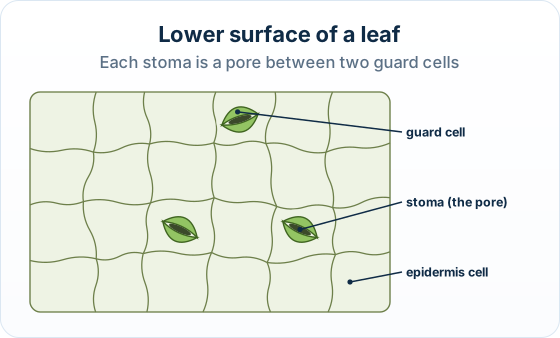
Two traps: The stoma is the pore; the guard cells are the two cells round it. When you label a guard cell, touch the cell, not the gap.
The cuticle is not a route in: gases enter only through stomata.
Remember it as: Wax keeps water in; stomata let gases in; guard cells decide when.
Real example: water lily leaves. A water lily leaf floats with its lower surface on the water, so its stomata are on the upper surface, the only side open to the air.
Memorize terms 3x faster
Smart flashcards show you cards right before you forget them. Perfect for definitions and key concepts.
How this is tested: Leaf gas exchange is tested on Paper 1A and Paper 1B, usually with an image of a leaf.
What each paper asks
- Paper 1B: a short data-style question shows a leaf — a cross-section or the lower surface — and asks you to outline the path carbon dioxide takes from the air into the chloroplasts
- The marks are for the ordered steps: stoma → air spaces → across the cell wall/membrane → chloroplast
- Paper 1A: you may be shown a labelled leaf cross-section and asked to identify the structures marked X and Y (for example palisade mesophyll, spongy mesophyll, a stoma or a guard cell)
- You may also be asked to mark or label the position of a guard cell or a stoma on an image of the leaf's lower surface
Exam-style question — trace the path of carbon dioxide
A dicot leaf is photosynthesising in bright light. Outline the path that a carbon dioxide molecule takes from the air outside the leaf to a chloroplast inside a mesophyll cell. [2]
How to score both marks
- Get into the leaf. The CO₂ diffuses in through an open stoma on the lower surface of the leaf.
- Move through the air spaces. It then spreads through the air spaces between the spongy mesophyll cells.
- Cross into the cell and reach the chloroplast. It diffuses across the cell wall and cell membrane, through the cytoplasm, and into a chloroplast.
Final answer
CO₂ diffuses in through an open stoma, through the air spaces of the spongy mesophyll, then across the cell wall and membrane into the cytoplasm and on into a chloroplast.
Why this scores full marks: The answer is a clear, ordered sequence: stoma → air spaces → cell wall/membrane → chloroplast.
For a 2-mark 'outline the path', give the steps in the right order, not just the word 'diffusion'. Naming the stoma and the spongy mesophyll air spaces is what scores.
Follow the blue arrow: CO₂ enters through the open stoma, fills the air spaces between the spongy mesophyll cells, then diffuses across the cell wall and membrane into the cytoplasm and finally into a chloroplast — where photosynthesis uses it.
Interactive diagram
Explore the labelled diagram, charts and maps for this topic in full study mode.
A 2-mark Explain, in the papers' style:
Explain the roles of two leaf structures that help with the process of gas exchange in the leaf.
Model answer plan
See the answer broken into clear points, with guidance on how each point earns marks.