Lung volumes at Higher Level: The same statement as SL. HL papers ask you to describe how a volume is measured, or to pick a volume out of a trace.
Practise this as you read
- Describe how tidal volume or vital capacity is measured.
- Identify the tidal volume and the reserve volumes on a trace.
Free preview
This is the free notes preview
You're reading the free notes. Aimnova Pro unlocks the full study experience — and you can try it with your first topic free to keep:
- FlashcardsLock in vocabulary and key terms with spaced repetition.
- Practice questionsAnswer exam-style questions and get instant AI marking.
- Mock exams & past-paper vaultSit full mocks and see exactly how examiners award marks.
- Personalised study planA daily plan built around your exam date and weak areas.
The big idea: Your lungs do not fill and empty completely with every breath. At rest you move only a small amount of air in and out.
Key points
- You can breathe in much more, and force out much more, if you need to
- A spirometer is the instrument that measures these volumes
- It records them as a trace (a graph of lung volume against time)
Why it matters: Reading volumes off a spirometer trace is a classic data question — so the key skill is knowing exactly what each volume means and where to measure it on the graph.
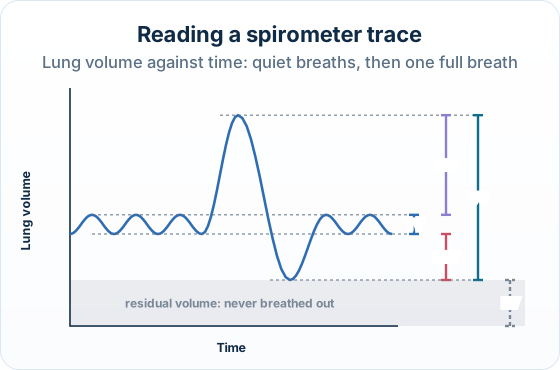
A spirometer trace: quiet tidal breathing (small waves), then one deep breath in and a full breath out. The brackets on the right mark tidal volume (TV), inspiratory and expiratory reserve volumes (IRV, ERV), vital capacity (VC) and the residual volume (RV) that always stays in the lungs.
Interactive diagram
Explore the labelled diagram, charts and maps for this topic in full study mode.
- Spirometer
- An instrument that measures the volume of air a person breathes in and out, recording it as a trace over time.
- Tidal volume (TV)
- The volume of air in one normal, resting breath — the height of one small wave on the trace.
- Inspiratory reserve volume (IRV)
- The extra air that can be breathed IN on top of a normal breath.
- Expiratory reserve volume (ERV)
- The extra air that can be forced OUT after a normal breath out.
- Vital capacity (VC)
- The largest volume of air that can be moved in a single breath: IRV + TV + ERV (the deepest breath in to the fullest breath out).
- Residual volume (RV)
- Air that always stays in the lungs and cannot be breathed out — so it never appears on the trace.
Two volumes that catch people out: Vital capacity is NOT the total lung capacity. Vital capacity is only the air you can actually move; the residual volume is always left behind.
So: total lung capacity = vital capacity + residual volume. You can breathe out the vital capacity, but never the residual volume.
Memorize terms 3x faster
Smart flashcards show you cards right before you forget them. Perfect for definitions and key concepts.
The person breathes into a sealed chamber. Repeating each breath draws the up-and-down waves you read the volumes from.
Breathing **in**
- Air is drawn out of the chamber
- A floating drum sinks
- The pen rises on the trace
Breathing **out**
- Air returns to the chamber
- The pen falls
| Reading volumes off the trace | Where to measure it |
|---|---|
| Tidal volume | The height of one small resting wave (one normal breath) |
| Vital capacity | From the top of the deepest breath in down to the bottom of the fullest breath out (it adds up IRV + TV + ERV) |
| Ventilation rate | The number of complete breaths (waves) in one minute — count the waves over a known time and scale up |
To read vital capacity (VC): measure from the very top of the deepest breath in down to the very bottom of the fullest breath out (VC = IRV + TV + ERV). The residual volume (RV) is NOT included — it cannot be breathed out.
Interactive diagram
Explore the labelled diagram, charts and maps for this topic in full study mode.
The valves and the soda lime: The breathing circuit has two parts you must know.
Parts of the breathing circuit
- One-way valves — inhaled and exhaled air travel on separate tubes and do not mix, which keeps the trace accurate
- Soda lime — a canister that absorbs the carbon dioxide the person breathes out, so they re-breathe air without a build-up of CO₂
A side effect: Removing that CO₂ has a side effect you must be able to explain — it makes the baseline drift downward (see below).
Why the resting baseline slopes downward: On a closed-circuit spirometer the resting trace slowly drifts down over time. Two things are happening together.
Why the trace drifts down
Oxygen is used up
The person's cells take oxygen from the chamber for respiration, so the total volume of gas in the sealed circuit falls.
Exhaled CO₂ is removed
The soda lime absorbs the carbon dioxide breathed out, so the CO₂ is not replaced into the chamber.
Total gas falls
Oxygen leaves the gas (into the body) but the CO₂ is taken out by the soda lime, so the total gas in the circuit keeps falling — and the whole trace slopes downward.
| Part of the spirometer | What it does | Why it matters |
|---|---|---|
| Air chamber / floating drum | Rises and falls as the person breathes air in and out | Its movement is what the pen records as the trace |
| Pen on a rotating drum | Draws the lung-volume trace against time | Gives the graph you read volumes and rate from |
| One-way valves | Keep inhaled air and exhaled air on separate tubes | Stops the two airstreams mixing, so the trace stays accurate |
| Soda lime canister | Absorbs the carbon dioxide breathed out | Removes CO₂ so the person re-breathes clean air; also makes the baseline slope down |
Breathing IN (inspiration)
- Air is drawn out of the chamber
- The floating drum sinks
- The pen rises on the trace
- A larger lung volume = a higher point
Breathing OUT (expiration)
- Air is returned to the chamber
- The floating drum rises
- The pen falls on the trace
- A smaller lung volume = a lower point
Exercise changes the trace: During exercise, breathing becomes deeper and faster. On the trace the waves get taller (larger tidal volume) and closer together (higher ventilation rate).
Both changes together greatly increase the total volume of air inhaled per minute — delivering more oxygen to the muscles and removing more carbon dioxide.
Check the apparatus. On many spirometers a pulley makes the pen rise as you breathe in. If the pen is fixed straight to the lid of the chamber, it moves down with the lid as you breathe in, so the trace goes down. Always follow which way the chamber in the question moves.
The big idea: Every lung volume comes from how the person breathes into the spirometer: normal breaths for the tidal volume, the deepest breath in and the fullest breath out for the rest.
The points to remember
- Fit a nose clip, so every breath goes through the mouthpiece.
- Breathe normally for a minute: the height of one small wave is the tidal volume.
- Then breathe in as deeply as possible and out as fully as possible into the spirometer: that whole drop is the vital capacity.
- Inspiratory reserve = deepest breath in minus the top of a normal breath.
- Expiratory reserve = bottom of a normal breath minus the fullest breath out.
- Repeat three times and take the mean.
Two traps: Tidal volume is a normal breath: never a deep or forced one.
Vital capacity needs both a maximum breath in and a maximum breath out into the spirometer.
Remember it as: Normal breath = tidal; biggest in to biggest out = vital capacity.
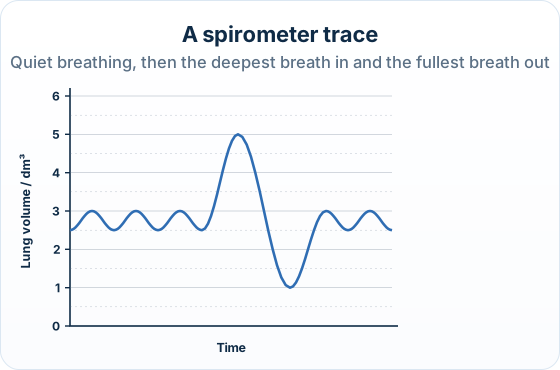
Worked reading. On this trace, quiet breaths run between 2.5 and 3.0 dm³, the deepest breath in reaches 5.0 dm³ and the fullest breath out falls to 1.0 dm³.
| Volume | Working | Answer |
|---|---|---|
| Tidal volume | 3.0 − 2.5 | 0.5 dm³ |
| Inspiratory reserve | 5.0 − 3.0 | 2.0 dm³ |
| Expiratory reserve | 2.5 − 1.0 | 1.5 dm³ |
| Vital capacity | 5.0 − 1.0 | 4.0 dm³ |
Check your reading: The three parts add up to the vital capacity: 2.0 + 0.5 + 1.5 = 4.0 dm³.
Real example: a lung-function test. In a clinic, a patient wears a nose clip and breathes into a spirometer. Their vital capacity is compared with the expected value for their age, sex and height to check how well the lungs work.
Know your predicted grade
Take timed mock exams and get detailed feedback on every answer. See exactly where you're losing marks.
How this is tested: This micro is a data-question favourite. You must know exactly where each volume is measured, and how the spirometer works.
| Paper | What you are asked |
|---|---|
| Paper 1A | Given a spirometer trace, read off the vital capacity, tidal volume or ventilation rate |
| Paper 1B | The spirometer itself: State the function of a valve in the breathing circuit, Describe the pen trace during a breath, or Explain why the resting baseline slopes downward |
| A common Explain | Links to exercise — why deeper, faster breathing raises the total volume of air inhaled |
Exam-style question — read the vital capacity off a trace
A student records a spirometer trace of normal breathing followed by one maximum breath in and one maximum breath out. Describe how you would use the trace to find the student's vital capacity. [3]
How to score all three marks
- Find the highest point. Identify the top of the deepest breath in (the maximum inspiration) on the trace.
- Find the lowest point. Identify the bottom of the fullest breath out (the maximum expiration).
- Read off the difference. Read the lung volume at each point off the axis and find the difference between them — that is the vital capacity (it adds up the inspiratory reserve, tidal and expiratory reserve volumes). The residual volume is not included.
Final answer
Vital capacity = the volume between the top of the deepest breath in and the bottom of the fullest breath out (IRV + TV + ERV); read each volume off the axis and take the difference. The residual volume is not included.
Why this scores full marks: It tells the marker where to measure (highest point and lowest point) and what to do (take the difference), and correctly excludes the residual volume.
A weak answer just writes 'the biggest breath' without saying it is measured between the deepest in and the fullest out.
| Lung volume | What it is | How you read it off the trace |
|---|---|---|
| Tidal volume (TV) | The volume of one normal breath at rest | The height of one small resting wave |
| Inspiratory reserve volume (IRV) | The EXTRA air you can breathe in on top of a normal breath | From the top of a tidal breath up to the deepest breath in |
| Expiratory reserve volume (ERV) | The EXTRA air you can force out after a normal breath out | From the bottom of a tidal breath down to the fullest breath out |
| Vital capacity (VC) | The largest volume you can move in one breath (IRV + TV + ERV) | Top of the deepest breath in to the bottom of the fullest breath out |
| Residual volume (RV) | Air that ALWAYS stays in the lungs and cannot be breathed out | The level below the fullest breath out — it never appears on the trace |
A 3-mark Describe, in the papers' style:
Describe how tidal volume can be measured in a human.
Model answer plan
See the answer broken into clear points, with guidance on how each point earns marks.