aımnova
DashboardMy LearningCrash CoursesStudy Plan

Aimnova site navigation

Stay in the loop

Get the latest study resources and updates

New features, study tips and exam insights — straight to your inbox.

IB Diploma

  • IB Past Papers
  • IB Study Notes
  • IB Question Bank
  • IB Mock Exams
  • IB Revision

IB Subjects

  • IB Math AA
  • IB Math AI
  • IB Economics
  • IB Business Management
  • IB Physics
  • IB Biology
  • View all IB subjects→

IB Past Papers

  • IB Math AA HL Past Papers
  • IB Math AA SL Past Papers
  • IB Math AI HL Past Papers
  • IB Math AI SL Past Papers
  • IB Economics HL Past Papers
  • IB Economics SL Past Papers
  • IB ESS Past Papers
  • View all past papers→

Study Resources

  • Study Notes
  • Question Bank
  • Mock Exams
  • Crash Courses
  • Flashcards
  • Revision Guide
  • Exam Skills
  • Command Terms
  • Grade Calculator
  • Exam Timetable 2026

Aimnova

  • Features
  • Pricing
  • For Teachers
  • For Schools
  • For Parents
  • About Us
  • Blog
  • Contact
aımnova

IB study, practice and feedback built around the real exam.

TermsPrivacyCookies·© 2026 Aimnova. All rights reserved.c90f7ab

Aimnova is not affiliated with or endorsed by the International Baccalaureate Organization (IB).

NotesBiology HLTopic 2.5Surface area-to-volume ratios and constraints on cell size
Back to Biology HL Topics
2.5.64 min read

Surface area-to-volume ratios and constraints on cell size (Biology HL)

IB Biology · Unit 2

Your first topic is free to keep

Know exactly what to write for full marks

Practice with exam questions and get AI feedback that shows you the perfect answer — what examiners want to see.

Start Free

Contents

  1. 1SA:V ratio at Higher Level
  2. 2SA:V ratio and the size of cells
  3. 3Exam-style question (step by step)
SA:V ratio at Higher Level: The same statement as SL. At HL the ratio also explains heat loss in whole animals, and leads on to the ways cells raise their SA:V on the next page.

Practise this as you read

  • Calculate SA:V for cube models.
  • Explain and suggest effects of size on exchange and heat loss.

Free preview

This is the free notes preview

You're reading the free notes. Aimnova Pro unlocks the full study experience — and you can try it with your first topic free to keep:

  • FlashcardsLock in vocabulary and key terms with spaced repetition.
  • Practice questionsAnswer exam-style questions and get instant AI marking.
  • Mock exams & past-paper vaultSit full mocks and see exactly how examiners award marks.
  • Personalised study planA daily plan built around your exam date and weak areas.
Start Studying Free Full access to Aimnova Pro · cancel anytime
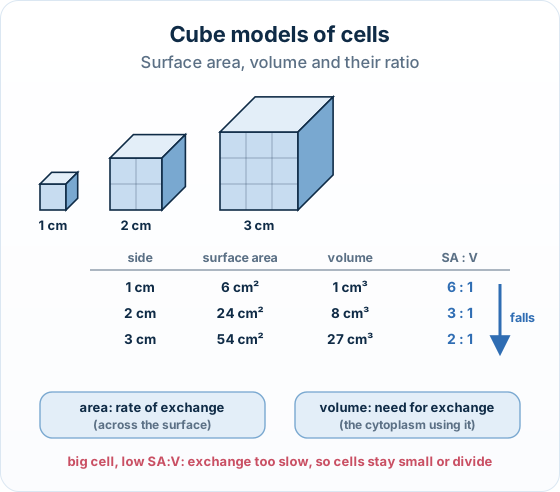
The big idea: As a cell gets bigger its volume grows faster than its surface area, so the SA:V ratio falls and exchange cannot keep up.

The points to remember

  • Materials enter and leave across the surface, so the rate of exchange depends on the surface area.
  • The need for exchange (oxygen used, waste made) depends on the volume of the cell.
  • When a cell doubles its length, its area is multiplied by 4 but its volume by 8, so SA:V halves.
  • A large cell would not exchange materials fast enough, so cells stay small or divide.
  • A cube is a simplified model of a cell: real cells are not cubes, but area and volume scale the same way.
Remember it as: Bigger cell, smaller ratio, slower exchange per unit of cell.
For a cube of side LFormula
Surface area6 × L × L
VolumeL × L × L
SA:V ratiosurface area ÷ volume
Cubes of side 1, 2 and 3 cm with a table: surface areas 6, 24 and 54 square centimetres, volumes 1, 8 and 27 cubic centimetres, SA:V ratios 6, 3 and 2 to 1; the ratio falls; area sets the rate of exchange, volume sets the need
Why big cells exchange too slowly.
Real example: a mouse and an elephant: A mouse has a much larger SA:V ratio than an elephant, so it loses heat across its skin far faster for its size. To stay warm, each gram of mouse uses energy much faster than each gram of elephant.

Study smarter, not longer

Most students waste 40% of study time on topics they already know. Our AI tracks your progress and optimizes every minute.

Try Smart Study FreeYour first topic is free to keep • No credit card required
How it is asked: Expect a Paper 1A item on how SA:V and the rate of exchange change as a cell grows, a cube calculation, or a Paper 2 Explain or Suggest about size, heat or exchange.
IB-style questionExplain[3 marks]

An amoeba divides when it reaches about 0.5 mm across. Explain why cells divide when they reach a certain size.

Model answer plan

See the answer broken into clear points, with guidance on how each point earns marks.

Claim your free topic

Try an IB Exam Question — Free AI Feedback

Test yourself on Surface area-to-volume ratios and constraints on cell size. Write your answer and get instant AI feedback — just like a real IB examiner.

Newborn babies lose body heat much faster than adults, for each kilogram of body mass.

reasons for this.
[2 marks]

Related Biology HL Topics

Continue learning with these related topics from the same unit:

2.1.1Chemical properties of carbon that allow diverse compounds2.1.2Production of macromolecules by condensation reactions2.1.3Digestion of polymers into monomers by hydrolysis reactions2.1.4Form and function of monosaccharides
View all Biology HL topics
Improve your exam techniqueCommand terms, paper structure, and mark-scheme tips for Biology HL
Previous2.5.5Cell size as an aspect of specializationNextAdaptations to increase surface area-to-volume ratios of cells2.5.7

8 practice questions on Surface area-to-volume ratios and constraints on cell size

Students who practiced this topic on Aimnova scored 82% on average. Try free practice questions and get instant AI feedback.

Try 3 Free QuestionsView All Biology HL Topics