Stem cells at Higher Level: The same statement as SL. The HL page follows the stem cells of a flatworm, which can rebuild a whole body, to show the two properties working together.
Practise this as you read
- Define and outline the two properties of stem cells.
- Explain why a specialized cell is not a stem cell.
Free preview
This is the free notes preview
You're reading the free notes. Aimnova Pro unlocks the full study experience — and you can try it with your first topic free to keep:
- FlashcardsLock in vocabulary and key terms with spaced repetition.
- Practice questionsAnswer exam-style questions and get instant AI marking.
- Mock exams & past-paper vaultSit full mocks and see exactly how examiners award marks.
- Personalised study planA daily plan built around your exam date and weak areas.
Start Studying Free Full access to Aimnova Pro · cancel anytime
The big idea: A stem cell is an unspecialized cell with two special abilities.
The two abilities
- It can divide again and again to make more cells (called self-renewal).
- It can differentiate — develop into one or more specialized cell types (such as a muscle cell, a red blood cell or a nerve cell).
Potency: How many different cell types a stem cell can become is called its potency.
- Stem cell
- An unspecialized cell that can keep dividing (self-renew) and can differentiate into one or more specialized cell types.
- Self-renewal
- The ability of a stem cell to divide repeatedly to produce more stem cells, keeping a supply available in the body.
- Differentiation
- The process by which an unspecialized cell becomes a specialized cell with a particular structure and function.
- Potency
- A measure of how many different cell types a stem cell is able to differentiate into.
- Niche
- The specific location in the body where a particular type of stem cell is found (for example, blood-forming stem cells in red bone marrow).
| Defining property | What it means | Why it matters |
|---|---|---|
| Self-renewal | A stem cell can divide repeatedly to make more stem cells | Keeps a lasting supply of stem cells in the body |
| Differentiation (potency) | A stem cell can develop into one or more specialized cell types | Replaces and builds the specialized cells the body needs |
Two properties, always together: Both properties must be present for a cell to count as a stem cell:
it must be able to self-renew (keep dividing) and able to differentiate (turn into specialized cells).
A cell that can only divide, or only differentiate, is not a stem cell.
Know your predicted grade
Take timed mock exams and get detailed feedback on every answer. See exactly where you're losing marks.
Try Mock Exams FreeYour first topic is free to keep • No credit card required
The big idea: A stem cell can divide endlessly and its daughter cells can differentiate along different pathways: these two properties together make it a stem cell.
The points to remember
- Stem cells divide by mitosis again and again, with no limit to the number of divisions.
- After a division, one daughter cell usually stays a stem cell, so the supply never runs out.
- Other daughter cells differentiate into specialized cells.
- They can follow different pathways, so one kind of stem cell can give several cell types.
- Most specialized cells, such as neurons, have lost these abilities: they no longer divide or change type.
Remember it as: Divide without end, differentiate in different directions.
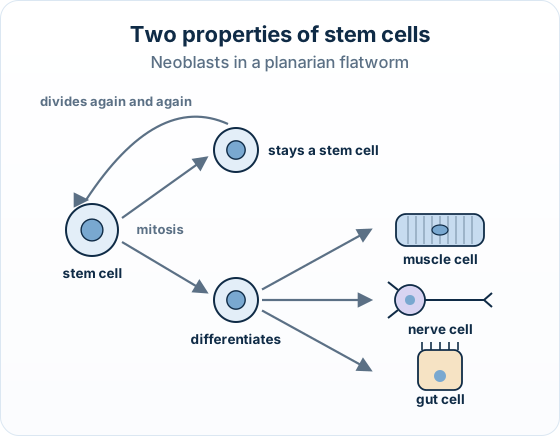
Real example: a flatworm that regrows its head: A planarian flatworm cut into small pieces regrows a whole worm from each piece. Its stem cells, called neoblasts, divide and differentiate into every missing cell type.
How it is asked: Expect a one-mark Define in Paper 2, or a Paper 1A item about why stem cells are useful: they can become the cell type that is missing.
IB-style questionOutline[2 marks]
Outline the two properties of stem cells.
Model answer plan
See the answer broken into clear points, with guidance on how each point earns marks.