Differentiation at Higher Level: The same statement as SL, with the limb bud as the example: one chemical from one side of the bud decides which finger each group of cells becomes.
Practise this as you read
- Explain how cells with the same genome become different, link by link.
- Suggest what happens when a gradient is moved or blocked in an experiment.
Free preview
This is the free notes preview
You're reading the free notes. Aimnova Pro unlocks the full study experience — and you can try it with your first topic free to keep:
- FlashcardsLock in vocabulary and key terms with spaced repetition.
- Practice questionsAnswer exam-style questions and get instant AI marking.
- Mock exams & past-paper vaultSit full mocks and see exactly how examiners award marks.
- Personalised study planA daily plan built around your exam date and weak areas.
The big idea: A complex organism such as a human is made of many different kinds of cell — neurons, muscle cells, red blood cells and hundreds more.
Where they come from
- Every one of them started out as an unspecialized cell with no particular job.
- The process that turns an unspecialized cell into a specialized cell with a particular structure and function is called differentiation.
Differentiation turns one kind of unspecialized cell into many specialized cell types — each shaped for a different job.
Interactive diagram
Explore the labelled diagram, charts and maps for this topic in full study mode.
- Unspecialized cell
- A cell that has not yet taken on a particular structure or job — it can still develop into different cell types.
- Specialized cell
- A cell that has developed a particular structure suited to one particular function (for example a neuron or a red blood cell).
- Differentiation
- The process by which an unspecialized cell develops into a specialized cell with a particular structure and function.
- Multicellular organism
- An organism made of many cells of different specialized types working together (for example a human, a plant or a fungus).
- Tissue
- A group of similar specialized cells that work together to perform a function (for example muscle tissue or nervous tissue).
The word is a clue: Differentiation comes from 'different' — it is the process that makes cells become different from one another.
Before differentiation, the cells are all the same (unspecialized). After it, they are specialized into many different types.
See how examiners mark answers
Answer exam-style questions with model answers. Learn exactly what earns marks and what doesn't.
A whole human starts as a single cell — a fertilized egg. So how does one cell become a body made of hundreds of different cell types?
Two steps that work together
Divide
The cell first divides to make many copies of itself.
Differentiate
Those copies then differentiate into the cell types the body needs.
Divide to make more, differentiate to make them different.
- Cell division (mitosis)
- The process that makes more cells. One cell divides into two genetically identical cells, increasing cell number.
- Differentiation
- The process that makes cells different. Unspecialized cells develop into specialized cell types.
- Zygote
- The single unspecialized cell formed when a sperm fertilizes an egg; it divides and differentiates to build the whole organism.
Division makes more cells; differentiation makes them different: These are two separate jobs and exams reward keeping them apart:
Cell division (mitosis) increases the number of cells, but the new cells are still identical and unspecialized.
Differentiation then gives each cell a particular structure and function, so the body ends up with many different cell types.
| Stage | What happens | Key process |
|---|---|---|
| 1. One cell | A fertilized egg (zygote) is a single unspecialized cell | — |
| 2. Many cells | It divides over and over to make many identical unspecialized cells | Cell division (mitosis) |
| 3. Many cell types | Cells take on particular structures and jobs (neurons, muscle, blood…) | Differentiation |
| 4. Tissues and organs | Groups of the same specialized cells form tissues, which form organs | Differentiation + organization |
Why a body needs differentiation: A multicellular organism needs many jobs done at once — carrying oxygen, sending signals, contracting to move, absorbing food.
Division of labour
- No single cell shape can do all of these well.
- Differentiation lets each cell specialize for one job.
- So the whole organism works far more efficiently — this is a division of labour between cells.
Name the process: When a question asks how a multicellular organism develops specialized tissues, the process named is differentiation.
Cell division (mitosis)
- Increases the number of cells
- Makes genetically identical copies
- The new cells are still unspecialized
- Builds up the quantity of cells
Differentiation
- Increases the variety of cell types
- Makes cells different from one another
- The cells become specialized for a job
- Builds up the range of tissues
An easy way to remember: Division makes more cells. Differentiation makes them different.
First you copy (division), then you customize (differentiation).
The big idea: Every cell in your body carries the same complete set of genes — the same genome.
The puzzle: So how can a muscle cell, a nerve cell and a skin cell all look and behave so differently if they share the same instructions?
The answer
- Selective gene expression: each cell type switches on only the genes it needs and leaves the rest switched off.
- Becoming specialized in this way is called differentiation.
- Differentiation
- The process by which an unspecialized cell becomes a specialized cell with a particular structure and function.
- Genome
- The complete set of genes in a cell. Every body cell of an organism has the same genome.
- Gene expression
- Switching a gene 'on' so that it is used to make its protein. An expressed gene is active; an unexpressed gene is silent.
- Selective gene expression
- Expressing only some of the genes in the genome — different genes in different cell types — so each cell makes only the proteins it needs.
- Specialized cell
- A cell adapted to do a particular job (for example a nerve cell or a red blood cell), as a result of differentiation.
Same genome, different genes used: Do not say differentiated cells have different genes — they have the same genes (the same genome).
What differs is which genes are switched on (expressed). A muscle cell and a skin cell carry identical instructions but read different parts of them.
Study smarter, not longer
Most students waste 40% of study time on topics they already know. Our AI tracks your progress and optimizes every minute.
If every cell has the same genome, something outside the cell must tell it which genes to express.
A chemical signal: That 'something' is a chemical signal. As an organism develops, signalling molecules spread out from where they are made, forming a concentration gradient across the tissue.
- Chemical signal (signalling molecule)
- A molecule released by some cells that travels to other cells and influences how they behave.
- Concentration gradient
- A smooth change in the concentration of a substance from one place to another — here, high near the source of the signal and lower further away.
- Position information
- The idea that a cell's position in a gradient (the concentration it experiences) tells it where it is, and therefore which genes to express.
Signal gradients give a cell its position: A signalling chemical is made in one region and diffuses outward, so cells nearby meet a high concentration and cells further away meet a lower concentration.
The concentration a cell experiences depends on where it sits in the gradient.
That concentration switches on a particular set of genes, so cells in different positions differentiate into different cell types.
The cause-and-effect chain: Follow the chain from signal to specialized cell:
position in gradient → concentration of signal detected → specific genes switched on → specific proteins made → specialized structure and function.
Change the concentration a cell meets and you change which genes it expresses — and so the type of cell it becomes.
| Step | What happens | Result |
|---|---|---|
| 1. Position | A cell sits at a certain place in the developing organism | It meets a particular level of signalling chemical |
| 2. Signal | A chemical signal (in a gradient) reaches the cell | The signal is detected by the cell |
| 3. Selective expression | Specific genes are switched ON; others stay OFF | Only certain genes are expressed |
| 4. Proteins | The expressed genes are used to make particular proteins | The cell gains its specialized molecules |
| 5. Specialization | The cell takes on a specific structure and function | It has differentiated into a cell type |
What is the SAME in every cell
- The genome (full set of genes)
- The DNA sequence of every gene
- The instructions are complete in all cells
What is DIFFERENT after differentiation
- Which genes are expressed (switched on)
- The proteins the cell makes
- The cell's structure and function
| Gene switched ON (expressed) | Gene switched OFF (not expressed) | |
|---|---|---|
| Is the gene present? | Yes — it is in the genome | Yes — it is still in the genome |
| Is its protein made? | Yes — the gene is used to make its protein | No — the gene is not used |
| Effect on the cell | Gives the cell a specialized feature | That feature is absent in this cell |
| Example | Insulin gene ON in a pancreas β-cell | Insulin gene OFF in a skin cell |
An easy way to remember: Gradient → genes → proteins → cell type.
Where a cell sits sets the signal it meets; the signal sets which genes are expressed; the genes set the proteins; the proteins set the cell type.
The big idea: In an early embryo a gradient of a signalling chemical tells each cell where it is, and so which genes to switch on.
The points to remember
- After fertilization the zygote divides by mitosis into many unspecialized cells with the same genes.
- Some cells release a signalling chemical; it spreads out, so its concentration is high near the source and low further away: a gradient.
- Each cell receives a different concentration, which depends on its position in the embryo.
- Different concentrations switch on (express) different genes.
- Different genes make different proteins, so the cells differentiate into different cell types.
- The signal does not add or remove genes: every cell keeps the whole genome; only which genes are expressed changes.
Remember it as: Where you are sets how much signal you get; that sets which genes you use.
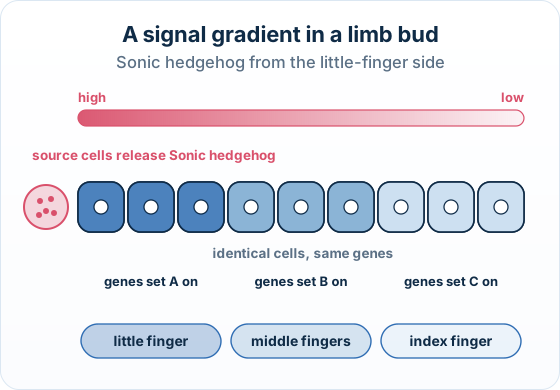
Real example: fingers in a limb bud: In a chick or human limb bud, cells on the little-finger side release Sonic hedgehog. When a bead soaked in it is put on the thumb side of a chick wing bud, extra digits form there in a mirror image.
Practice with exam-style questions
Answer exam-style questions and get AI feedback that shows you exactly what examiners want to see in a full-marks response.
How this is tested: Most questions here are 1-mark items asking you to name the process.
What you may be asked
- The most common version asks you to name the process that turns unspecialized cells into a specialized cell type (such as neurons) — the answer is differentiation.
- A closely related 1-mark question asks for the process required to develop specialized tissues in a multicellular organism — again, differentiation.
Watch the trap: If the question asks how the cell number is increased, that is cell division (mitosis), not differentiation.
Exam-style question — name the process
In a developing embryo, unspecialized cells give rise to specialized nerve cells (neurons). State the process by which the neurons are produced from the unspecialized cells. [1]
How to score the mark
- Spot what is being asked. The cells start unspecialized and end up as a specialized cell type (neurons). The question wants the name of that process.
- Avoid the trap. It is not asking how the cell number went up — that would be cell division (mitosis). It asks how the cells became a particular type.
- Give the answer. The process that turns unspecialized cells into specialized cells is differentiation. (Award the 1 mark for 'differentiation'.)
Final answer
Differentiation — the process by which unspecialized cells develop into specialized cells such as neurons.
Why this scores the mark: The single word differentiation is the scoring point.
Writing 'mitosis' or 'cell division' would lose the mark, because those make more cells rather than making them specialized.
| Feature | Unspecialized cell | Specialized cell |
|---|---|---|
| What it is | A cell with no particular job yet | A cell adapted for one particular job |
| Can it still change? | Yes — it can still differentiate into different cell types | No — it has committed to one cell type |
| Structure | A general, simple shape | A shape and contents suited to its function |
| Example | A stem cell in an early embryo | A neuron, red blood cell or root hair cell |
| Made by | Cell division (mitosis) | Differentiation of an unspecialized cell |
All the cells in a developing embryo contain the same genome, yet they differentiate into many different cell types. Explain how cells with the same genome can become different from one another.
Model answer plan
See the answer broken into clear points, with guidance on how each point earns marks.
A 4-mark Explain, in the Paper 2 style:
All the cells of an early-stage embryo have the same genome. Explain how they become different specialized cells.
Model answer plan
See the answer broken into clear points, with guidance on how each point earns marks.