Glycoproteins and glycolipids at Higher Level: The same statement as SL. At HL it leads to the cell-adhesion molecules that hold tissues together, and to how toxins and viruses use surface chains to pick their target cells.
Practise this as you read
- Outline the structure and position of glycoproteins and glycolipids.
- Explain how their position suits recognition and adhesion.
Free preview
This is the free notes preview
You're reading the free notes. Aimnova Pro unlocks the full study experience — and you can try it with your first topic free to keep:
- FlashcardsLock in vocabulary and key terms with spaced repetition.
- Practice questionsAnswer exam-style questions and get instant AI marking.
- Mock exams & past-paper vaultSit full mocks and see exactly how examiners award marks.
- Personalised study planA daily plan built around your exam date and weak areas.
Start Studying Free Full access to Aimnova Pro · cancel anytime
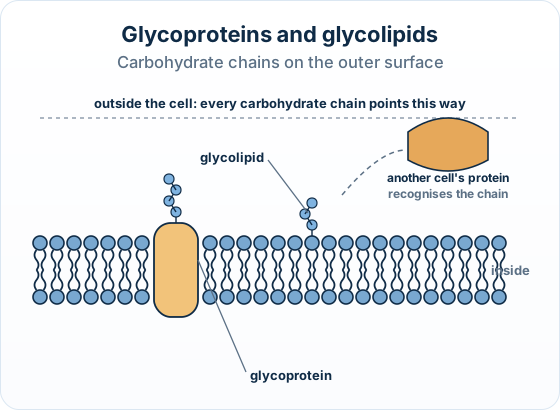
The big idea: Some membrane proteins and lipids carry short carbohydrate chains. The chains always face the outside of the cell, where other cells can meet them.
The points to remember
- A glycoprotein is a protein with a carbohydrate chain attached.
- A glycolipid is a lipid with a carbohydrate chain attached, in the outer layer of the bilayer.
- The carbohydrate chains are always on the extracellular side: the outside of the cell.
- Their pattern differs between cell types and between people, so cells can be recognised.
- They also help cells stick together (cell adhesion) in tissues.
Remember it as: Sugar on the outside: a name tag and a handshake.
Never wonder what to study next
Get a personalized daily plan based on your exam date, progress, and weak areas. We'll tell you exactly what to review each day.
Try Free Study PlanYour first topic is free to keep • No credit card required
The big idea: Carbohydrate chains are read by other cells: they say what kind of cell this is, and let cells bind to each other.
Cell recognition
- Other cells' proteins fit the chains
- Immune cells tell 'self' from 'non-self'
- Blood groups depend on these chains
Cell adhesion
- Chains bind matching molecules on a neighbour
- Holds cells together in tissues
- Lets a sperm attach to an egg
Real example: cholera toxin: Cholera toxin binds a glycolipid called GM1 on the surface of gut cells. Only cells with this glycolipid are recognised and entered by the toxin.
Because the chains are outside the cell, they can only work at the surface: they meet the cell's neighbours and anything in the fluid around it.
How it is asked: Paper 1A shows a membrane diagram and asks which part allows recognition. Paper 2 can ask how the position of the carbohydrate chains suits their roles.
IB-style questionExplain[2 marks]
Explain why the carbohydrate chains of glycolipids are found on the outer surface of the membrane.
Model answer plan
See the answer broken into clear points, with guidance on how each point earns marks.