Archaea at Higher Level: The same statement as SL. HL questions ask about archaea as a domain and the variety of their energy sources.
Practise this as you read
- State the three domains of life.
- Outline how archaea obtain energy.
Free preview
This is the free notes preview
You're reading the free notes. Aimnova Pro unlocks the full study experience — and you can try it with your first topic free to keep:
- FlashcardsLock in vocabulary and key terms with spaced repetition.
- Practice questionsAnswer exam-style questions and get instant AI marking.
- Mock exams & past-paper vaultSit full mocks and see exactly how examiners award marks.
- Personalised study planA daily plan built around your exam date and weak areas.
Start Studying Free Full access to Aimnova Pro · cancel anytime
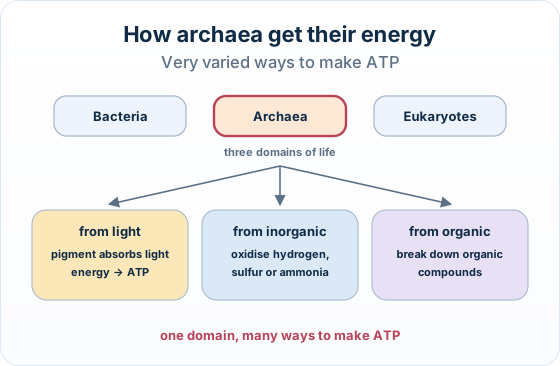
The big idea: Archaea are one of the three domains of life. As a group they are very varied in how they obtain energy to make ATP.
The points to remember
- Three domains: bacteria, archaea and eukaryotes; archaea are prokaryotes.
- Some use light, absorbed by a pigment, to make ATP.
- Some oxidise inorganic chemicals such as hydrogen, sulfur compounds or ammonia.
- Some break down organic compounds made by other organisms.
Remember it as: Light, inorganic chemicals, organic compounds: archaea use them all.
Real example: methanogens. Methanogens are archaea that get energy by combining hydrogen with carbon dioxide, releasing methane; they live in swamps, rice paddies and the guts of cattle.
Trap: Archaea are not a kind of bacteria: they are prokaryotes, but a separate domain.
Stop wasting time on topics you know
Our AI identifies your weak areas and focuses your study time where it matters. No more overstudying easy topics.
Try Smart Study FreeYour first topic is free to keep • No credit card required
How it is asked: Expect the three domains, or a question on how varied archaea are in obtaining energy.
IB-style questionOutline[3 marks]
Outline the diversity of ways in which archaea obtain energy for ATP production.
Model answer plan
See the answer broken into clear points, with guidance on how each point earns marks.