Photosynthesis as nutrition at Higher Level: The same statement as SL. HL questions ask which groups of organisms are photoautotrophs and how their nutrition differs from heterotrophs.
Practise this as you read
- State the groups that photosynthesise.
- Distinguish autotrophs from heterotrophs.
Free preview
This is the free notes preview
You're reading the free notes. Aimnova Pro unlocks the full study experience — and you can try it with your first topic free to keep:
- FlashcardsLock in vocabulary and key terms with spaced repetition.
- Practice questionsAnswer exam-style questions and get instant AI marking.
- Mock exams & past-paper vaultSit full mocks and see exactly how examiners award marks.
- Personalised study planA daily plan built around your exam date and weak areas.
The big idea: Every living thing needs two things to build its body and stay alive: a source of energy and a source of carbon (to make organic molecules).
Mode of nutrition: An organism's mode of nutrition is just the answer to those two questions: where does its energy come from, and where does its carbon come from? The first big split is between autotrophs and heterotrophs.
Autotrophs
- Make their own organic carbon
Heterotrophs
- Take organic carbon from other organisms
| Mode | Energy source | Carbon source | Plain meaning |
|---|---|---|---|
| Autotroph | Light (photo-) or inorganic chemicals (chemo-) | Carbon dioxide (CO₂) — an inorganic source | Makes its own food / organic carbon |
| Heterotroph | Chemical energy in organic molecules it eats | Organic carbon from other organisms | Takes food / organic carbon from others |
| Mixotroph | Both — can use light AND organic molecules | Both — CO₂ and organic carbon from others | Switches between making and taking food |
- Mode of nutrition
- The way an organism obtains its energy and its carbon (the building blocks for organic molecules).
- Autotroph
- An organism that makes its own organic carbon compounds from an inorganic carbon source (carbon dioxide). 'Auto' = self, 'troph' = feeding — self-feeding.
- Heterotroph
- An organism that obtains its organic carbon by taking in organic molecules made by other organisms. 'Hetero' = other — feeding on others.
- Mixotroph
- An organism that can use both modes — it can make its own food like an autotroph AND take in organic food like a heterotroph (e.g. Euglena).
Read the word: The names tell you the answer:
auto = self → an autotroph feeds itself (makes its own carbon from CO₂).
hetero = other → a heterotroph feeds on others (takes carbon from food).
mixo = mixed → a mixotroph does both.
Practice with exam-style questions
Answer exam-style questions and get AI feedback that shows you exactly what examiners want to see in a full-marks response.
Both autotrophs and heterotrophs come in more than one kind. The differences come down to the SAME two questions — energy and carbon — asked more precisely.
Autotrophs
- The carbon source is always CO₂
- So we split them by their energy source
Heterotrophs
- The carbon always comes from other organisms
- So we split them by how and where they get and digest that food
Two kinds of autotroph: All autotrophs build organic carbon from CO₂, but they power that work in two ways:
Photoautotrophs use light energy (photosynthesis) — plants, algae, cyanobacteria.
Chemoautotrophs use energy from oxidising simple inorganic chemicals (such as hydrogen sulfide) — some bacteria, including those around deep-sea vents where there is no light.
| Type of autotroph | Where it gets its energy | Example |
|---|---|---|
| Photoautotroph | Light (sunlight) — captured in photosynthesis | Plants, algae, cyanobacteria |
| Chemoautotroph | Energy released by oxidising simple inorganic chemicals (e.g. H₂S, NH₃) | Some bacteria around deep-sea vents |
Three kinds of heterotroph: Heterotrophs all take organic carbon from other organisms, but how they do it differs.
How each one feeds
- Holozoic — ingests food and digests it INTERNALLY, inside the body (most animals).
- Saprotroph — feeds on dead matter, digesting it EXTERNALLY by secreting enzymes onto it and absorbing the products (many fungi and bacteria — the decomposers).
- Parasite — feeds on a living host and harms it (a tapeworm, a head louse).
| Heterotroph type | Where the food comes from | How food is digested | Example |
|---|---|---|---|
| Holozoic | Other organisms, taken in whole or in pieces | INTERNALLY — ingested, then digested inside the body | Most animals (e.g. a frog eating an insect) |
| Saprotroph | Dead organic matter (decaying remains, waste) | EXTERNALLY — releases enzymes onto the food, then absorbs the products | Many fungi and bacteria (decomposers) |
| Parasite | A living host, which is harmed | Takes nutrients from the host (in or on its body) | Tapeworm, head louse, many disease microbes |
Saprotroph
- Feeds on dead organic matter
- Digestion is external (enzymes secreted onto the food)
- Absorbs the digested products
- Does not harm a living host — a decomposer
Holozoic
- Ingests food (often living or freshly dead)
- Digestion is internal (inside a gut / body)
- Egests undigested remains
- Typical of most animals
Mixotrophs — the in-betweeners: A mixotroph is not stuck with one mode. It can photosynthesise like an autotroph and take in organic food like a heterotroph, switching depending on conditions.
A classic example is Euglena: in the light it photosynthesises; in the dark it feeds on organic matter. This is why some protists are hard to slot neatly into one mode.
Don't forget oxygen: An organism's nutrition also depends on whether it needs oxygen to release energy:
an obligate aerobe must have oxygen; an obligate anaerobe is poisoned by it; a facultative anaerobe uses oxygen when present but can manage without it.
Oxygen requirement is part of an organism's niche — its full role in the ecosystem.
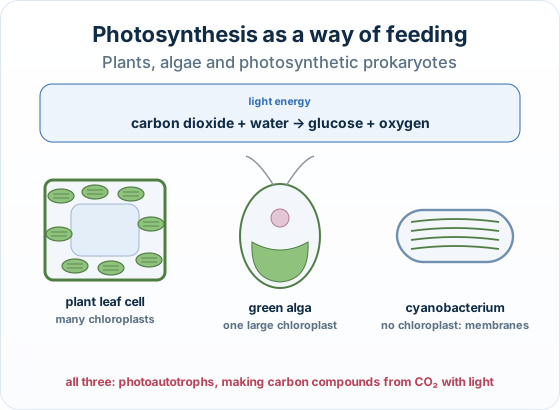
The big idea: Photosynthesis is a mode of nutrition: using light energy, an organism makes its own carbon compounds from carbon dioxide and water.
The points to remember
- Plants photosynthesise in chloroplasts, mostly in leaf cells.
- Algae, from single cells to seaweeds, also have chloroplasts.
- Some prokaryotes, such as cyanobacteria, photosynthesise without chloroplasts.
- All of them are photoautotrophs: light for energy, carbon dioxide for carbon.
Remember it as: Light in, carbon dioxide in, food made.
Real example: Prochlorococcus. Prochlorococcus, a cyanobacterium less than a micrometre across, is thought to be the most abundant photosynthetic organism on Earth, living in huge numbers in warm oceans.
Trap: Photosynthesis is not only for plants: algae and some bacteria do it too, and prokaryotes do it without chloroplasts.
Feeling unprepared for exams?
Get a clear study plan, practice with real questions, and know exactly where you stand before exam day. No more guessing.
How this is tested: To name a mode of nutrition, work from the energy source and the carbon source together. Three question types use this.
| Question | What it asks | How to score |
|---|---|---|
| Multiple choice (1 mark) | Describes an organism's feeding and asks you to name the mode of nutrition | A fungus that externally digests dead wood is a saprotroph; an organism that uses both sunlight and other organisms is a mixotroph |
| Data-style row | Gives an energy source and a carbon source and asks which mode they describe | Classify it from the two sources together (light + CO₂ = photoautotroph; oxidising chemicals + CO₂ = chemoautotroph) |
| Short Define (1 mark) | Autotroph (or heterotroph) | Give the energy and carbon source in the definition |
Exam-style question — classify a mode from a data row
A microbe living deep underground obtains its energy by oxidising hydrogen sulfide and obtains its carbon from carbon dioxide. State its mode of nutrition and justify your answer. [2]
How to score both marks
- Check the carbon source first. Its carbon comes from carbon dioxide — an inorganic source — so the microbe makes its own organic carbon. That makes it an autotroph.
- Now check the energy source to pick the sub-type. Its energy comes from oxidising an inorganic chemical (hydrogen sulfide), not from light, so it is a chemoautotroph.
Final answer
Chemoautotroph — it fixes carbon from CO₂ (so it is an autotroph) and gets its energy by oxidising an inorganic chemical rather than from light.
Why this works: The answer uses both clues. The carbon source (CO₂) proves it is an autotroph; the energy source (oxidising a chemical, not light) proves it is the chemo kind.
Classifying nutrition always means reading the two sources together, not just one.
| If energy comes from… | …and carbon comes from… | the mode of nutrition is… |
|---|---|---|
| Light | Carbon dioxide | Photoautotroph |
| Oxidising inorganic chemicals | Carbon dioxide | Chemoautotroph |
| Eating other organisms | Organic molecules in that food | Heterotroph |
| Both light and food | Both CO₂ and organic food | Mixotroph |