Predators and prey at Higher Level: The same statement as SL. HL questions often use data from experiments on predator and prey behaviour: reading control results, comparing curves and judging error bars.
Practise this as you read
- Classify adaptations as chemical, physical or behavioural.
- Analyse data on predator-prey behaviour.
Free preview
This is the free notes preview
You're reading the free notes. Aimnova Pro unlocks the full study experience — and you can try it with your first topic free to keep:
- FlashcardsLock in vocabulary and key terms with spaced repetition.
- Practice questionsAnswer exam-style questions and get instant AI marking.
- Mock exams & past-paper vaultSit full mocks and see exactly how examiners award marks.
- Personalised study planA daily plan built around your exam date and weak areas.
The big idea: Predators have chemical, physical and behavioural adaptations for finding, catching and killing their prey.
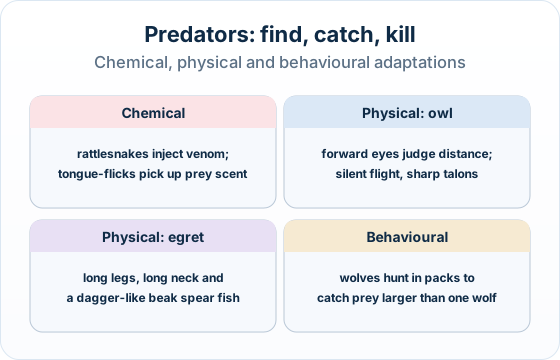
The points to remember
- Chemical: venom to kill or paralyse; a keen sense of smell to find prey.
- Physical: forward-facing eyes, sharp talons, claws or teeth, long legs and beaks, speed.
- Behavioural: hunting in packs, ambushing, stalking, hunting when prey are active.
Real example: the barn owl. Barn owls hunt in the dark: their dish-shaped face funnels sound to ears set at different heights, so they can pinpoint a mouse by hearing alone, and soft feathers make their flight almost silent.
Never wonder what to study next
Get a personalized daily plan based on your exam date, progress, and weak areas. We'll tell you exactly what to review each day.
The big idea: Prey resist predation with chemical, physical and behavioural adaptations: they avoid being found, caught or eaten.
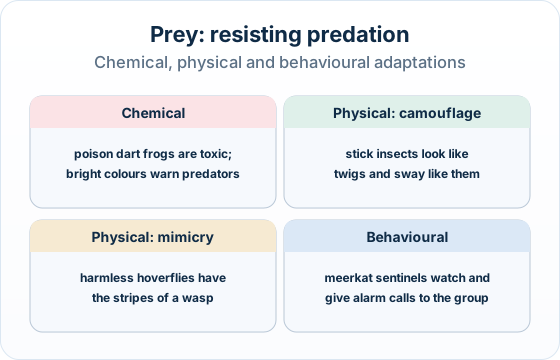
The points to remember
- Chemical: toxins or foul tastes, often with warning colours.
- Physical: camouflage, spines, shells, mimicry of a dangerous species.
- Behavioural: vigilance, alarm calls, living in groups, signals such as stotting.
Remember it as: Sort every adaptation: chemical, physical or behavioural?
Real example: stotting gazelles. Thomson's gazelles that spot a cheetah often stot, leaping stiff-legged into the air; cheetahs are less likely to chase a gazelle that stots, perhaps because it signals that it is fit and will be hard to catch.
Trap: Classify carefully: looking like a bee is physical; feeding among bees is behavioural.
How it is asked: Expect an adaptation of a named predator or prey, classifying adaptations as chemical, physical or behavioural, or data from an experiment on predator and prey behaviour.
Suggest three ways in which a small bird feeding on the ground can reduce its risk of being eaten.
Model answer plan
See the answer broken into clear points, with guidance on how each point earns marks.