Glycoproteins at Higher Level: The same statement as SL. At HL the same idea, cells recognising each other by surface molecules, runs through the immune system, so be clear that recognition depends on the carbohydrate chain on the outside.
Practise this as you read
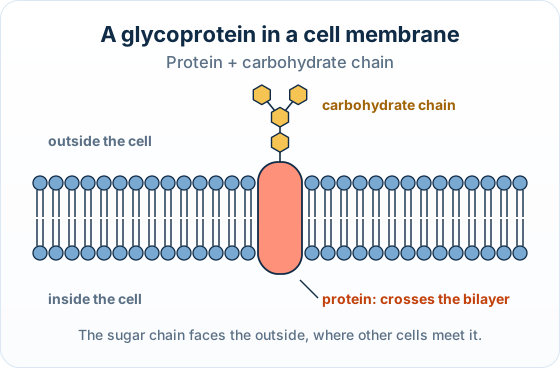
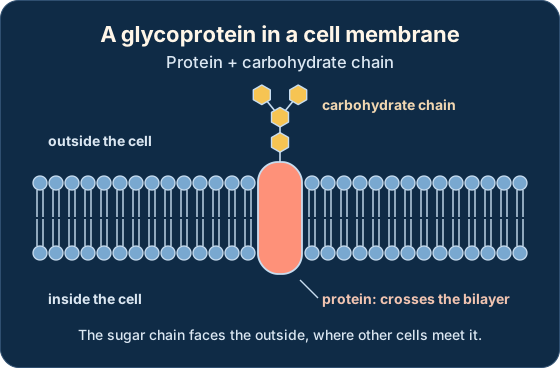
- Deduce from an image that a glycoprotein is integral and used in recognition.
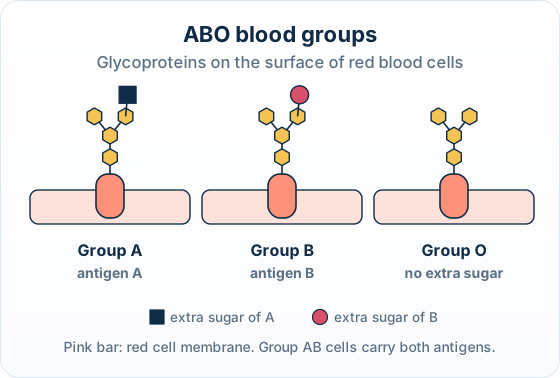
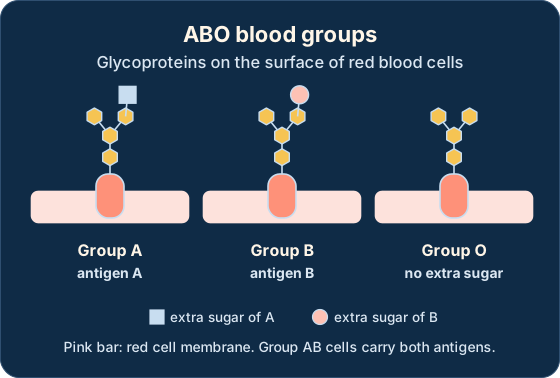
- Outline cell–cell recognition with the ABO antigens as the example.
Free preview
This is the free notes preview
You're reading the free notes. Aimnova Pro unlocks the full study experience — and you can try it with your first topic free to keep:
- FlashcardsLock in vocabulary and key terms with spaced repetition.
- Practice questionsAnswer exam-style questions and get instant AI marking.
- Mock exams & past-paper vaultSit full mocks and see exactly how examiners award marks.
- Personalised study planA daily plan built around your exam date and weak areas.
The big idea: Glycoproteins are proteins with sugar chains on the outside of the membrane. The chains let cells recognise each other.
The points to remember
- A glycoprotein is a protein with a carbohydrate chain attached.
- Most are integral proteins: they cross the membrane.
- The carbohydrate chain always faces the outside of the cell.
- The chain acts like a name tag: other cells recognise it.
- This is cell–cell recognition: telling which cells belong together, and which are foreign.
Remember it as: Sugar on the outside, a name tag for the cell.
Real example: matching a transplant: Before a kidney transplant, doctors match the donor's and patient's cell-surface glycoproteins as closely as they can, so the patient's immune system is less likely to attack the new kidney.
Know your predicted grade
Take timed mock exams and get detailed feedback on every answer. See exactly where you're losing marks.
The big idea: Your blood group is set by glycoprotein antigens on your red blood cells: A, B, both or neither.
The points to remember
- Red blood cells carry glycoproteins called ABO antigens.
- Antigen A and antigen B differ by one sugar at the end of the chain.
- Group A cells carry antigen A; group B, antigen B; group AB, both; group O, neither.
- The immune system recognises an antigen it does not have as foreign.
- So blood for a transfusion must be matched, or the red cells are attacked and clump together.
| Blood group | Antigens on red cells |
|---|---|
| A | A |
| B | B |
| AB | A and B |
| O | neither |
Antigens are on the cells: The ABO antigens are glycoproteins on the surface of red blood cells. Group O cells have no A or B antigen, not an antigen called O.
How it is asked: A multiple-choice item that shows a glycoprotein in a membrane and asks what you can tell from it, and short answers on the ABO antigens.
The image shows a glycoprotein embedded in the phospholipid bilayer of a cell membrane. Which features of this glycoprotein can be deduced from the image?
Model answer plan
See the answer broken into clear points, with guidance on how each point earns marks.
And a short written answer:
Outline the role of glycoproteins in cell–cell recognition, using the ABO blood groups as an example.
Model answer plan
See the answer broken into clear points, with guidance on how each point earns marks.