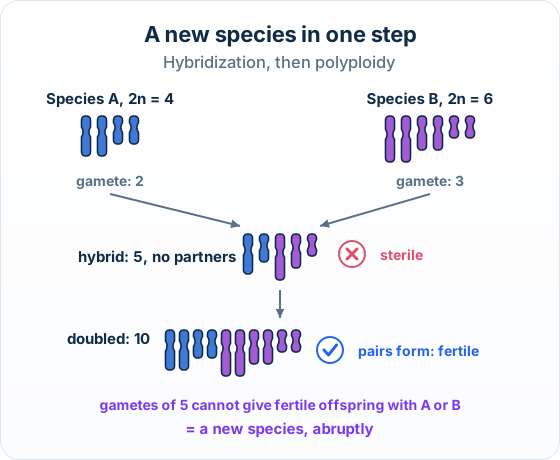
The big idea: In plants, a hybrid between two species is usually sterile. If its chromosome number doubles, it becomes fertile and is a new species at once: abrupt speciation.
The points to remember
- A polyploid has more than two sets of chromosomes.
- A hybrid of two species is sterile: its chromosomes have no partners, so meiosis fails.
- Doubling the chromosome number gives every chromosome a partner, so meiosis can work.
- The polyploid makes diploid gametes (a tetraploid's gametes have two sets) and is fertile.
- It cannot make fertile offspring with either parent: reproductively isolated in one or two generations.
Remember it as: Double the set, make a species.
Use the word exactly:
Whole sets, not one chromosome: Polyploidy is having extra whole sets of chromosomes. One extra or missing chromosome is something else, and does not make a fertile new species.
Free preview
This is the free notes preview
You're reading the free notes. Aimnova Pro unlocks the full study experience — and you can try it with your first topic free to keep:
- FlashcardsLock in vocabulary and key terms with spaced repetition.
- Practice questionsAnswer exam-style questions and get instant AI marking.
- Mock exams & past-paper vaultSit full mocks and see exactly how examiners award marks.
- Personalised study planA daily plan built around your exam date and weak areas.
Start Studying Free Full access to Aimnova Pro · cancel anytime
The big idea: The knotweeds and smartweeds (genus Persicaria) contain many species that arose by hybridization and polyploidy: speciation that was abrupt, not gradual.
Either name is fine in an answer: knotweed or smartweed, or the genus Persicaria.
Real example: Persicaria: Many Persicaria species have chromosome numbers that are multiples of one small basic number. That pattern shows whole sets were added: hybrids between species doubled their chromosomes and became new species.
Gradual and abrupt describe how fast a new species appears.
Gradual
- Small changes accumulate slowly
- The fossil record shows a smooth series of in-between forms
Abrupt
- A new species appears in a short time
- Example: a change in chromosome number instantly stops a plant breeding with its parent population
- So a new species forms almost at once
| Feature | Gradual speciation | Abrupt speciation |
|---|---|---|
| Time taken | long (many generations) | short (few generations) |
| Fossil record | smooth series of in-between forms | new form appears suddenly, few in-betweens |
| Typical cause | slow build-up of small changes | a sudden change, e.g. in chromosome number |
| Example group | many animal lineages | some flowering plants |
See how examiners mark answers
Answer exam-style questions with model answers. Learn exactly what earns marks and what doesn't.
Try Exam Vault FreeYour first topic is free to keep • No credit card required
How it is tested: Paper 1A: what shows that a polyploid is a new species (polyploids fertilize each other). Paper 2: predict a chromosome number with a reason, or discuss how polyploidy overcomes hybrid sterility.
IB-style questionExplain[3 marks]
Two species of a wild plant, each with 2n = 14, cross to give a sterile hybrid. Later a fertile plant with 28 chromosomes appears among the hybrids. Explain how this plant could be a new species.
Model answer plan
See the answer broken into clear points, with guidance on how each point earns marks.
Give the reason with the number: When asked for a chromosome number, add why: 'same number in both parents' or 'two diploid gametes fused'. 'Polyploidy' on its own is not a reason.