The big idea: A cladogram (an evolutionary tree) used to be drawn from what organisms look like: their shape and structure. Today, trees are built mainly from molecular evidence.
What we compare between species
- The base sequence of a gene, such as the gene for rRNA.
- The amino-acid sequence of a protein, such as haemoglobin.
The key rule: The more differences there are between two species' sequences, the longer ago they split from a common ancestor. Fewer differences means they are more closely related.
- Molecular evidence
- Data from the sequences of molecules — the bases in DNA/RNA or the amino acids in proteins — used to work out how closely species are related.
- Base sequence
- The order of the bases (A, T, C, G) along a gene; comparing the same gene in different species shows how much their DNA has changed.
- Amino-acid sequence
- The order of amino acids in a protein; because the protein is built from the gene, this also reflects differences in the DNA.
- Mutation
- A change in a base (or amino acid). Mutations build up gradually over time, so they act as a record of how long two lines have been separate.
| Type of molecule | What is compared | Why it works |
|---|---|---|
| A gene's base sequence (e.g. the gene for rRNA) | The order of bases (A, T, C, G) in the same gene in different species | rRNA is found in every cell and changes very slowly, so it can be lined up even between very distantly related groups (bacteria vs animals) |
| A protein's amino-acid sequence (e.g. haemoglobin, cytochrome c) | The order of amino acids in the same protein in different species | The protein is the gene's product, so differences in amino acids reflect differences in the underlying DNA |
Why molecules beat appearances: Looks can mislead — unrelated species can evolve to look alike (a dolphin and a shark), and close relatives can look very different.
A sequence is just a string of letters, so it can be counted and compared objectively — even between organisms that share no obvious features at all.
Free preview
This is the free notes preview
You're reading the free notes. Aimnova Pro unlocks the full study experience — and you can try it with your first topic free to keep:
- FlashcardsLock in vocabulary and key terms with spaced repetition.
- Practice questionsAnswer exam-style questions and get instant AI marking.
- Mock exams & past-paper vaultSit full mocks and see exactly how examiners award marks.
- Personalised study planA daily plan built around your exam date and weak areas.
Start Studying Free Full access to Aimnova Pro · cancel anytime
The big idea: Several cladograms can be drawn for the same species. Parsimony picks the one that needs the fewest sequence changes: the most probable tree.
The points to remember
- Align the sequences: the same gene or protein, position by position.
- Count the differences between every pair of species.
- Species with the fewest differences are joined at the most recent node.
- For each possible tree, count the changes needed to explain every difference.
- The tree with the fewest changes is the most parsimonious: the most likely one.
Remember it as: Fewest changes, best tree.
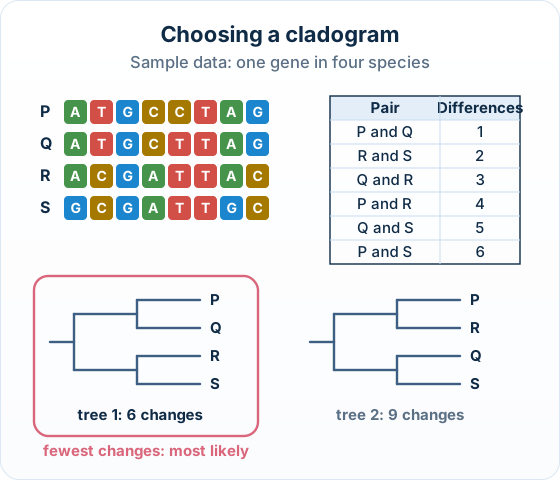
Example: sample data: In the player, tree 1 explains all eight positions with 6 changes; tree 2 needs 9. Both fit the data, but tree 1 is the simpler explanation.
A cladogram is a hypothesis:
Different criteria, different trees: Another gene, or another way of choosing, can give a different tree. A cladogram is the best hypothesis for the data, not a proven fact.
Learn what examiners really want
See exactly what to write to score full marks. Our AI shows you model answers and the key phrases examiners look for.
Try AI Feedback FreeYour first topic is free to keep • No credit card required
How it is tested: Paper 1B gives sequence data and asks how they are used to build a cladogram; Paper 2 asks you to discuss amino acid sequences or to name another type of evidence.
IB-style questionExplain[4 marks]
The base sequence of the same gene was found in four species of whale. Explain how these sequences can be used to construct a cladogram.
Model answer plan
See the answer broken into clear points, with guidance on how each point earns marks.
Another type of evidence: If a cladogram was built from DNA, other evidence could be amino acid sequences of proteins, or homologous morphological traits.