The big idea: Some viruses evolve faster than any living organism. Several features speed up their evolution, and natural selection does the rest.
The points to remember
- High mutation rate: many copying errors, so many new variants appear.
- RNA viruses and retroviruses copy with enzymes that do not proofread (RNA polymerase, reverse transcriptase).
- Short generation time: a new generation in hours, so hundreds of generations a year.
- Huge numbers: one infected cell releases hundreds of viruses, and one host can carry billions.
- Recombination: two strains in one cell can swap genetic material, making new combinations.
- Natural selection by antibodies, vaccines or drugs keeps the variants that escape them.
Remember it as: Many copies, many mistakes, fast generations: selection does the rest.
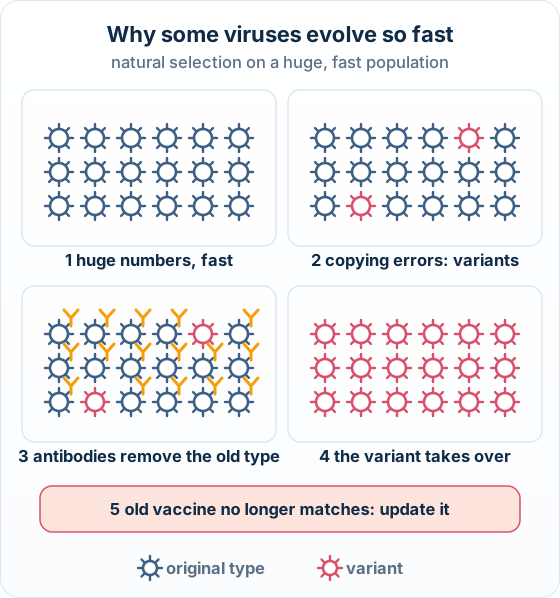
2. Why do viruses change so fast?: Because they have enormous populations, very short generation times and high mutation rates, so natural selection acts on them at extraordinary speed — fast enough to dodge our immune systems and our drugs within a single flu season.
Now the second question: why do viruses evolve so fast? Read it as a chain of cause and effect, and notice it is just natural selection running at high speed on a virus population.
The rapid-evolution chain (cause → effect)
- A virus makes billions of copies inside a single host — a huge population.
- Each genome is copied with many errors; RNA polymerases lack proofreading, so RNA viruses mutate especially fast — this creates lots of variation.
- A new generation is produced in hours, so selection acts over many generations very quickly.
- Any variant that survives the immune system or a drug leaves more offspring — that is natural selection.
- Within weeks the population is dominated by the better-adapted variant — the virus has evolved.
| Factor | What it means | Why it speeds up evolution |
|---|---|---|
| Huge population size | A single infected person can carry billions of virus particles | More copies = more chances for a useful mutation to appear somewhere |
| Very short generation time | A new generation can be produced in hours, not years | Natural selection runs through many generations very quickly |
| High mutation rate | Genomes are copied with many errors — RNA virus polymerases lack proofreading | Lots of variation is created for selection to act on |
Say 'selection': 'Immune defences make viruses evolve' is not enough: write that antibodies or vaccines are a selection pressure. If a question says 'other than a high mutation rate', give generation time, numbers, recombination or selection instead.
Free preview
This is the free notes preview
You're reading the free notes. Aimnova Pro unlocks the full study experience — and you can try it with your first topic free to keep:
- FlashcardsLock in vocabulary and key terms with spaced repetition.
- Practice questionsAnswer exam-style questions and get instant AI marking.
- Mock exams & past-paper vaultSit full mocks and see exactly how examiners award marks.
- Personalised study planA daily plan built around your exam date and weak areas.
Influenza: antigenic drift and shift: Influenza shows two named patterns of this change, both affecting its surface proteins (the proteins your immune system recognises).
Antigenic drift
- Small, gradual mutations build up, so the surface proteins slowly change.
- This is why the flu vaccine is updated most years.
Antigenic shift
- A large, sudden change when two strains swap whole genome segments in one host.
- The surface proteins can look almost new, existing immunity barely works, and a pandemic can result.
| Antigenic DRIFT | Antigenic SHIFT | |
|---|---|---|
| What changes | Small, gradual changes in the surface proteins | A large, sudden change in the surface proteins |
| How it happens | Point mutations build up over time as the virus copies its genome | Two different strains infect one host and swap whole genome segments (reassortment) |
| Size of change | Minor — the virus stays recognisably similar | Major — the surface proteins can look almost brand-new |
| Effect on immunity | Existing immunity is partly lost, so flu jabs are updated most years | Existing immunity may be almost useless — can trigger a pandemic |
| Influenza example | Why the seasonal flu strain drifts year to year | Why occasional new pandemic flu strains appear |
The surface proteins matter for evolution: the immune system recognises the capsid and the glycoprotein spikes, so mutations that change those surface proteins let new variants slip past existing immunity.
Interactive diagram
Explore the labelled diagram, charts and maps for this topic in full study mode.
SARS-CoV-2 variants: the same process, live: During the COVID-19 pandemic, SARS-CoV-2 produced a stream of variants (Alpha, Delta, Omicron and more). Each was a population in which mutations had changed the spike protein.
Why did those variants win?
Selection in real time: Variants that spread faster or escaped immunity from earlier infection or vaccination were selected for and took over — a textbook case of natural selection acting on a virus in real time, and the reason vaccines were reformulated to match new variants.
Learn what examiners really want
See exactly what to write to score full marks. Our AI shows you model answers and the key phrases examiners look for.
The big idea: HIV is the guide's second example. It changes so fast inside one person that drugs and vaccines struggle to keep up.
The reason starts with the enzyme that copies its genes:
Sloppy copying → fast evolution: Reverse transcriptase has no proofreading. When it copies the RNA into DNA it makes lots of mistakes (mutations) and does not correct them. So HIV mutates very fast and evolves rapidly.
Two big consequences
- The virus quickly changes its surface, so the immune system (and any vaccine) struggles to keep up — this immune escape is a major reason there is still no effective HIV vaccine.
- Populations of the virus quickly evolve resistance to a single drug, which is why HIV is treated with a combination of antiretroviral drugs at once.
A clever drug target: Reverse transcriptase is an enzyme your own cells do not have — only the virus brings it.
That makes it a key drug target: drugs that block reverse transcriptase stop the virus copying its RNA into DNA, so it cannot integrate or replicate, while leaving your own cells largely unharmed.
Consequences for treatment
- Flu vaccines are remade every year to match the strains expected that winter.
- HIV is treated with three or more drugs at once, so a virus would need several resistance mutations at the same time.
- There is still no HIV vaccine: its surface proteins change too fast.
- An antiviral used on its own soon stops working, as resistant variants are selected.
Real example: HIV in one person: In one untreated person, HIV makes about ten billion new particles a day. With so many copies, every possible single mutation can arise every day.
Explain why viruses such as influenza evolve rapidly, and why this means vaccines often have to be updated.
Model answer plan
See the answer broken into clear points, with guidance on how each point earns marks.
Why this scores full marks: It frames the change as natural selection (not vague 'the virus adapts'), names the three drivers (population size, generation time, mutation rate / no proofreading), explains immune escape via changed surface proteins, and closes the loop on why the vaccine no longer matches and must be updated.
And the trap to avoid:
A common way to lose marks: Saying a virus 'tries' or 'wants' to change — selection has no intent; it simply favours variants that already happen to survive better.
New strains of influenza appear every year. Explain two reasons, other than a high mutation rate, that influenza viruses evolve rapidly.
Model answer plan
See the answer broken into clear points, with guidance on how each point earns marks.