Education — same study at HL: The educación vocabulary on school systems, study and educational issues is the same at HL and SL. You are in the right place.
What HL adds later
- You argue these issues across a longer 450–600-word essay.
- You meet denser Paper 2 reading.
- Get fluent debating schools and learning here. The extra HL length then lets you develop both sides more fully.
What 'la educación' covers: Education (la educación) is part of the theme Social organization. You need vocabulary to talk about studying, school and university life, exams, and learning habits — and to give your opinion about them. Learn the words below as a deck, then use them in the reading and writing sections.
- la educación
- education
- estudiar — el/la estudiante
- to study — the student
- la asignatura
- the (school) subject
- aprobar / suspender un examen
- to pass / to fail an exam
- sacar buenas notas
- to get good marks
- tomar apuntes
- to take notes
- repasar
- to revise
- el horario
- the timetable
- la beca
- the scholarship / grant
- la carrera (universitaria)
- the (university) degree
- matricularse (en)
- to enrol (in)
- el bachillerato
- upper-secondary / the Diploma years
- aprender de memoria
- to learn by heart
| Useful expression (Spanish) | English |
|---|---|
| Se me dan bien los idiomas. | I'm good at languages. |
| Tengo que repasar para el examen. | I have to revise for the exam. |
| Quiero estudiar una carrera de ciencias. | I want to study a science degree. |
| Saco mejores notas cuando tomo apuntes. | I get better marks when I take notes. |
| Me cuesta concentrarme en casa. | I find it hard to concentrate at home. |
Why this matters: This vocabulary turns up in every skill — a reading text about school life, a listening interview about study habits, a Paper 1 blog, or your oral. Reusing the right topic words is how you score Criterion A (Language).
Free preview
Reading it is one thing — hearing it is another
You're reading the free notes. Aimnova Pro unlocks the full study experience — and you can try it with your first topic free to keep:
- Audio on every wordTap any vocabulary word or example to hear it read aloud in natural Spanish.
- FlashcardsLock in vocabulary and key terms with spaced repetition.
- Practice questionsAnswer exam-style questions and get instant AI marking.
- Mock exams & past-paper vaultSit full mocks and see exactly how examiners award marks.
- Personalised study planA daily plan built around your exam date and weak areas.
Have something to say: Examiners reward developed ideas, not just vocabulary. Around education, the common debates are: which university degree to choose, the pressure of exams, and using technology like tablets in class. Take a position and back it up.
Opinion phrases (use these to introduce a view)
- En mi opinión… / Desde mi punto de vista… — In my opinion… / From my point of view…
- Me parece que… / Creo que… — It seems to me that… / I think that…
- Lo más importante es… — The most important thing is…
- Por un lado… por otro lado… — On the one hand… on the other hand…
- Estoy (totalmente) de acuerdo con… — I (completely) agree with…
Desventajas de las tabletas en clase (drawbacks)
- Distraen mucho: es fácil abrir otra aplicación.
- Algunos alumnos copian respuestas de internet.
- No todo el mundo puede permitirse una.
Ventajas (benefits)
- Dan acceso a muchos recursos y vídeos.
- Pesan menos que un montón de libros.
- Hacen las clases más interactivas.
How we learn
- tabletas e inteligencia artificial en el aula
- cursos totalmente en línea: ventajas e inconvenientes
- una escuela en el bosque, aprender vocabulario
Help and opportunities
- alumnos mayores que dan clases a los pequeños
- becas poco conocidas para ir a la universidad
- la escuela en los pueblos, salvar las clases de música
Paths and rules
- Formación Profesional o universidad
- un amigo deportista que suspende
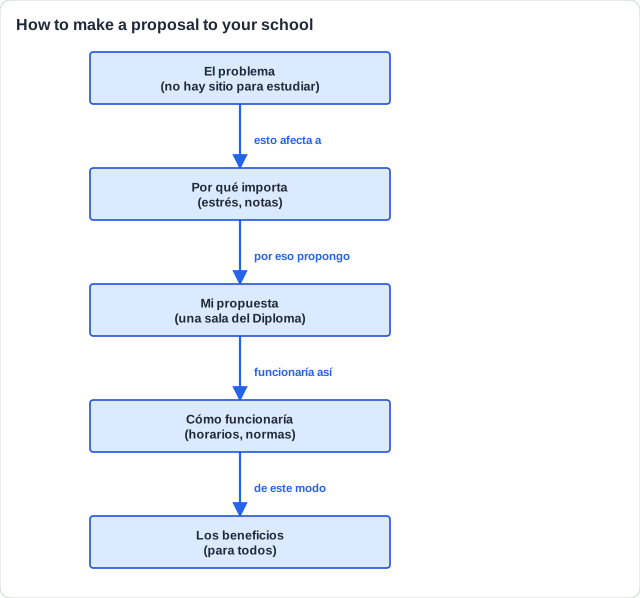
- un espacio para los alumnos del Diploma, el uniforme
Big questions behind this topic (IB guide, theme Social organization)
- ¿Qué papel tienen las normas en la escuela y en la sociedad?
- ¿La escuela debe preparar para el trabajo o para la vida?
- ¿Tienen todos los jóvenes las mismas oportunidades de estudiar?
Link your ideas: Connectors lift your answer from a list into an argument: además (besides), sin embargo (however), por lo tanto (therefore), aunque (although). Use at least two or three in any written answer.
See how examiners mark answers
Answer exam-style questions with model answers. Learn exactly what earns marks and what doesn't.
Read like Paper 2: Here is a short blog — the kind of text Paper 2 (Reading) gives you. Then we'll do one exam question together.
How to read it
Read once for the gist
Read it once just for the general idea; don't worry about every word.
Listen
Tap the audio button to hear it.
Stuck?
Tap Ver traducción if you get stuck.
Gist → Listen → Translate if stuck
Una sala de estudio para Bachillerato: El mes pasado, varios alumnos de Bachillerato pedimos una sala de estudio en el instituto. Antes no teníamos ningún sitio tranquilo para repasar entre clase y clase.
La idea funcionó muy bien. Empezamos a estudiar en grupo durante los recreos y aprobamos más exámenes porque nos ayudábamos unos a otros.
Una sala de estudio para Bachillerato (continuación)
Me di cuenta de que en casa perdía mucho tiempo con el móvil, pero en la sala me concentraba mejor. Ahora la sala está siempre llena y la dirección quiere abrir otra. No ha sido una solución mágica, pero hemos aprendido a organizarnos y a estudiar de forma más eficaz.
- la sala de estudio
- the study room
- repasar
- to revise
- el recreo
- break time
- concentrarse
- to concentrate
- eficaz
- effective
IB-style task — una pregunta de Paper 2
Una pregunta, paso a paso
- The question — Según el texto, ¿por qué aprobaron más exámenes los alumnos?
- Find it in the text. Look for aprobamos más exámenes: aprobamos más exámenes porque nos ayudábamos unos a otros.
- The answer — Porque estudiaban en grupo y se ayudaban unos a otros.
Reading technique: For a según el texto (according to the text) question, find the exact line that proves your answer — don't rely on memory or general knowledge.
La tarea — your task: Tu colegio organiza una semana sobre técnicas de estudio. Escribe una carta formal al director del colegio: describe cómo estudian muchos estudiantes y propón cambios para estudiar de forma más eficaz.
Escribe entre 450 y 600 palabras.
Formal letter structure — 4 steps
Place and date
Where and when you write. Valencia, 2 de octubre de 2026
Formal greeting
Title and colon. Estimado señor director:
Body
Who you are, the problem, your proposals, in usted. Le escribo en nombre de… Le propongo…
Formal close
A formal closing formula, then name and role. Le saluda atentamente, Marcos Gil, delegado de clase
Place + date → Estimado…: → Body → Le saluda atentamente
Modelo: los 4 pasos en ~100 palabras
La carta, paso a paso
- Valencia, 2 de octubre de 2026
- Estimado señor director:
- Le escribo en nombre de los estudiantes de 1.º de Bachillerato para hablarle de nuestra forma de estudiar. Muchos dejamos todo para el último día y repasamos con el móvil al lado, por lo que aprobamos con dificultad. Por ello, le propongo dos cambios: un aula de estudio abierta por las tardes y un taller sobre cómo tomar apuntes y organizar un horario realista. Estoy seguro de que mejorarían nuestros resultados.
- Agradeciéndole de antemano su atención, le saluda atentamente, Marcos Gil, delegado de clase
Por qué funciona — why it works: A strong formal letter does this for each of the three Paper 1 criteria:
A — Language /12
- Usted forms: le escribo, le propongo
- Conditional: mejorarían
- Connectors of consequence: por lo que, por ello
B — Message /12
- Task fully done: describes study habits AND proposes changes
- Two concrete proposals with a clear benefit
C — Conceptual /6
- Letter conventions: place and date, Estimado señor director:
- Usted all the way through
- A formal close with name and role
Ready to ace Education?
You've seen the preview. Here's what you'll unlock:
Bite-Sized Study Notes
Full syllabus broken into chunks that stick
Exam Practice
See exactly how to score full marks
AI Feedback
Know exactly what examiners want
Smart Study Plan
Know exactly what to study next