Migration — HL depth later: Here is the reassuring part: the migración vocabulary is the same at HL as at SL, so you belong here.
Same as SL
- Integration
- Cultural difference
- The human side of moving countries
What HL adds later
- This sensitive topic appears in denser Paper 2 texts
- It appears in a longer 450–600-word essay that wants real nuance
- Get the language and the empathy right now, and HL becomes an extension, not a new subject
What 'la migración' covers: Migration (la migración) is part of the theme Experiences. You need vocabulary to talk about moving to another country, cultural differences, integration and the challenges immigrants face — and to give your opinion about them. Learn the words below as a deck, then use them in the reading and writing sections.
- la migración / migrar
- migration / to migrate
- emigrar — inmigrar
- to emigrate (leave) — to immigrate (arrive)
- el/la inmigrante
- the immigrant
- mudarse / trasladarse
- to move (house/country)
- establecerse en
- to settle in
- en busca de una vida mejor
- in search of a better life
- adaptarse / la adaptación
- to adapt / adaptation
- integrarse / la integración
- to integrate / integration
- el choque cultural
- culture shock
- echar de menos / extrañar
- to miss (someone/something)
- la barrera del idioma
- the language barrier
- el país de acogida
- the host country
- vivir entre dos culturas
- to live between two cultures
| Useful expression (Spanish) | English |
|---|---|
| Mi familia emigró en busca de una vida mejor. | My family emigrated in search of a better life. |
| Al principio sufrí un choque cultural. | At first I experienced culture shock. |
| La barrera del idioma fue lo más difícil. | The language barrier was the hardest thing. |
| Poco a poco conseguí integrarme. | Little by little I managed to integrate. |
| Echo de menos a mi familia y mis costumbres. | I miss my family and my customs. |
Why this matters: This vocabulary turns up in every skill — a reading text about an immigrant's experience, a listening interview about living abroad, a Paper 1 email advising a friend who is moving, or your oral. Reusing the right topic words is how you score Criterion A (Language).
Free preview
Reading it is one thing — hearing it is another
You're reading the free notes. Aimnova Pro unlocks the full study experience — and you can try it with your first topic free to keep:
- Audio on every wordTap any vocabulary word or example to hear it read aloud in natural Spanish.
- FlashcardsLock in vocabulary and key terms with spaced repetition.
- Practice questionsAnswer exam-style questions and get instant AI marking.
- Mock exams & past-paper vaultSit full mocks and see exactly how examiners award marks.
- Personalised study planA daily plan built around your exam date and weak areas.
Have something to say: Examiners reward developed ideas, not just vocabulary. Take a position and back it up.
The common debates around migration
- The difficulties immigrants face in a new city, and how to help them
- The cultural differences of living abroad
- The advice you'd give a friend who is moving
Opinion phrases (use these to introduce a view)
- En mi opinión… / Desde mi punto de vista… — In my opinion… / From my point of view…
- Me parece que… / Creo que… — It seems to me that… / I think that…
- Lo más importante es… — The most important thing is…
- Por un lado… por otro lado… — On the one hand… on the other hand…
- Estoy (totalmente) de acuerdo con… — I (completely) agree with…
Dificultades de emigrar (drawbacks)
- La barrera del idioma dificulta la vida diaria.
- Muchos inmigrantes echan de menos a su familia.
- El choque cultural puede causar soledad.
Ventajas de vivir fuera (benefits)
- Aprendes otro idioma y otra cultura.
- Conoces a gente de todo el mundo.
- Te vuelves más abierto y tolerante.
Leaving
- un amigo que se va a vivir al extranjero
- huir de una guerra o de una crisis
- una carta escrita en un barco de emigrantes
Arriving and adapting
- el primer mes en un país nuevo
- sentimientos encontrados al vivir fuera
- un cantante que emigró a Estados Unidos
Welcoming
- escribir al alcalde sobre los problemas de los inmigrantes
- el Día del Migrante en el colegio
- ayudar a los migrantes en la frontera
Big questions behind this topic (IB guide, theme Experiences)
- ¿Cómo cambiaría nuestra visión del mundo vivir en otra cultura?
- ¿Qué necesita una persona para sentirse en casa en otro país?
- ¿Cómo puede una sociedad favorecer la integración de todos?
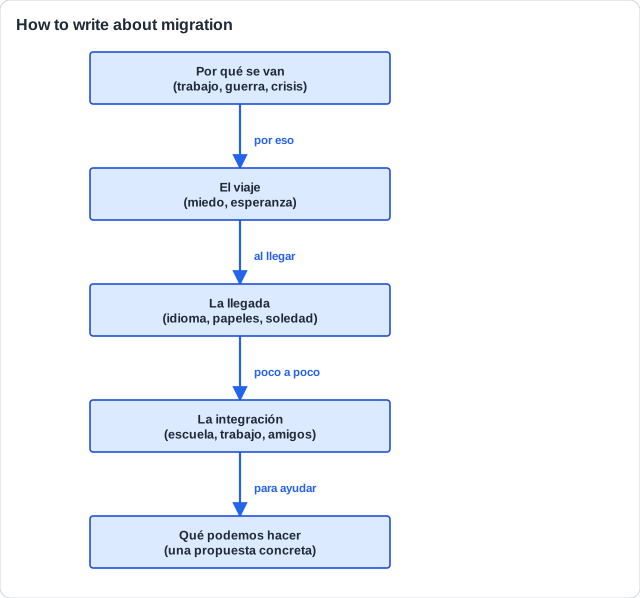
Link your ideas: Connectors lift your answer from a list into an argument: además (besides), sin embargo (however), por lo tanto (therefore), aunque (although). Use at least two or three in any written answer.
Memorize terms 3x faster
Smart flashcards show you cards right before you forget them. Perfect for definitions and key concepts.
Read like Paper 2: Here is a short blog, the kind of text Paper 2 (Reading) gives you. Read it once just for the general idea; don't worry about every word.
How to use the text
- Tap the audio button to hear it.
- Tap Ver traducción if you get stuck.
- Then we'll do one exam question together.
Vivir entre dos mundos: Hace dos años mi familia y yo emigramos a otro país en busca de una vida mejor. Al principio todo me resultaba extraño: el idioma, las costumbres y hasta la comida.
Lo más difícil fue echar de menos a mis abuelos y no entender bien a la gente en clase.
Vivir entre dos mundos (continuación)
Sin embargo, poco a poco hice nuevas amistades y empecé a sentirme parte del barrio. El instituto organizó un programa de acogida y unos compañeros me ayudaron con el idioma. Hoy hablo dos lenguas, conozco dos culturas y, aunque a veces extraño mi país, me siento afortunada de poder vivir entre dos mundos.
- resultar extraño
- to feel/seem strange
- el programa de acogida
- the welcome programme
- hacer amistades
- to make friends
- afortunado/a
- fortunate / lucky
- entre dos mundos
- between two worlds
IB-style task — una pregunta de Paper 2
Una pregunta, paso a paso
- The question — Según el texto, ¿quién ayudó a la persona con el idioma?
- Find it in the text. Look for idioma: El instituto organizó un programa de acogida y unos compañeros me ayudaron con el idioma.
- The answer — La ayudaron unos compañeros (de clase), gracias al programa de acogida del instituto.
Reading technique: For a según el texto (according to the text) question, find the exact line that proves your answer — don't rely on memory or general knowledge.
La tarea — your task: Tu amigo Diego se va a vivir y estudiar a otro país y está nervioso. Escríbele un correo electrónico: cuéntale tu propia experiencia mudándote y dale consejos para adaptarse e integrarse.
Escribe entre 450 y 600 palabras.
Email structure — 6 steps
Subject line
A short, friendly subject. Asunto: ¡Tu nueva vida en el extranjero!
Greeting
Greet your friend by name. ¡Hola, Diego!
Body
React to his news and tell your own move in the past tense. Me alegra saber que… Cuando yo emigré, al principio lo pasé mal…
Advice / request
Give advice with tú commands and ask him to write back. Aprende el idioma…, mantén el contacto…, Escríbeme cuando llegues.
Friendly close
A warm sign-off. Un abrazo muy fuerte,
Signature
Just your first name. Andrés
Subject → ¡Hola! → Body → Advice → Un abrazo → Name
Modelo: los 6 pasos en ~100 palabras
El correo, paso a paso
- Asunto: ¡Tu nueva vida en el extranjero!
- ¡Hola, Diego!
- ¿Qué tal estás? Me alegra mucho saber que vas a estudiar fuera, y entiendo que estés nervioso. Cuando yo emigré, al principio lo pasé mal: no entendía el idioma, echaba de menos a mi familia y todo me parecía diferente. Me sentía un poco solo.
- Por eso te doy tres consejos: primero, aprende el idioma desde el primer día; segundo, apúntate a actividades para conocer gente; y tercero, mantén el contacto con tu familia. Sin embargo, lo más importante es tener paciencia, porque adaptarse lleva tiempo. Escríbeme cuando llegues y cuéntame qué tal.
- Un abrazo muy fuerte,
- Andrés
Por qué funciona — why it works: A strong informal email does this for each of the three Paper 1 criteria:
A — Language /12
- Preterite vs imperfect: emigré / echaba de menos
- Tú commands: aprende, apúntate, mantén, escríbeme
- Connectors: por eso, sin embargo, porque
B — Message /12
- Task fully done: shares an experience AND gives advice
- Advice answers Diego's real worries about moving
C — Conceptual /6
- Email conventions: subject line, ¡Hola, Diego!, sign-off and name
- Tú register and a request to the reader: Escríbeme
- A warm, reassuring tone for a friend
Ready to ace Migration?
You've seen the preview. Here's what you'll unlock:
Bite-Sized Study Notes
Full syllabus broken into chunks that stick
Exam Practice
See exactly how to score full marks
AI Feedback
Know exactly what examiners want
Smart Study Plan
Know exactly what to study next