The big idea: Every cell in your body releases the energy it needs by breaking down food using oxygen. That is cellular respiration — cells getting energy out of food.
The waste it leaves: It leaves carbon dioxide behind as waste. So oxygen has to keep coming in, and carbon dioxide has to keep going out.
Our example: Jonah is sitting on the bench at his basketball game, breathing quietly. Two minutes later he is on court, sprinting.
Same lungs, very different breathing. Everything here is one of those two moments.
In — oxygen
- The air around Jonah is about a fifth oxygen
- He breathes it down into his lungs
- The blood takes it on to his working muscles
In the cell — cellular respiration
- His muscle cells use that oxygen to get energy from food
- That energy is what lets his legs push off the floor
- Carbon dioxide is left over
Out — carbon dioxide
- It cannot be allowed to build up
- The blood carries it back to the lungs
- He breathes it out
So the lungs are a swap shop. Air on one side, blood on the other, and two gases trading places all day. The rest of this micro is how that swap happens, and how the air keeps getting there.
Free preview
This is the free notes preview
You're reading the free notes. Aimnova Pro unlocks the full study experience — and you can try it with your first topic free to keep:
- FlashcardsLock in vocabulary and key terms with spaced repetition.
- Practice questionsAnswer exam-style questions and get instant AI marking.
- Mock exams & past-paper vaultSit full mocks and see exactly how examiners award marks.
- Personalised study planA daily plan built around your exam date and weak areas.
One breath travels down one road, and that road keeps splitting and getting narrower. You are expected to know the order.
What happens, step by step
Nose and mouth
Air is warmed, wetted and cleaned on the way in. Jonah breathes through his mouth once he is working hard, because it lets more air through.
Trachea — the windpipe
One wide tube down the front of the neck. Rings of cartilage hold it open, so it cannot squash shut.
Bronchi
The windpipe splits into two bronchi — one big tube heading into each lung.
Bronchioles
Each bronchus branches again and again into thousands of bronchioles, tiny tubes spreading through the lung like the branches of a tree.
Alveoli — the air sacs
The end of the road. Millions of tiny air sacs, walls just one cell thick, each one wrapped in blood vessels. This is the only place the swap happens.
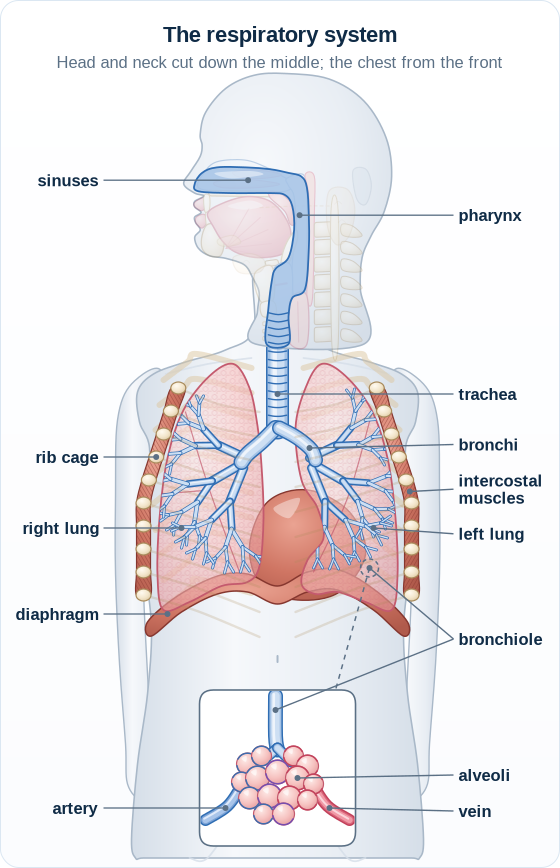
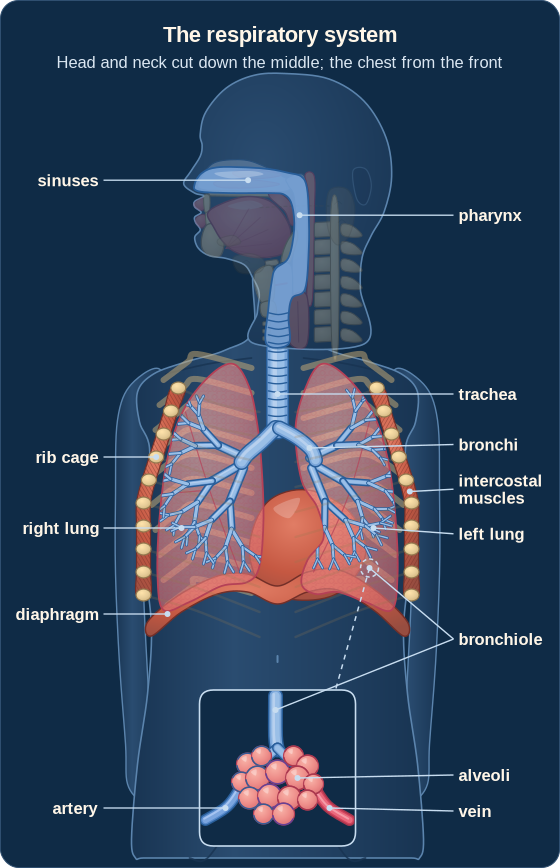
Everything above the air sacs is plumbing: No gas crosses into the blood in the windpipe or the bronchi.
Those tubes only deliver. The whole job of the respiratory system is done in the alveoli.
See how examiners mark answers
Answer exam-style questions with model answers. Learn exactly what earns marks and what doesn't.
Diffusion, in one sentence: Diffusion is things spreading out on their own, from where there are lots of them to where there are fewer.
Concentration gradient: That difference between the two sides has a name: a concentration gradient. It is only a formal way of saying more here than there.
The road in, then the swap itself. Watch which way each gas goes, and what makes it go that way.
Interactive diagram
Explore the labelled diagram, charts and maps for this topic in full study mode.
Air inside the alveolus
- Freshly breathed in, so lots of oxygen
- Hardly any carbon dioxide
- So oxygen diffuses out of the air and into the blood
Blood arriving from the muscles
- Its oxygen has been used up, so hardly any oxygen
- Lots of carbon dioxide, made by the working cells
- So carbon dioxide diffuses out of the blood and into the air
Why the swap never runs out: Nothing pushes these gases. They only move while one side is higher than the other.
Breathing keeps bringing fresh air in, and blood keeps flowing past. Both sides are constantly topped up, so the gradient never disappears.
Why the gradient is steeper in exercise: Working muscle takes more oxygen out of the blood, a bigger arteriovenous oxygen difference. Blood returning to the lungs carries less oxygen, so the gradient from the alveoli is steeper and oxygen diffuses in faster.
Lungs have no muscles of their own. They cannot pull air in. What actually happens is that muscles change the size of the chest, and the air follows.
Breathing in, step by step
The diaphragm pulls down
The diaphragm is a sheet of muscle under the lungs. It contracts and flattens downwards, out of the way.
The ribs swing up and out
The external intercostal muscles contract. Intercostal just means between the ribs. They lift the rib cage up and outwards.
The chest gets bigger
Down at the bottom, out at the sides. There is more room inside than there was a moment ago.
The pressure inside drops
The same air is now spread through a bigger space, so the pressure inside the lungs falls below the pressure of the air outside.
Air flows in
Air always moves from higher pressure to lower pressure. It flows down the airway into the air sacs on its own.
You never suck air in: You make room for it, and it comes.
It is the same idea as the swap at the air sacs: something moves because there is more of it in one place than the other.
Study smarter, not longer
Most students waste 40% of study time on topics they already know. Our AI tracks your progress and optimizes every minute.
On the bench, Jonah does no work at all to breathe out. On court, sprinting, he works at both ends of every breath. That difference is worth marks.
Quiet breathing out — at rest
- The diaphragm and the external intercostals simply relax
- The lungs and the rib cage are stretchy and spring back
- The chest gets smaller, so pressure inside rises and air leaves
- Passive — no muscle does any work
Forced breathing out — working hard
- Active — muscles do real work to push air out
- The abdominal muscles squeeze the belly in and up
- The internal intercostal muscles pull the ribs down and in
- Air leaves faster, and more of it leaves
Breathing in gets extra help too: Sprinting, the diaphragm and external intercostals are not enough on their own.
Accessory muscles in the neck and chest join in and haul the rib cage higher still, so the chest opens further than it ever does at rest.
The accessory muscles of inspiration
- Scalenes (side of the neck)
- Sternocleidomastoid (from behind the ear to the breastbone)
- Pectoralis minor (under the chest muscle)
- They pull the rib cage up and out further, so the chest volume grows more and each breath is deeper
The half of this that gets forgotten: At rest, breathing out is passive. Writing that muscles push the air out at rest is wrong — they let go, and the chest springs back by itself.
How this is tested — you say how air is moved in and out, and why the two gases cross at the air sacs. It comes up two ways:
Paper 1 — recall and data
- Multiple choice on the muscles used to breathe in
- Identify where gas exchange happens
- Data on how much of each gas is in air breathed in and out
Paper 2 — explain and evaluate
- Outline the mechanics of breathing in
- Explain why oxygen moves from the alveoli into the blood
- Marks for the pressure change and the concentration gradient
The trap: saying air is "sucked in": The lungs never pull. Muscles make the chest bigger, pressure inside falls below the pressure outside, and air flows in on its own. An answer with no pressure change in it loses the mark.
A gymnast has bruised ribs, so lifting her rib cage hurts. Sitting still, she breathes in mostly with her diaphragm. Outline how this draws air into her lungs. [3]
Model answer plan
See the answer broken into clear points, with guidance on how each point earns marks.
Where marks are lost: The diaphragm moves is not worth a mark. Say which way it moves and what that does to the size of the chest.
The third mark is almost always the pressure difference. Write it every time.
Exam tips
- Breathing in at rest: external intercostals and diaphragm contract, chest volume rises, pressure in the lungs falls below the air outside, air flows in.
- Exercise against rest: the muscles contract with more force, accessory muscles join in, breaths are deeper. A faster rate is not what is asked.
- Forced breathing out: the internal intercostals and the abdominals contract.
- A steeper oxygen gradient in exercise: muscles take more oxygen from the blood, so blood reaching the lungs carries less.