The big idea: Your body has a second way of sending messages.
Not down nerves. As chemicals, carried in your blood.
Our example: Ravi races the 400 m at 3 p.m. By ten to three he has not moved a step, but his hands are shaky and his heart is thumping.
Ten minutes after he finishes, it is still thumping. Everything in this micro is that feeling.
A gland is a small organ whose whole job is to make and release a chemical. The chemical it releases is a hormone. All the glands and all their hormones together are the endocrine system.
That system regulates — keeps in check — pretty much every process in your body. Not just the ones you notice during sport.
Every day
- How much sugar is in your blood
- How much water your kidneys keep
- When you start to feel sleepy
In sport
- How hard and fast the heart works
- Which fuel the muscles burn
- How the body is set up before the start
Over months and years
- Growth
- Bone strength
- Puberty and the changes that come with it
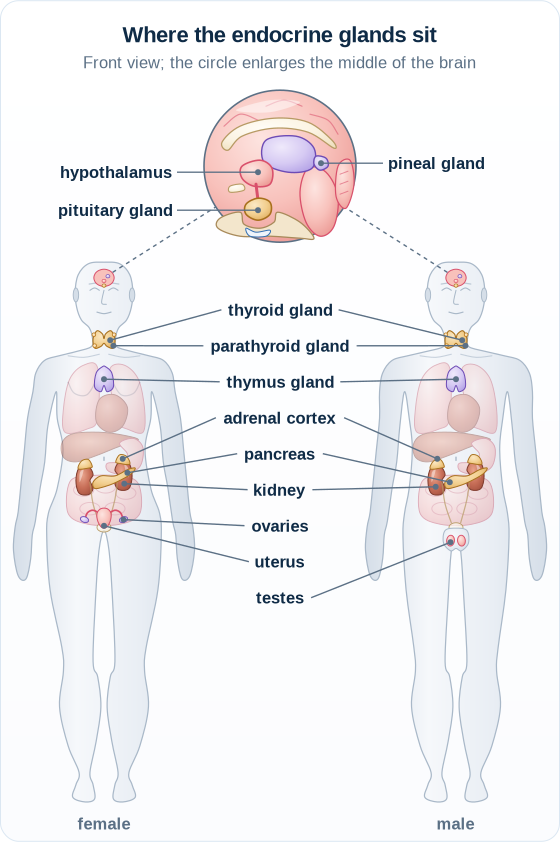
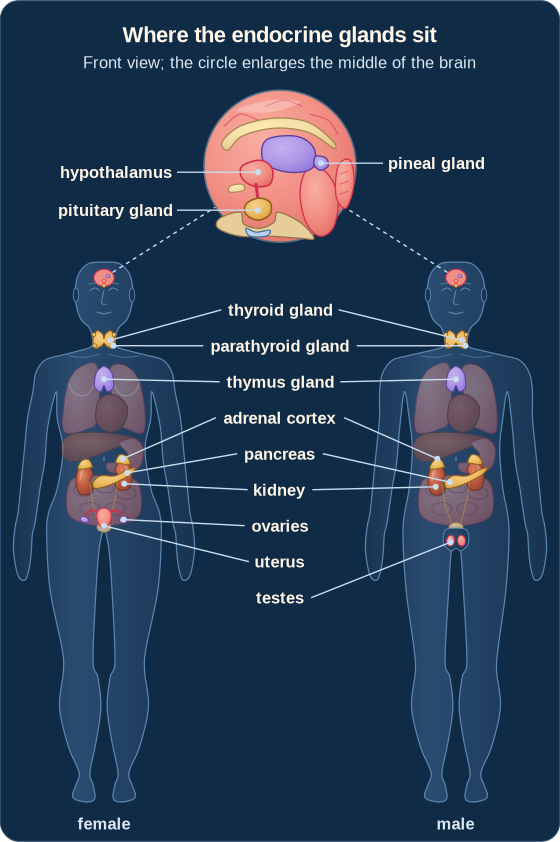
Free preview
This is the free notes preview
You're reading the free notes. Aimnova Pro unlocks the full study experience — and you can try it with your first topic free to keep:
- FlashcardsLock in vocabulary and key terms with spaced repetition.
- Practice questionsAnswer exam-style questions and get instant AI marking.
- Mock exams & past-paper vaultSit full mocks and see exactly how examiners award marks.
- Personalised study planA daily plan built around your exam date and weak areas.
Ravi's body used both ways inside the same minute.
Two signals, one start: The gun goes and his legs push off the blocks straight away — that is a nerve signal, and you met it in the first micro. The thumping heart he could already feel before the gun is the other way.
Nervous control
- An electrical signal down a nerve
- Goes to one target — a named muscle or organ
- Arrives in a fraction of a second
- Stops almost as soon as the signal stops
- Ravi pushing off the blocks
Hormonal control
- A chemical carried in the blood
- Goes everywhere the blood goes
- Takes seconds to minutes to build up
- The effect lasts minutes, sometimes hours
- Ravi still wired ten minutes after the finish
The fast private wire on top, the slow body-wide message underneath. Watch how many cells the hormone meets before anything happens.
Interactive diagram
Explore the labelled diagram, charts and maps for this topic in full study mode.
One way to hold on to it: A nerve signal is a phone call to one person.
A hormone is a letter posted to every house in the country — and only the people with the right key can open it.
Practice with exam-style questions
Answer exam-style questions and get AI feedback that shows you exactly what examiners want to see in a full-marks response.
The gland that made Ravi's hormone sits just above his kidney, at the back of his waist. Nothing there needed to change.
Where the change showed: What changed was his heart, high up in his chest, and the muscles in his legs. No nerve ran from that gland to any of them.
Mediator molecule: A mediator molecule is a go-between.
It is released in one part of the body and it changes what cells do in a different part. Nothing joins the two places up — the blood carries the message across.
What happens, step by step
Made and released
The gland makes the hormone and releases it straight into the blood running through it. It is not aimed at anything yet.
Carried in the blood
Your blood does a full lap of the body in about a minute, so the hormone is soon in every vessel Ravi has. It meets every cell he owns.
Acts somewhere else
It reaches cells a long way from the gland and changes what those cells are doing. A cell that responds to a hormone is its target cell.
One hormone, several jobs: Because the blood reaches everything, one hormone often changes several organs at once — heart, liver and muscle together.
That is why a hormonal response feels whole-body rather than coming from one spot.
Here is the obvious problem. If the hormone reaches every cell, why doesn't every cell react? It got to Ravi's big toe just as surely as it got to his heart.
The answer is the receptor: A cell only responds if it carries the matching receptor — a spot shaped to fit that one hormone, the way one key fits one lock.
No matching receptor, no response. The hormone drifts straight past.
Careful — "receptor" means two things: You met receptors earlier as whole cells that sense change — proprioceptors, baroreceptors, chemoreceptors.
This is a different use of the same word. Here a receptor is a spot on a cell that one hormone fits. Same word, two jobs, and the question will make clear which one it means.
A target cell
- Has the matching receptor
- The hormone locks on to it
- The cell changes what it is doing
- For Ravi: the muscle cells of his heart
Every other cell
- No matching receptor
- The hormone floats past it
- Nothing happens at all
- For Ravi: the cells in his big toe
So a body-wide message can still be precise: The blood is the delivery — it goes everywhere.
The receptor is the address — it decides who actually reads the message.
Feeling unprepared for exams?
Get a clear study plan, practice with real questions, and know exactly where you stand before exam day. No more guessing.
How this is tested — you say what the endocrine system is, and explain how a hormone released in one place ends up changing cells somewhere else. It comes up two ways:
Paper 1 — recall and data
- Multiple choice on what a hormone is
- State how a hormone travels to the cells it acts on
- One mark, no working — the word blood has to be there
Paper 2 — explain and evaluate
- Outline how hormonal control differs from nervous control
- Explain why only some cells respond to a hormone
- Marks for linking the blood to the target cell and its receptor
The trap: hormones do not travel along nerves: Writing the hormone is sent down a nerve to the heart loses the mark every time. Hormones move in the blood.
That one fact is also the reason the effect is slower, body-wide and longer-lasting, so examiners use it to separate the students who understand from the ones who memorised.
A hormone is released by a gland in the neck and increases the activity of muscle cells in the leg. Explain how that hormone reaches those cells and acts on them. [3]
Model answer plan
See the answer broken into clear points, with guidance on how each point earns marks.
Where marks are lost: The gland sends a message to the leg gets nothing. It names no route and no reason.
Say blood, then say receptor. Those two words are usually two of the three marks.
Exam tips
- Define a hormone: released by a gland into the blood, acting on target cells somewhere else.
- Compare with nerves: hormones are slower and last longer; nerve messages are fast and brief.
- Only cells with the matching receptor respond to a hormone.