The big idea: Your heart already beats. Your lungs already breathe. Your body already sits close to 37 °C.
The autonomic nervous system does not start any of these. It adjusts them, second by second, to fit what you are doing.
Our example: Leo rows a 2,000 m test on the machine in his school sports hall. The hall is warm, about 26 °C.
Everything in this micro happens inside those seven minutes and the two minutes after.
Cardiac function
- Sitting on the seat: 62 beats a minute
- Third minute of the test: 178
- Two minutes after he stops: 96
Breathing and ventilation
- Sitting on the seat: 13 breaths a minute
- Rowing hard: 42, and each one deeper
- He never decides to do any of it
Temperature control
- Before he starts: core temperature 36.9 °C
- At the finish: 38.1 °C
- Red face, soaked shirt, and both were ordered
Those three are the examples you have to know. All three work the same way. Something inside the body sets a basic rate, and the autonomic nerves push it up or pull it back down.
Free preview
This is the free notes preview
You're reading the free notes. Aimnova Pro unlocks the full study experience — and you can try it with your first topic free to keep:
- FlashcardsLock in vocabulary and key terms with spaced repetition.
- Practice questionsAnswer exam-style questions and get instant AI marking.
- Mock exams & past-paper vaultSit full mocks and see exactly how examiners award marks.
- Personalised study planA daily plan built around your exam date and weak areas.
A transplanted heart, whose nerves have not grown back yet, still beats. Nothing is telling it to.
That is the intrinsic part — intrinsic means it comes from inside the heart itself.
Where one beat comes from
The SA node fires
The sinoatrial node (SA node) is a small patch of cells in the wall of the right atrium. It makes its own electrical signal, over and over, with nobody asking it to. It is the pacemaker.
The atria squeeze
The signal spreads across both atria, which contract and push blood down into the ventricles.
The AV node holds it back
The atrioventricular node (AV node) catches the signal and holds it for a fraction of a second, so the atria finish emptying before the ventricles start.
The ventricles squeeze
The signal runs down the atrioventricular bundle (bundle of His), as the data booklet heart labels it, and out along the Purkinje fibres. The ventricles contract and blood leaves the heart.
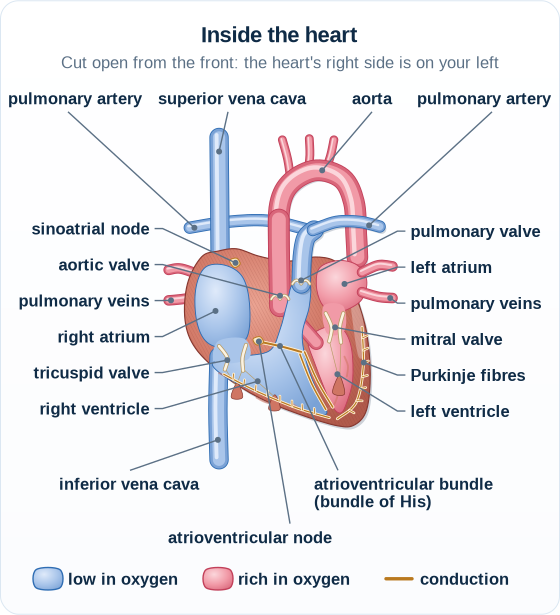
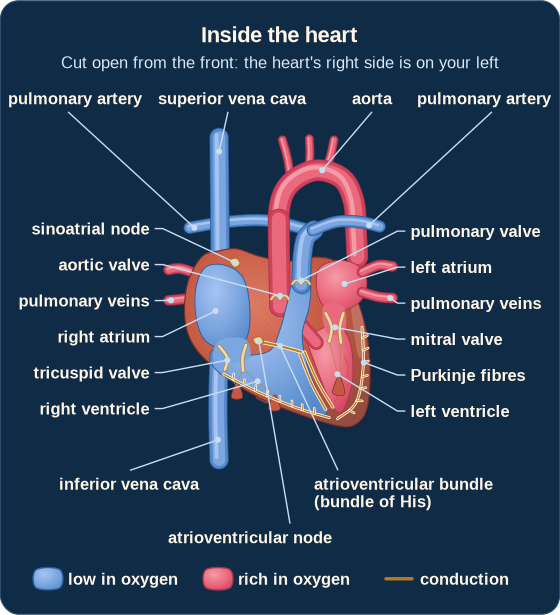
Left alone, the heart runs fast: On its own the SA node fires about 100 times a minute.
Leo sitting still is at 62. Something must be holding him down, and it is not coming from inside the heart.
Study smarter, not longer
Most students waste 40% of study time on topics they already know. Our AI tracks your progress and optimizes every minute.
Extrinsic means from outside the heart. Two nerves reach the SA node, and all they do is change how fast it fires.
The built-in beat first, then the brake, then the accelerator. Watch the number on the right change while the SA node stays the same.
Interactive diagram
Explore the labelled diagram, charts and maps for this topic in full study mode.
Parasympathetic — the brake
- Reaches the heart along the vagus nerve
- Slows the SA node down
- On while Leo sits, which is why he is at 62 and not 100
- Comes back on the moment he stops rowing
Sympathetic — the accelerator
- Reaches the heart along the cardiac nerves
- Speeds the SA node up
- Also makes each squeeze harder, so more blood leaves per beat
- On while he rows, which takes him to 178
Two more pushes from outside: Leo was already at 74 before the handle moved. His brain sped his heart up because he expected the effort.
Epinephrine (adrenaline) in the blood does the same job as the sympathetic nerve, and warmer blood nudges the SA node up too.
Leo goes from 13 breaths a minute to 42, and each one is deeper. He never once decides to breathe faster.
Where the rhythm comes from: The rhythm comes from the breathing control centre, a patch of the brain stem that fires again and again. It runs whether he is asleep, rowing or reading.
As a race begins: Chemoreceptors pick up rising carbon dioxide and falling blood pH and relay it to the respiratory control centre in the medulla.
The centre sends stronger, more frequent signals to the diaphragm and intercostals, so breaths get faster and deeper, and the sympathetic branch widens the airways (bronchodilation).
Answers that say the centre acts "via the sympathetic nervous system" are credited too.
What changes while he rows
Breathe more often
The control centre fires faster, so Leo takes 42 breaths a minute instead of 13.
Breathe deeper
Each breath moves more air, so far more oxygen reaches the blood every minute.
Open the airways
The sympathetic branch relaxes the muscle around the airways so they widen. Less to push against, more air in.
Then back down
When he stops, the parasympathetic branch narrows the airways again and the rate falls.
Breathing is the odd one out: You can take over. Hold your breath and the muscles obey you, because breathing muscles are skeletal muscle and take somatic orders.
But you cannot hold it for long. The automatic control always wins it back.
Practice with exam-style questions
Answer exam-style questions and get AI feedback that shows you exactly what examiners want to see in a full-marks response.
Working muscle makes heat. Leo's core temperature climbs from 36.9 °C to 38.1 °C in seven minutes, in a hall that was already warm.
The body's thermostat: The hypothalamus is the thermostat. It reads the temperature of the blood going past it, compares that with about 37 °C, and sends orders out when the two do not match.
Too hot — what gets ordered
- Vasodilation: the small blood vessels in the skin widen, so warm blood runs near the surface and heat leaves
- Sweat glands switch on, and sweat drying off the skin takes heat with it
- Leo at the finish: red face, soaked shirt
Too cold — what gets ordered
- Vasoconstriction: those same vessels narrow, keeping the warm blood deep inside
- Shivering: muscles twitch on and off, and the energy they waste comes out as heat
- Leo ten minutes later, sitting in a wet shirt, starting to feel cold
Which branch does which job: It is tempting to hand the cooling jobs to the parasympathetic branch. It does not do them.
The sympathetic branch switches the sweat glands on and sets how tightly the skin vessels are squeezed. Shivering is different: the hypothalamus drives it through the somatic motor nerves to skeletal muscle. It is involuntary, but it is not sympathetic.
How this is tested — you say which part of the nervous system caused a named change in the heart, the breathing or the body temperature. It comes up two ways:
Paper 1 — recall and data
- Multiple choice on which branch causes a named change
- A heart-rate or breathing trace, asking what is in control at a marked point
- One mark, so the branch has to be named exactly
Paper 2 — explain and evaluate
- Outline how heart rate is controlled during exercise
- Explain why resting heart rate sits below the SA node's own rate
- Marks for splitting intrinsic from extrinsic and linking each to its effect
The trap: saying the nerves start the heartbeat: The sympathetic nerve makes the heart beat scores nothing. The SA node makes it beat. The nerves only change how fast, so write increases the rate, never causes the beat.
A rower's heart rate is 62 beats per minute sitting on the machine and 178 during a 2,000 m test. Explain how the nervous system produces this change. [4]
Model answer plan
See the answer broken into clear points, with guidance on how each point earns marks.
Where marks are lost: The autonomic nervous system raises heart rate names the level above the answer. The autonomic system holds both branches.
Name the sympathetic one, and say the parasympathetic one eased off.
Exam tips
- Inspiration as a race begins: high CO2 or low pH is sensed and relayed to the respiratory control centre (medulla), which drives the sympathetic response.
- Then give the response: faster and deeper breathing, inspiratory muscles working harder, airways widening.
- Match branch to change: sympathetic raises heart rate and cardiac output; parasympathetic lowers them.
- For a raised heart rate in an event, give more than one cause: more oxygen needed, anxiety, sympathetic stimulation.