This page is about how the body reacts when the place you train or compete is hot, humid, cold or high, both on the day and over weeks.
Two time scales: An acute response happens within minutes or hours of meeting the environment and fades when you leave it.
A long-term adaptation builds over days or weeks of repeated exposure and changes how the body copes next time.
Our example: Kofi runs 10,000 m. This season he races once in hot, humid air at sea level and spends three weeks at an altitude camp.
Temperature
- Hot: harder to lose heat
- Cold: harder to keep heat
Humidity
- Air already full of water
- Sweat evaporates less, so cooling falls
Altitude
- Lower air pressure
- Less oxygen in each breath
Free preview
This is the free notes preview
You're reading the free notes. Aimnova Pro unlocks the full study experience — and you can try it with your first topic free to keep:
- FlashcardsLock in vocabulary and key terms with spaced repetition.
- Practice questionsAnswer exam-style questions and get instant AI marking.
- Mock exams & past-paper vaultSit full mocks and see exactly how examiners award marks.
- Personalised study planA daily plan built around your exam date and weak areas.
In the heat, the body works to keep its core near 37 °C while the muscles keep making heat. Humidity makes the main cooling route fail.
Kofi's acute responses in hot, humid air
Sweat sooner and more
The sweat response starts earlier and produces more sweat, to hold core temperature near 37 °C.
Sweat that does not evaporate
Humid air is already full of water, so sweat drips instead of evaporating. Its cooling effect is lost and core temperature rises faster.
Skin vessels open early
Vasodilation sends more warm blood to the skin to cool it.
Heart rate higher
Blood is shared between the skin and the muscles, and fluid is lost as sweat, so heart rate climbs at the same pace.
More sweat is not more cooling: In humid air Kofi sweats more but cools less. Only sweat that evaporates takes heat away.
Know your predicted grade
Take timed mock exams and get detailed feedback on every answer. See exactly where you're losing marks.
At altitude the problem is oxygen; in the cold it is keeping heat. Both bring quick responses within the first hours.
See it drawn, step by step
In My Learning, handwritten diagrams build one step at a time. Play, pause and replay each explanation until it clicks. Create your free account to try it.
Altitude: acute
- Breathing rate and depth rise
- Heart rate rises at rest and at a set pace
- Plasma volume falls in the first days
- Endurance events suffer most
- Sprints, jumps and throws can improve: thinner air means less drag
Cold: acute
- Vasoconstriction keeps warm blood in the core
- Shivering makes heat
- Non-shivering thermogenesis raises metabolic rate
- Hands and feet get cold and clumsy
Why heart rate rises at altitude: Less plasma means less blood returns to the heart, so stroke volume falls. Heart rate rises to keep cardiac output about the same at a given pace.
Heat or altitude?: Fourteen days in the heat: plasma volume rises. Fourteen days at altitude: plasma volume falls, so red cells make up a bigger share of the blood. Check which environment the question names.
Repeated exposure over days or weeks changes the body. These are adaptations, so they stay for a while after the exposure ends.
What changes with repeated exposure
| Environment | Adaptation | Why it helps |
|---|---|---|
| Heat (about 10-14 days) | Plasma volume rises | More fluid for sweat and for the heart to pump |
| Heat | Sweating starts earlier and is greater | Heat is lost sooner |
| Heat | Sweat is more dilute | Less sodium lost, and more sweat is left to evaporate, so more heat is lost and exhaustion comes later |
| Heat | Lower heart rate and core temperature at the same pace | Same work feels easier |
| Altitude (weeks) | More EPO, red blood cells and haemoglobin | More oxygen carried per litre of blood |
| Cold | Less shivering, better blood flow to hands | Heat kept with less effort |
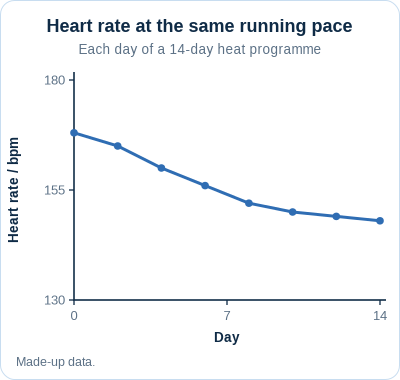
Acute or long-term?: Ask how long it took. Minutes to hours: an acute response. Days to weeks, and still there afterwards: a long-term adaptation.
Get feedback like a real examiner
Submit your answers and get instant feedback — what you did well, what's missing, and exactly what to write to score full marks.
How this is tested — you explain how the body responds to heat, humidity or altitude, on the day or over weeks. It comes up two ways:
Paper 1 — recall and data
- Paper 1A asks for a long-term heat adaptation or an acute altitude effect
- Or which blood changes happen over a 14-day stay
Paper 2 — explain and evaluate
- Paper 2 asks you to explain acute responses to hot, humid conditions
- Or to suggest responses to a heat acclimatisation programme
Response with no reason: "Sweat rate increases" is half a point in an explain question. Add why: to keep core temperature near 37 °C, or that in humid air it no longer cools.
A hockey player's heart rate at a steady pace is 150 beats per minute on a cool day. At the same pace on a day at 32 °C and 80 % humidity it is 172. Explain why her heart rate and core temperature are higher on the hot, humid day.
Model answer plan
See the answer broken into clear points, with guidance on how each point earns marks.
Exam tips
- Pair every response with its purpose: keeping core temperature near 37 °C, or getting oxygen to muscle.
- Humidity matters because sweat cannot evaporate, not because it makes you sweat more.
- Heat acclimatisation list: earlier and greater sweating, more dilute sweat, more plasma volume, lower heart rate, lower core temperature.
- Altitude: endurance events get worse (less oxygen); sprints, jumps and throws can get better (thinner air, less air resistance).