Studying this at HL: HL papers test this page in Paper 1A detail: the exact order the beat travels through the heart, and how exercise and training change insulin and glucose uptake. Learn both loops as chains you could put in order.
The big idea: You already know the shape of a negative feedback loop: something drifts, something notices, something corrects it.
One shape, used twice: Here that same shape is used twice — once on the heart, once on blood sugar. Learn the shape and both cases fall out of it.
Our example: Zara plays a full 60 minutes of netball on a Saturday morning. She ate porridge an hour before the first centre pass and nothing since.
Both loops in this micro are running inside that one match.
What is held steady
- Heart loop: blood pressure, and the oxygen arriving at the muscles
- Sugar loop: blood glucose concentration, which just means how much sugar is in the blood
- Neither of them is heart rate
What notices the drift
- Heart loop: baroreceptors, pressure sensors in the big arteries, and chemoreceptors watching the gases
- Sugar loop: the pancreas itself, checking the blood running through it
What does the correcting
- Heart loop: nerves reaching the heart and changing how fast it beats
- Sugar loop: insulin and glucagon, acting on the liver and the muscles
Zara's heart rate swings from 68 to 172 and back to 92. Her blood sugar reading barely moves at all: 5.4 millimoles per litre before the first centre pass, 5.1 at the final whistle.
That gap is the whole point. The number that moves is the correction. The number that stays still is what the loop is protecting.
Free preview
This is the free notes preview
You're reading the free notes. Aimnova Pro unlocks the full study experience — and you can try it with your first topic free to keep:
- FlashcardsLock in vocabulary and key terms with spaced repetition.
- Practice questionsAnswer exam-style questions and get instant AI marking.
- Mock exams & past-paper vaultSit full mocks and see exactly how examiners award marks.
- Personalised study planA daily plan built around your exam date and weak areas.
Heart rate is not the thing kept constant: it moved by over a hundred beats a minute in Zara's match.
What heart rate is for: Heart rate is what the body changes in order to keep something else the same: the pressure of the blood, and the oxygen reaching the working muscles.
One loop, around one sprint
Something drifts
Zara sprints. Leg vessels open, so pressure would fall unless the heart pumps more, and blood carbon dioxide climbs.
Something notices
Baroreceptors (aorta and neck arteries) feel the pressure start to dip; chemoreceptors feel the carbon dioxide rise.
The control centre decides
The heart centre in the brain stem works out how big a correction is needed.
The correction goes out
Nerves speed the heart and strengthen each beat. Pressure and oxygen supply recover.
The trigger disappears
Pressure restored, the sensors go quiet and the correction eases: negative feedback.
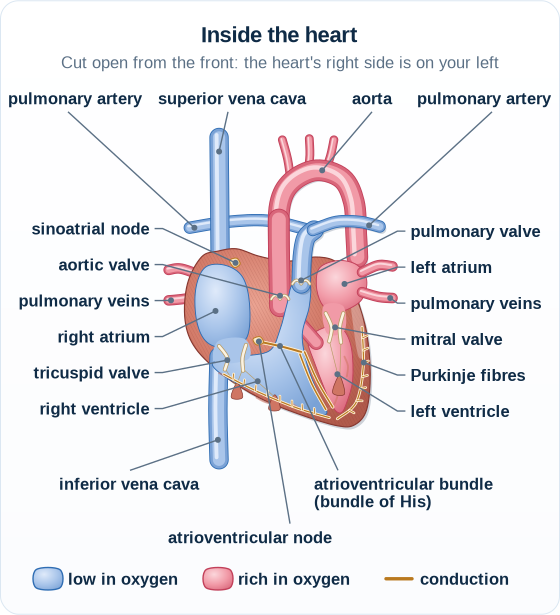
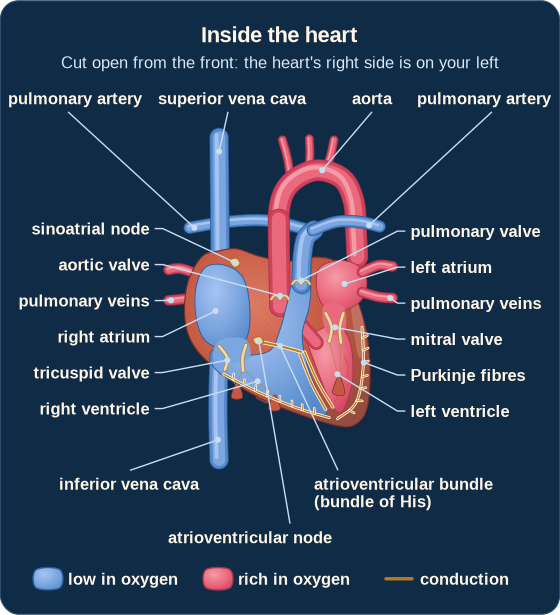
The loop does not start the beat. The sinoatrial node fires on its own: the intrinsic part, from inside the heart.
Intrinsic — the baseline
- Inside the heart: the SA node fires by itself
- Runs with or without the loop
- Would still beat with every nerve cut
Extrinsic — the loop's only lever
- Outside the heart: brain-stem nerves and hormones
- The arm the loop controls
- Pushed up when sensors report a problem, eased off after
Read as a loop: the node's own rate is the baseline; every change in the number is the loop correcting.
Interactive diagram
Explore the labelled diagram, charts and maps for this topic in full study mode.
The order the beat travels
SA node
Fires the signal; the atria contract.
AV node
Holds the signal briefly so the atria finish emptying.
Bundle of His
Carries it down between the ventricles.
Purkinje fibres
Spread it through the ventricle walls, which contract from the bottom up.
Feeling unprepared for exams?
Get a clear study plan, practice with real questions, and know exactly where you stand before exam day. No more guessing.
Now the second loop. The thing held steady is blood glucose concentration.
One organ, two jobs: What is neat here is that one organ does two of the loop's jobs. The pancreas both notices the drift and sends out the correction, so there is no separate sensor to learn.
The loop, running both ways
The level drifts up
Zara's porridge is digested and sugar moves into her blood. The pancreas picks up the rise and releases insulin.
Insulin corrects it
Sugar is taken out of the blood and stored, so the level comes back down — and the pancreas stops releasing insulin.
The level drifts down
Late in the match, her muscles have taken the spare sugar out of her blood. The pancreas picks up the fall and releases glucagon.
Glucagon corrects it
The liver lets its stored sugar back out into the blood, so the level comes back up — and the pancreas stops releasing glucagon.
One loop with two correcting arms. Each hormone only appears once the level has already moved, and goes away again once it is back.
Interactive diagram
Explore the labelled diagram, charts and maps for this topic in full study mode.
Notice what switches the hormones off: Nothing else does it. The correction itself removes the drift that set it going.
A loop that shuts itself down like that is exactly what negative feedback means.
Here is the part that looks wrong the first time you read it.
The puzzle: Zara is pulling sugar out of her blood as fast as her legs can take it. Insulin is the hormone that moves sugar out of the blood. And her body turns insulin down.
Why turning it down is the right move
The pancreas is told to ease off
The same sympathetic branch that speeds Zara's heart also reaches her pancreas, and the epinephrine in her blood adds to it. Together they limit the release of insulin.
So the liver keeps giving
Insulin's message to the liver is store it. With insulin low, the liver carries on letting sugar out into the blood instead of locking it away — which is what her legs need.
The muscle gets its sugar anyway
Uptake means taking sugar out of the blood and into a cell. A contracting muscle opens its own doorways for sugar, without waiting to be told by insulin.
So the level holds
Sugar leaves the liver at roughly the rate the working muscles take it up. Zara's reading goes 5.4 to 5.1 across the 60-minute match — barely a move.
What would happen if insulin stayed high?: The liver would be storing sugar away at the very moment Zara's muscles were emptying the blood of it.
Her blood sugar would drop fast and she would have nothing left to run on.
Say both halves: Exercise limits the release of insulin, and exercise helps glucose get into the muscle.
They sound like opposites and they are not. The first protects the level in the blood; the second feeds the muscle.
And with training: Regular aerobic training makes cells more sensitive to insulin, so less insulin is needed and muscle takes up glucose more readily. During exercise the glucose gradient into the muscle also rises, so uptake goes up even while insulin falls.
So after training, a rise in blood glucose is cleared from the blood faster, with less insulin.
Memorize terms 3x faster
Smart flashcards show you cards right before you forget them. Perfect for definitions and key concepts.
How this is tested — you put the heart's excitation in order, or say how exercise and training change insulin and glucose uptake. It comes up two ways:
Paper 1 — recall and data
- Paper 1A: the order of excitation through the heart
- Paper 1A: how training or exercise changes insulin sensitivity and glucose uptake
Paper 2 — explain and evaluate
- Paper 2 asks you to explain how blood glucose is kept up during exercise
- Marks for insulin limited, glucagon up, and uptake into muscle still rising
Insulin up in exercise: Exercise limits insulin release, yet muscle glucose uptake rises. Writing that insulin goes up to feed the muscles is the classic wrong answer.
Explain how blood glucose concentration is maintained during a 60-minute run.
Model answer plan
See the answer broken into clear points, with guidance on how each point earns marks.
Exam tips
- Excitation order: SA node, AV node (delay), bundle of His, Purkinje fibres.
- Intrinsic = the SA node; extrinsic = nerves and hormones from outside the heart.
- Regular aerobic training raises insulin sensitivity and glucose uptake.
- In exercise, insulin release is limited but glucose uptake into muscle increases: say both.