Start here: Most questions on this topic are about responding to heat, humidity, altitude and cold, then the feedback loops. Pair every response with its purpose, and say which kind of event suffers most.
1. Homeostasis and feedback
- Homeostasis keeps the internal environment relatively stable, in a narrow band.
- Negative feedback: a change is sensed and the response pushes it back towards normal.
- More carbon dioxide means lower blood pH; chemoreceptors trigger deeper, faster breathing.
- Heart loop: heart rate changes to protect blood pressure; insulin falls in exercise, uptake still rises.
2. Thermoregulation
- Core held at about 37 °C by the nervous, cardiovascular, muscular and integumentary systems.
- Too hot: vasodilation and sweating, heat lost by evaporation.
- Too cold: vasoconstriction keeps heat; shivering and non-shivering thermogenesis make it.
- At rest in a cool room most heat leaves by radiation; in hard exercise, by evaporation.
3. Environment (HL)
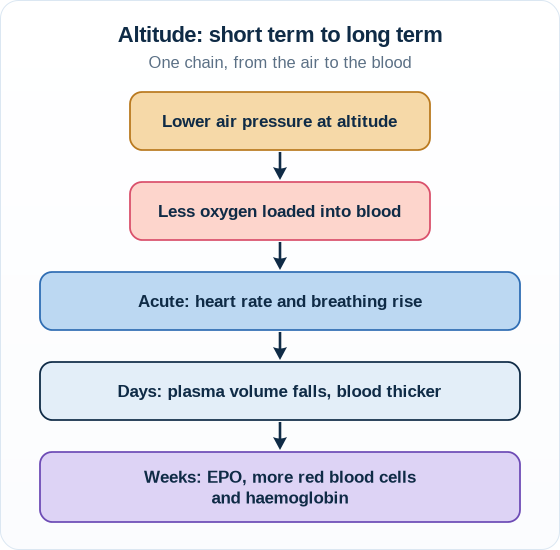
- Acute responses come within hours; long-term adaptations build over days or weeks.
- Heat acclimatization: earlier, more and more dilute sweat, more plasma, lower heart rate.
- Altitude: less oxygen pressure, so endurance suffers; sprints, jumps and throws can improve in the thinner air.
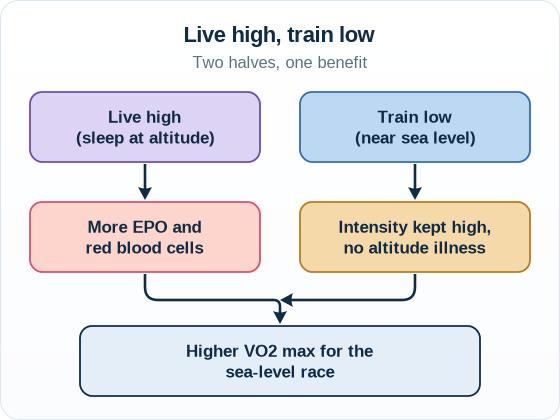
- Strategies: heat training, live high, train low, pre-cooling, fluids with electrolytes.
Too hot and too cold, side by side.
The two directions side by side. Watch which mechanisms fire when the core rises, and which fire when it falls.
Interactive diagram
Explore the labelled diagram, charts and maps for this topic in study mode.
Altitude, from lower air pressure to more red blood cells.
Live high, train low: both halves of the strategy.
Key terms, one line each:
| Term | In one line |
|---|---|
| Negative feedback | a response that reverses the change that set it off |
| Evaporation | sweat turning to vapour, taking heat from the skin |
| Acute response | a change within hours of exposure |
| Acclimatization | long-term adaptation to an environment |
| Humidity | water vapour in air: sweat cannot evaporate |
| Pre-cooling | lowering core temperature before an event |
IB-style questionExplain[4 marks]
A marathon is run in hot, humid conditions. Explain why the runners' performance falls.
Model answer plan
See the mark-by-mark plan — for / against / judgement, with marking guidance — in study mode.
Exam tips
- Pair every response with its purpose: holding core temperature near 37 °C, or getting oxygen to muscle.
- Humidity matters because sweat cannot evaporate, not because you sweat more.
- Name the event type first: long endurance events suffer most from heat and altitude.
- In an energy-system question, the last link is more reliance on anaerobic supply.
- Link every strategy to what it does in the body, not just its name.