aımnova
DashboardMy LearningCrash CoursesStudy Plan

Aimnova site navigation

Stay in the loop

Get the latest study resources and updates

New features, study tips and exam insights — straight to your inbox.

IB Diploma

  • IB Past Papers
  • IB Study Notes
  • IB Question Bank
  • IB Mock Exams
  • IB Revision

IB Subjects

  • IB Math AA
  • IB Math AI
  • IB Economics
  • IB Business Management
  • IB Physics
  • IB Biology
  • View all IB subjects→

IB Past Papers

  • IB Math AA HL Past Papers
  • IB Math AA SL Past Papers
  • IB Math AI HL Past Papers
  • IB Math AI SL Past Papers
  • IB Economics HL Past Papers
  • IB Economics SL Past Papers
  • IB ESS Past Papers
  • View all past papers→

Study Resources

  • Study Notes
  • Question Bank
  • Mock Exams
  • Crash Courses
  • Flashcards
  • Revision Guide
  • Exam Skills
  • Command Terms
  • Grade Calculator
  • Exam Timetable 2027

Aimnova

  • Features
  • Pricing
  • For Teachers
  • For Schools
  • For Parents
  • About Us
  • Blog
  • Contact
aımnova

IB study, practice and feedback built around the real exam.

TermsPrivacyCookies·© 2026 Aimnova. All rights reserved.d9e1c61

Aimnova is not affiliated with or endorsed by the International Baccalaureate Organization (IB).

NotesSports, Exercise and Health Science HLTopic 7.1
Unit 7 · Individual differences · Topic 7.1

IB Sports, Exercise and Health Science HL — Personality

Personality

Higher Level students should use this topic hub as a map: start with the shared sub-topics, then follow the HL-only extensions and exam-skill links where this topic asks for deeper analysis.

Exam technique guidePractice questions

Key concepts in Personality

Start here: Questions on this topic ask for the trait in a description and how behaviour is learned from others. Say whether you mean a trait or a situational explanation, and quote the clue.

1. What personality is

  • A person's usual pattern of thinking, feeling and behaving.
  • It comes from genes and environment together.
  • Traits are stable over time and across situations.

2. The big five

  • Openness: curious, open to new ideas. Conscientiousness: organized, self-disciplined.
  • Extraversion: sociable, outgoing. Agreeableness: kind, cooperative.
  • Neuroticism: anxious, emotionally unstable.

3. Learning and change (HL)

  • Social learning: behaviours, attitudes and consequences learned by observation and imitation.
  • The more a role model is regarded, the more is copied.
  • Personality can be modified over years by experience, coaching and reflection.
  • No personality profile predicts performance: behaviour = traits + social learning.

Learning by watching a regarded model.
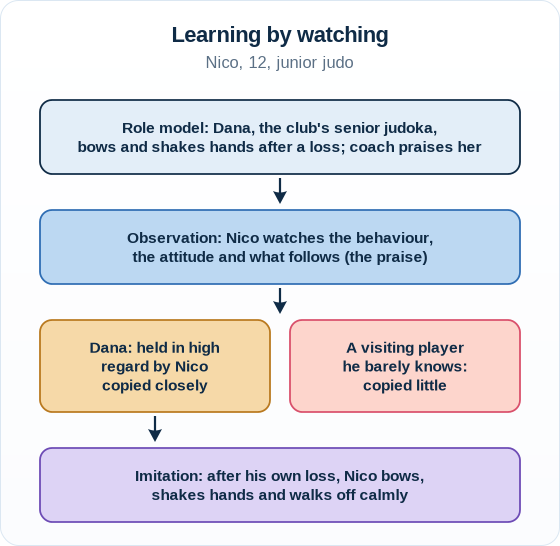
A role model is observed, copied more when highly regarded, and imitated
Recap: learning by watching.

Personality change across years, not days.
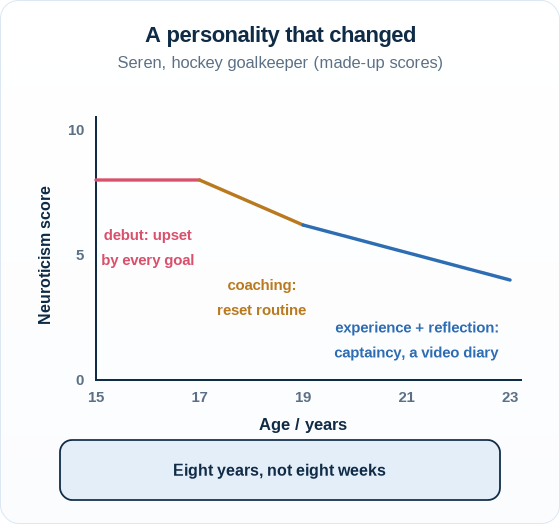
Line graph of a neuroticism score falling slowly over eight years
Recap: slow change.

Inside My Learning

Turn these notes into practice

Try each question, reveal a clear model answer, and learn how to build your response.

  • 1.A player is described as sociable and self-disciplined. Identify two traits. [2]
  • 2.Outline how personality traits are assessed. [1]
  • 3.Outline how a novice gymnast learns a skill through social learning. [2]
Claim your free topic

Key terms, one line each:

TermIn one line
Personalitya person's usual pattern of thinking, feeling, behaving
Traita stable characteristic of a person
Social learning theorylearning by observing and imitating others
Modellingcopying a demonstrated behaviour

Inside My Learning

Turn these notes into practice

Try each question, reveal a clear model answer, and learn how to build your response.

  • 1.Kind and cooperative: which trait?
  • 2.Curious about new tactics: which trait?
  • 3.Is a bad mood for a day a personality change?
Claim your free topic
IB-style questionExplain[3 marks]

Young players in a club copy the captain's calm reaction to referee decisions. Explain this using social learning theory.

Model answer plan

See the mark-by-mark plan — for / against / judgement, with marking guidance — in study mode.

Claim your free topic →

Exam tips

  • Learning a skill by watching others is modelling.
  • Name what is learned: behaviours, attitudes and their consequences.
  • Personality changes over a long period, not day to day.
  • No personality profile predicts sport performance.
  • Control observer bias with blind observers and a fixed checklist.

What you'll learn in Topic 7.1

  • 7.1.1 Personality and the big five
  • 7.1.2 Social learning theory
  • 7.1.3 Personality change
Suggested study order: Read the notes for each sub-topic below → test yourself with flashcards → attempt practice questions → review exam technique.

Study resources — 7.1 Personality

7.1.1

Personality and the big five

Notes
7.1.2

Social learning theory

Notes
7.1.3

Personality change

Notes

Ready to study Personality?

Get expert practice questions with instant AI feedback, and a study planner tailored to your IB Sports, Exercise and Health Science HL exam date.

Start studying free

Topic 7.1 Personality forms a core part of Unit 7: Individual differences in IB Sports, Exercise and Health Science HL. Mastering these concepts will strengthen your understanding of connected topics across the syllabus and prepare you for exam questions that require analysis, evaluation, and real-world application.

Previous topic
6.2 Injury interventions
Next topic
7.2 Mental toughness
All Sports, Exercise and Health Science HL topics
Exam technique

Ready to practice?

Get AI-graded practice questions, mock exams, flashcards, and a personalised study plan — all aligned to your IB syllabus.

Start Studying Free

No credit card required · No time limit