aımnova
DashboardMy LearningCrash CoursesStudy Plan

Aimnova site navigation

Stay in the loop

Get the latest study resources and updates

New features, study tips and exam insights — straight to your inbox.

IB Diploma

  • IB Past Papers
  • IB Study Notes
  • IB Question Bank
  • IB Mock Exams
  • IB Revision

IB Subjects

  • IB Math AA
  • IB Math AI
  • IB Economics
  • IB Business Management
  • IB Physics
  • IB Biology
  • View all IB subjects→

IB Past Papers

  • IB Math AA HL Past Papers
  • IB Math AA SL Past Papers
  • IB Math AI HL Past Papers
  • IB Math AI SL Past Papers
  • IB Economics HL Past Papers
  • IB Economics SL Past Papers
  • IB ESS Past Papers
  • View all past papers→

Study Resources

  • Study Notes
  • Question Bank
  • Mock Exams
  • Crash Courses
  • Flashcards
  • Revision Guide
  • Exam Skills
  • Command Terms
  • Grade Calculator
  • Exam Timetable 2027

Aimnova

  • Features
  • Pricing
  • For Teachers
  • For Schools
  • For Parents
  • About Us
  • Blog
  • Contact
aımnova

IB study, practice and feedback built around the real exam.

TermsPrivacyCookies·© 2026 Aimnova. All rights reserved.d9e1c61

Aimnova is not affiliated with or endorsed by the International Baccalaureate Organization (IB).

NotesSports, Exercise and Health Science HLTopic 6.2
Unit 6 · Injury · Topic 6.2

IB Sports, Exercise and Health Science HL — Injury interventions

Interventions related to injury

Higher Level students should use this topic hub as a map: start with the shared sub-topics, then follow the HL-only extensions and exam-skill links where this topic asks for deeper analysis.

Exam technique guidePractice questions

Key concepts in Injury interventions

Start here: Most questions on this topic are about lowering injury risk in a named sport, then concussion. Name the method, fit it to the sport and say how it lowers risk.

1. Lowering risk

  • Every method cuts the force that arrives or raises what the body can take.
  • Padding, helmets and soft surfaces spread force over more time or area.
  • Warm-up, strength and flexibility training prepare the body.
  • Technique coaching and rule changes change the movement or the game.

2. Treating injury

  • Inflammation starts healing, and it is also what hurts.
  • Initial treatment: ice, compression, elevation, NSAIDs.
  • Ice limits: less blood flow may delay repair; little effect on deep tissue.
  • Complete tears or major fractures may need surgery, then rehabilitation.

3. Concussion

  • A qualified professional decides on return to play, never the athlete.
  • Stage 1: symptom-limited activity, not complete bed rest.
  • Brain work (learning) and body work climb in stages.
  • Recovery is not linear: if symptoms return, go back a stage.

All the methods, sorted by their two jobs.
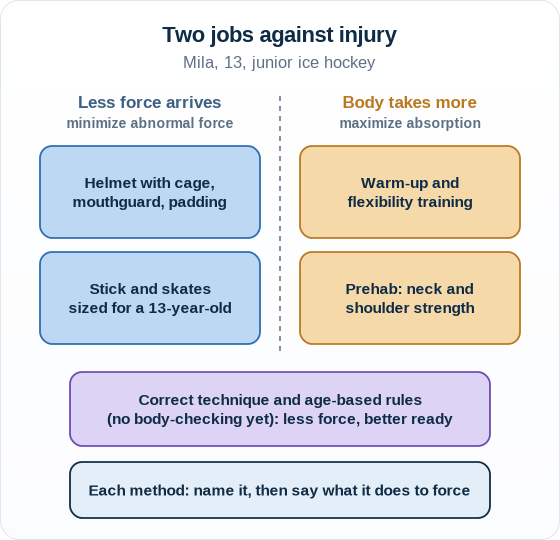
Methods sorted into reducing force and raising absorption, with technique and rules doing both
Recap: two jobs.

The staged return after a concussion.
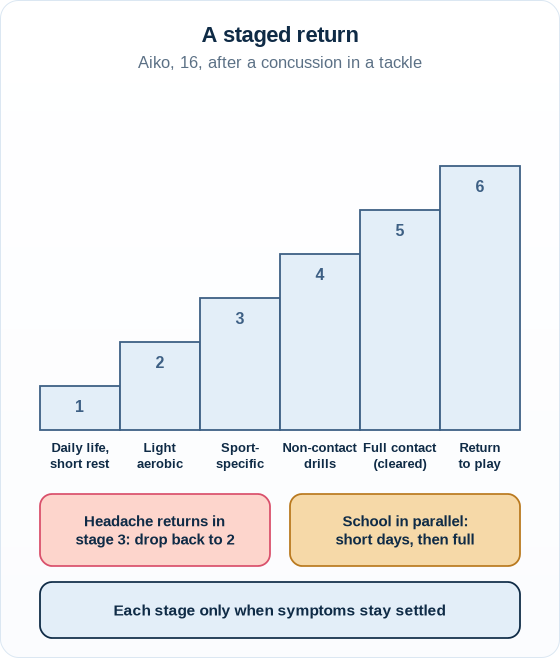
A six-step staircase from daily life to return to play
Recap: a staged return.

Inside My Learning

Turn these notes into practice

Try each question, reveal a clear model answer, and learn how to build your response.

  • 1.Outline two ways to reduce the risk of concussion in rugby. [2]
  • 2.Outline two initial treatments for inflammation after an ankle sprain. [2]
  • 3.Outline the first stage of returning from a concussion. [1]
Claim your free topic

Key terms, one line each:

TermIn one line
Inflammationthe body's first response to tissue damage
NSAIDnon-steroidal anti-inflammatory drug
Return-to-play protocolstaged steps back to full sport
Symptom-limited activityactivity that does not bring symptoms back

Inside My Learning

Turn these notes into practice

Try each question, reveal a clear model answer, and learn how to build your response.

  • 1.Is complete bed rest the first stage after concussion?
  • 2.Who decides the return to play?
  • 3.Is a polyphenol diet an initial treatment?
Claim your free topic
IB-style questionEvaluate[4 marks]

Evaluate the use of ice in the treatment of a hamstring strain.

Model answer plan

See the mark-by-mark plan — for / against / judgement, with marking guidance — in study mode.

Claim your free topic →

Exam tips

  • Fit every method to the sport in the question.
  • Say how the method works: less force arriving, or more force the body can take.
  • Shoes or braces count only with their reason.
  • Inflammation helps repair: treatment eases pain without stopping healing.
  • Recovery from concussion is not linear; a professional decides the return.

What you'll learn in Topic 6.2

  • 6.2.1 Lowering injury risk
  • 6.2.2 Treating injury
  • 6.2.3 Concussion management
Suggested study order: Read the notes for each sub-topic below → test yourself with flashcards → attempt practice questions → review exam technique.

Study resources — 6.2 Injury interventions

6.2.1

Lowering injury risk

Notes
6.2.2

Treating injury

Notes
6.2.3

Concussion management

Notes

Ready to study Injury interventions?

Get expert practice questions with instant AI feedback, and a study planner tailored to your IB Sports, Exercise and Health Science HL exam date.

Start studying free

Topic 6.2 Injury interventions forms a core part of Unit 6: Injury in IB Sports, Exercise and Health Science HL. Mastering these concepts will strengthen your understanding of connected topics across the syllabus and prepare you for exam questions that require analysis, evaluation, and real-world application.

Previous topic
6.1 Causes of injury
Next topic
7.1 Personality
All Sports, Exercise and Health Science HL topics
Exam technique

Ready to practice?

Get AI-graded practice questions, mock exams, flashcards, and a personalised study plan — all aligned to your IB syllabus.

Start Studying Free

No credit card required · No time limit