aımnova
DashboardMy LearningCrash CoursesStudy Plan

Aimnova site navigation

Stay in the loop

Get the latest study resources and updates

New features, study tips and exam insights — straight to your inbox.

IB Diploma

  • IB Past Papers
  • IB Study Notes
  • IB Question Bank
  • IB Mock Exams
  • IB Revision

IB Subjects

  • IB Math AA
  • IB Math AI
  • IB Economics
  • IB Business Management
  • IB Physics
  • IB Biology
  • View all IB subjects→

IB Past Papers

  • IB Math AA HL Past Papers
  • IB Math AA SL Past Papers
  • IB Math AI HL Past Papers
  • IB Math AI SL Past Papers
  • IB Economics HL Past Papers
  • IB Economics SL Past Papers
  • IB ESS Past Papers
  • View all past papers→

Study Resources

  • Study Notes
  • Question Bank
  • Mock Exams
  • Crash Courses
  • Flashcards
  • Revision Guide
  • Exam Skills
  • Command Terms
  • Grade Calculator
  • Exam Timetable 2027

Aimnova

  • Features
  • Pricing
  • For Teachers
  • For Schools
  • For Parents
  • About Us
  • Blog
  • Contact
aımnova

IB study, practice and feedback built around the real exam.

TermsPrivacyCookies·© 2026 Aimnova. All rights reserved.d9e1c61

Aimnova is not affiliated with or endorsed by the International Baccalaureate Organization (IB).

NotesSports, Exercise and Health Science HLTopic 7.2
Unit 7 · Individual differences · Topic 7.2

IB Sports, Exercise and Health Science HL — Mental toughness

Mental toughness

Higher Level students should use this topic hub as a map: start with the shared sub-topics, then follow the HL-only extensions and exam-skill links where this topic asks for deeper analysis.

Exam technique guidePractice questions

Key concepts in Mental toughness

Start here: Questions on this topic are on mental toughness and attribution theory, then the self-fulfilling prophecy. Say how a belief or explanation changes confidence, and write probability, not certainty.

1. What it is

  • Helps people cope with pressure: challenge, commitment, confidence, control, resilience.
  • Attributes: determination, focus, persistence, emotional control.
  • Partly genetic, but it can be trained.

2. Toughness and health

  • Toughness is associated with fewer depressive and burnout symptoms and better sleep.
  • A link, not proof of cause: a correlation.
  • Better design: follow athletes over time, or use a control group.

3. Beliefs and success

  • Self-fulfilling prophecy: confidence, more effort and persistence, higher chance of success.
  • Learned helplessness: no perceived control, so the athlete gives up.
  • It grows from blaming failures on stable, uncontrollable causes.

4. Attribution theory

  • Results explained by locus (internal or external), stability and control.
  • After a loss: internal, unstable, controllable reasons (effort) protect confidence.
  • Blaming referees or ice: nothing to improve, mistakes repeated.

Mental toughness: the attributes that meet pressure.
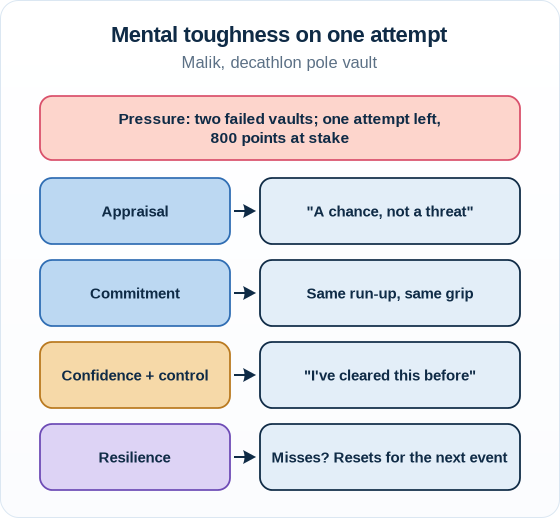
The five parts of mental toughness on one pole-vault attempt
Recap: five parts on one attempt.

The three dimensions of an attribution.
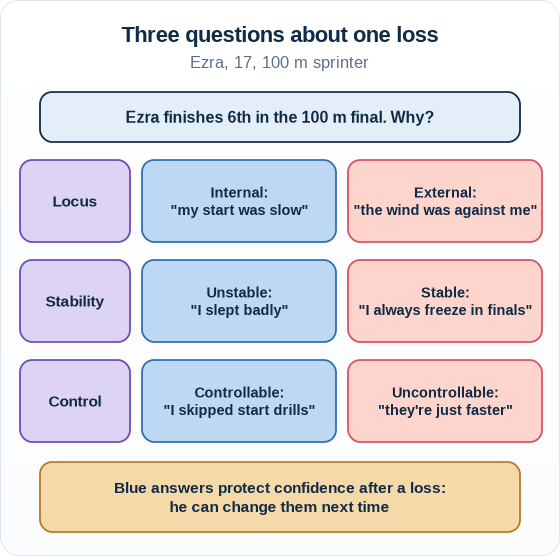
Three rows of reasons for a lost sprint final sorted by locus, stability and control
Recap: three dimensions.

Inside My Learning

Turn these notes into practice

Try each question, reveal a clear model answer, and learn how to build your response.

  • 1.List three attributes of a mentally tough athlete. [3]
  • 2.Outline learned helplessness. [2]
  • 3.Explain why a coach should focus a losing athlete on effort. [2]
Claim your free topic

Key terms, one line each:

TermIn one line
Mental toughnessthe capacity to cope with pressure and setbacks
Self-fulfilling prophecya belief that raises the chance of its outcome
Learned helplessnessbelieving effort cannot change the outcome
Locus of causalitywhether a cause is internal or external
Stabilitywhether a cause stays the same over time

Inside My Learning

Turn these notes into practice

Try each question, reveal a clear model answer, and learn how to build your response.

  • 1.Bad luck: internal or external?
  • 2.Does toughness cause better sleep?
  • 3.Prophecy: certainty or probability of success?
Claim your free topic
IB-style questionExplain[3 marks]

After three defeats a sprinter says she is just not talented enough. Explain how this attribution could affect her.

Model answer plan

See the mark-by-mark plan — for / against / judgement, with marking guidance — in study mode.

Claim your free topic →

Exam tips

  • Errors seen as stable and uncontrollable lower confidence.
  • Effort is internal and controllable: focusing on it raises motivation.
  • Name all three health outcomes with their direction.
  • Call toughness and health an association, not a cause.
  • For the prophecy, write probability, not certainty.

What you'll learn in Topic 7.2

  • 7.2.1 Mental toughness
  • 7.2.2 Self-fulfilling prophecy
  • 7.2.3 Toughness and health
  • 7.2.4 Attribution theory
Suggested study order: Read the notes for each sub-topic below → test yourself with flashcards → attempt practice questions → review exam technique.

Study resources — 7.2 Mental toughness

7.2.1

Mental toughness

Notes
7.2.2

Self-fulfilling prophecy

Notes
7.2.3

Toughness and health

Notes
7.2.4

Attribution theory

Notes

Ready to study Mental toughness?

Get expert practice questions with instant AI feedback, and a study planner tailored to your IB Sports, Exercise and Health Science HL exam date.

Start studying free

Topic 7.2 Mental toughness forms a core part of Unit 7: Individual differences in IB Sports, Exercise and Health Science HL. Mastering these concepts will strengthen your understanding of connected topics across the syllabus and prepare you for exam questions that require analysis, evaluation, and real-world application.

Previous topic
7.1 Personality
Next topic
8.1 Motor learning processes
All Sports, Exercise and Health Science HL topics
Exam technique

Ready to practice?

Get AI-graded practice questions, mock exams, flashcards, and a personalised study plan — all aligned to your IB syllabus.

Start Studying Free

No credit card required · No time limit