Studying this at HL: HL papers ask you to name big five traits from a player's behaviour, to pick which list item is a big five trait, and to say how traits and learned behaviour together shape what a performer does.
Personality: Personality is the way one person differs from another in their usual patterns of thinking, feeling and behaving.
It comes from genetic traits interacting with the environment.
Our example: Tavita, 17, plays point guard for her school basketball team. Her coach calls her "quiet, organised, and hard on herself after mistakes". That lasting pattern is her personality.
See it drawn, step by step
In My Learning, handwritten diagrams build one step at a time. Play, pause and replay each explanation until it clicks. Create your free account to try it.
Thinking
- What Tavita expects before a game
- "I must not lose the ball."
Feeling
- How she feels after a turnover
- Upset for several minutes
Behaving
- What she does next
- Passes safely and stops driving
Free preview
This is the free notes preview
You're reading the free notes. Aimnova Pro unlocks the full study experience — and you can try it with your first topic free to keep:
- FlashcardsLock in vocabulary and key terms with spaced repetition.
- Practice questionsAnswer exam-style questions and get instant AI marking.
- Mock exams & past-paper vaultSit full mocks and see exactly how examiners award marks.
- Personalised study planA daily plan built around your exam date and weak areas.
This section shows the trait approach: describing personality as a set of traits, and measuring them with a questionnaire.
The trait approach: A trait is a characteristic that is relatively enduring and stable: it shows across many situations and over a long time.
Traits are measured with validated self-report questionnaires.
What those words mean
Self-report
The athlete answers the questions about themselves, for example rating "I like meeting new people" from 1 to 5.
Questionnaire
The same fixed questions for everyone, so scores can be compared.
Validated
Tested by researchers to show it really measures the trait it claims to measure.
Strengths
- Quick and cheap to give to a whole team
- Gives a number, so athletes can be compared
- Asks the person who knows their own thoughts best
Limitations
- Self-report bias: people may answer to look good
- Mood or tiredness on the day can change answers
- Other variables (fitness, skill, team-mates) also affect performance, so a trait cannot be shown to cause a result
Memorize terms 3x faster
Smart flashcards show you cards right before you forget them. Perfect for definitions and key concepts.
This section teaches the big five, the most common way to describe traits. In the exam you name the trait from a description of a player.
Remember it as OCEAN: Openness, Conscientiousness, Extraversion, Agreeableness, Neuroticism. Each one is a scale: a person can be high, low or in between.
| Trait | What it describes | What you see in a player |
|---|---|---|
| Openness to experience | Willing to try new things, open to feeling unsure, thinks in original ways | Happy to try a new position, tactic or coaching instruction |
| Conscientiousness | Controls impulses, follows the rules, works towards goals | Organised, on time, sticks to the training plan |
| Extraversion (or introversion) | Gets energy from being with other people (or finds it tiring) | Talkative and sociable in the changing room |
| Agreeableness | Gets on with others and acts to keep relationships good | Supportive, cooperative, avoids arguments with team-mates |
| Neuroticism (or emotional stability) | Sees situations as upsetting, or keeps an emotional balance | High: easily upset after a mistake. Low: stays calm |
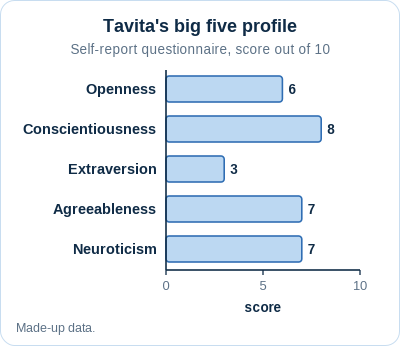
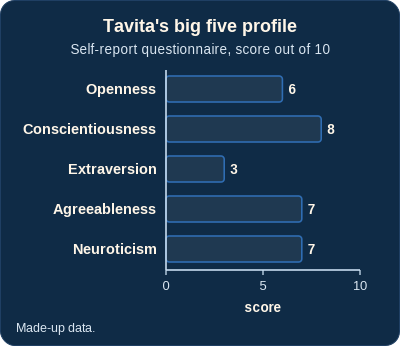
Reading Tavita's profile: High conscientiousness (8) and agreeableness (7): organised and cooperative. Low extraversion (3): introverted. High neuroticism (7): she struggles to keep an emotional balance under stress.
Not on the list: Loyalty, honesty, dependability and mental toughness are not big five traits. Learn the five by name.
How this is tested — you name big five traits from behaviour, and say how traits shape what a performer does. It comes up two ways:
Paper 1 — recall and data
- Paper 1A describes a player: name the trait or pair
- Or picks the true statement about traits and behaviour
Paper 2 — explain and evaluate
- Paper 2 asks you to describe traits in a player
- Each trait named with the clue that shows it
Traits are not the whole story: Behaviour comes from traits together with the situation and what the performer has learned from others. Traits alone do not predict success.
A coach says of a swimmer: "She tries every new drill I suggest, and she never misses a session or cuts a set short." Describe two big five traits this swimmer shows.
Model answer plan
See the answer broken into clear points, with guidance on how each point earns marks.
Exam tips
- Sociable and talkative = extraversion; self-disciplined = conscientiousness.
- Poor emotional balance under stress = neuroticism.
- High conscientiousness and openness: consistent effort, and listening to the coach's new ideas.
- Traits combine with behaviour learned by observing influential team-mates.
- Mental toughness, loyalty and honesty are not big five traits.