aımnova
DashboardMy LearningCrash CoursesStudy Plan

Aimnova site navigation

Stay in the loop

Get the latest study resources and updates

New features, study tips and exam insights — straight to your inbox.

IB Diploma

  • IB Past Papers
  • IB Study Notes
  • IB Question Bank
  • IB Mock Exams
  • IB Revision

IB Subjects

  • IB Math AA
  • IB Math AI
  • IB Economics
  • IB Business Management
  • IB Physics
  • IB Biology
  • View all IB subjects→

IB Past Papers

  • IB Math AA HL Past Papers
  • IB Math AA SL Past Papers
  • IB Math AI HL Past Papers
  • IB Math AI SL Past Papers
  • IB Economics HL Past Papers
  • IB Economics SL Past Papers
  • IB ESS Past Papers
  • View all past papers→

Study Resources

  • Study Notes
  • Question Bank
  • Mock Exams
  • Crash Courses
  • Flashcards
  • Revision Guide
  • Exam Skills
  • Command Terms
  • Grade Calculator
  • Exam Timetable 2027

Aimnova

  • Features
  • Pricing
  • For Teachers
  • For Schools
  • For Parents
  • About Us
  • Blog
  • Contact
aımnova

IB study, practice and feedback built around the real exam.

TermsPrivacyCookies·© 2026 Aimnova. All rights reserved.d9e1c61

Aimnova is not affiliated with or endorsed by the International Baccalaureate Organization (IB).

NotesSports, Exercise and Health Science HLTopic 4.1
Unit 4 · Generating movement in the body · Topic 4.1

IB Sports, Exercise and Health Science HL — Position, planes and movement

Anatomical position, planes and movement

Higher Level students should use this topic hub as a map: start with the shared sub-topics, then follow the HL-only extensions and exam-skill links where this topic asks for deeper analysis.

Exam technique guidePractice questions

Key concepts in Position, planes and movement

Start here: Most questions on this topic ask for planes, axes and movements, then for how body proportions affect performance. Link each body measure to the movement it changes, and give a cost as well as a benefit.

1. Skeleton and position terms

  • Axial: skull, vertebrae, ribs, sternum. Appendicular: limbs plus the shoulder and pelvic girdles.
  • Appendicular jobs: levers for movement, tendon attachment, blood cells made in the marrow.
  • Every position word is a comparison: say what it is relative to.
  • Proximal/distal only along a limb; superior/inferior for the head and trunk.

2. Planes and axes

  • Sagittal plane, side-to-side axis: flexion and extension.
  • Frontal plane, front-to-back axis: abduction, adduction, inversion, eversion.
  • Transverse plane, top-to-bottom axis: rotation, pronation, supination.
  • Circumduction is a circle at the shoulder or hip, built from four movements.

3. Anthropometry and ergonomics (HL)

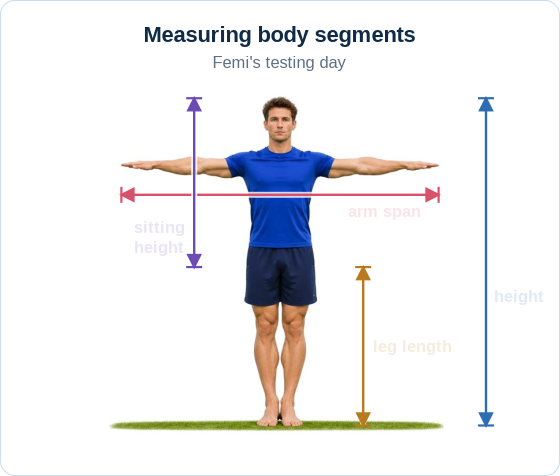
  • Anthropometry measures segments: height, sitting height, limb length, arm span, girths, mass.
  • A longer leg gives a longer stride but is harder to swing: cadence can fall.
  • Reliable measures: repeat, same time of day, calibrated tools, same tester.
  • Ergonomic kit is sized from databases (often 5th-95th percentile): comfort, efficiency, less injury.

Each plane with the axis that passes straight through it.

Each sheet of glass in turn, with the rod that pokes through it. Watch which way the rod points.

Interactive diagram

Explore the labelled diagram, charts and maps for this topic in study mode.

Claim your free topic →

The body measures anthropometry uses.

A person with arms out and arrows for height, arm span, leg length and sitting height
Recap: four body measures.

Inside My Learning

Turn these notes into practice

Try each question, reveal a clear model answer, and learn how to build your response.

  • 1.State the plane and axis of knee extension when kicking a ball. [2]
  • 2.Outline one benefit and one limitation of long legs for a race walker. [2]
  • 3.Suggest two ways to make anthropometric measurements more reliable. [2]
Claim your free topic

Key terms, one line each:

TermIn one line
Sagittal planedivides the body into left and right
Abductionmovement away from the midline
Anthropometrymeasurement of body size and proportions
Ergonomicsfitting equipment to the body and the task
Percentile rangethe share of people a size range fits

Inside My Learning

Turn these notes into practice

Try each question, reveal a clear model answer, and learn how to build your response.

  • 1.Which plane is rotation in?
  • 2.Why scale down junior equipment?
  • 3.Is *longer legs perform better* enough?
Claim your free topic
IB-style questionDiscuss[4 marks]

Discuss whether a tall rower with long arms has an advantage.

Model answer plan

See the mark-by-mark plan — for / against / judgement, with marking guidance — in study mode.

Claim your free topic →

Exam tips

  • Give plane, axis and movement as three separate answers.
  • Link the segment to the movement: longer leg, longer stride; longer lever, more end speed.
  • Limitations score too: a longer limb is harder to rotate.
  • Randomizing participants avoids selection bias.
  • A shorter junior stick gives control, never more speed.

What you'll learn in Topic 4.1

  • 4.1.1 Skeleton and position terms
  • 4.1.2 Planes, axes and movements
  • 4.1.3 Anthropometry
  • 4.1.4 Equipment and ergonomics
Suggested study order: Read the notes for each sub-topic below → test yourself with flashcards → attempt practice questions → review exam technique.

Study resources — 4.1 Position, planes and movement

4.1.1

Skeleton and position terms

Notes
4.1.2

Planes, axes and movements

Notes
4.1.3

Anthropometry

Notes
4.1.4

Equipment and ergonomics

Notes

Ready to study Position, planes and movement?

Get expert practice questions with instant AI feedback, and a study planner tailored to your IB Sports, Exercise and Health Science HL exam date.

Start studying free

Topic 4.1 Position, planes and movement forms a core part of Unit 4: Generating movement in the body in IB Sports, Exercise and Health Science HL. Mastering these concepts will strengthen your understanding of connected topics across the syllabus and prepare you for exam questions that require analysis, evaluation, and real-world application.

Previous topic
3.3 Fatigue and recovery
Next topic
4.2 Connective tissues and joints
All Sports, Exercise and Health Science HL topics
Exam technique

Ready to practice?

Get AI-graded practice questions, mock exams, flashcards, and a personalised study plan — all aligned to your IB syllabus.

Start Studying Free

No credit card required · No time limit