Start here: Questions on this topic ask what each connective tissue does and which class of synovial joint allows a movement. Link structure to function in one sentence.
1. Connective tissues
- Bone: support and levers. Cartilage: absorbs shock, reduces friction.
- Ligament: bone to bone, gives stability. Tendon: muscle to bone, moves the joint.
- Fascia: sheets of fibrous tissue wrapping muscles and organs.
- Built this way, so it does this job: dense parallel fibres resist pulling.
2. Joints
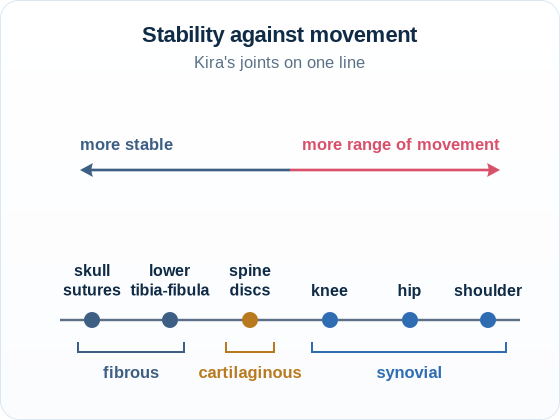
- Fibrous joints barely move; cartilaginous give a little; synovial move freely.
- Synovial joint: capsule, synovial membrane and fluid, articular cartilage, ligaments.
- More range of movement always means less stability.
3. Six synovial classes
- Ball and socket: hip, shoulder. Hinge: elbow, knee.
- Pivot: atlas-axis, radioulnar. Condyloid: wrist.
- Saddle: base of the thumb. Gliding (plane): between carpals.
- Give class, joint, movement and when the athlete uses it.
Ligament or tendon: the difference is what each one joins.
Two bands that look much the same. The only thing that differs is what sits at the far end.
Interactive diagram
Explore the labelled diagram, charts and maps for this topic in study mode.
Range of movement against stability.
Key terms, one line each:
| Term | In one line |
|---|---|
| Ligament | joins bone to bone |
| Tendon | joins muscle to bone |
| Fascia | fibrous sheet wrapping muscles and organs |
| Synovial fluid | lubricates a synovial joint |
| Condyloid joint | oval surface: the wrist |
IB-style questionDescribe[3 marks]
Describe the structure of a synovial joint, using the knee as an example.
Model answer plan
See the mark-by-mark plan — for / against / judgement, with marking guidance — in study mode.
Exam tips
- Cartilage absorbs shock and reduces friction; stability is the ligament's job.
- Tendon = muscle to bone; ligament = bone to bone.
- Do not repeat a class when several synovial joints are asked for.
- Wrist = condyloid, elbow = hinge, radioulnar = pivot.
- Link structure to function in one sentence.