Studying this at HL: HL Paper 1A tests this three ways: the jobs of the axial skeleton, a bone classified with its function, and where one bone sits relative to another along a limb. Learn every pair both ways round, and each part's jobs, including the movement the axial skeleton allows.
The big idea: Every bone in the body belongs to one of two groups.
Which group a bone is in tells you what that bone is mainly there for.
Our example: Bruno keeps goal in handball. He dives for a low shot, takes the ball hard in the ribs, and lands on his shoulder.
Everything in this micro is that one save, or the notes his physiotherapist writes afterwards.
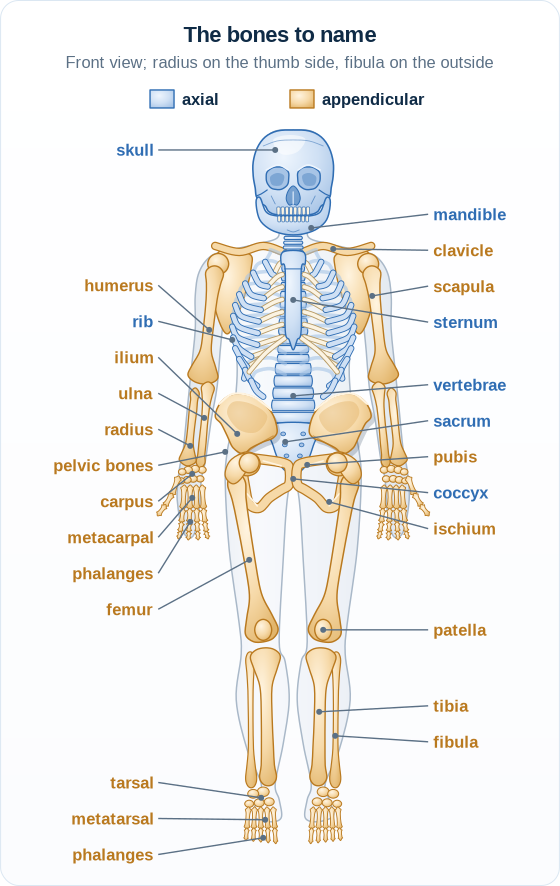
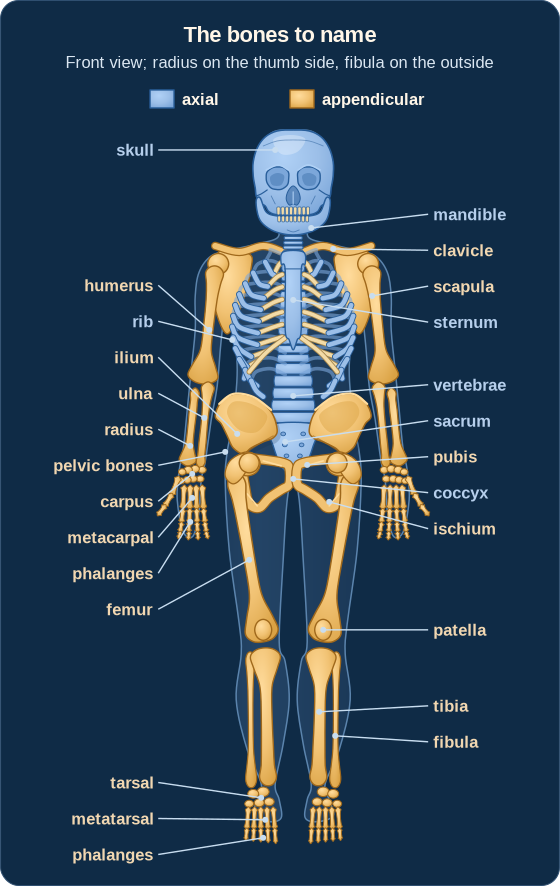
Axial skeleton
- The bones down the middle line of the body
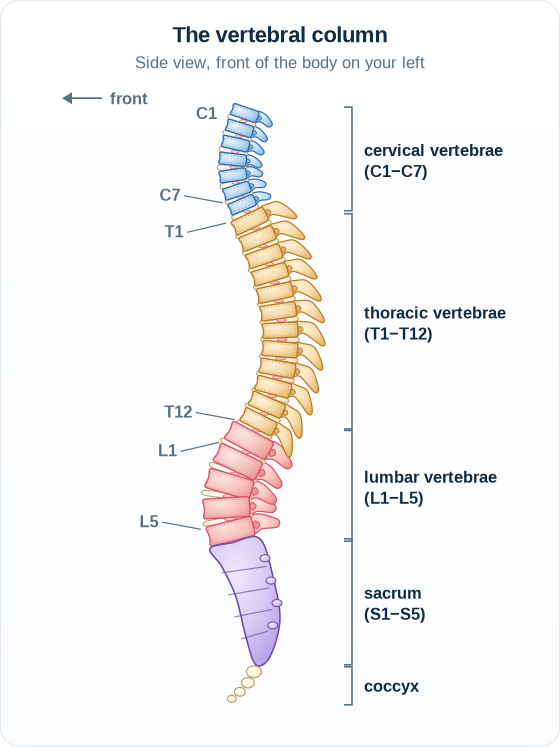
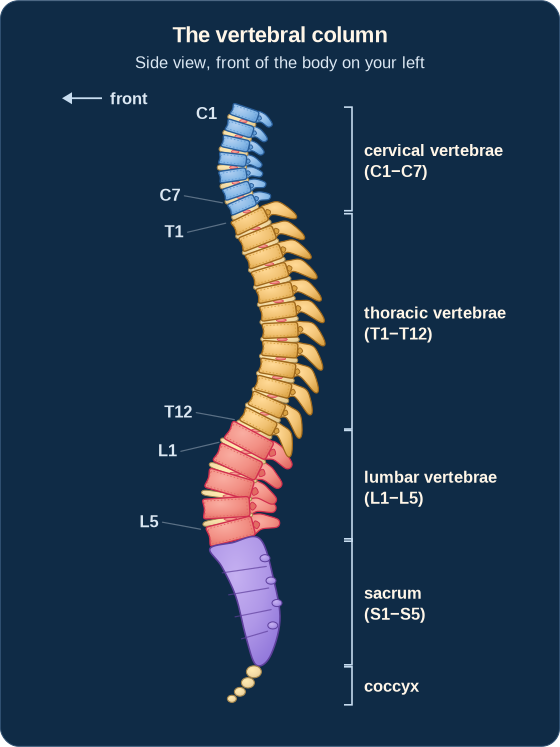
- Skull, vertebral column (the spine), ribs and sternum (the breastbone)
- Bruno's head, neck, chest and back
Appendicular skeleton
- The bones that hang off that middle line
- Arm and leg bones, plus the two girdles that attach them
- Bruno's shoulders, arms, hips and legs
Appendicular comes from the same word as appendage, which just means something added on. That is the whole idea: the middle line, and everything hanging off it.
See it drawn, step by step
In My Learning, handwritten diagrams build one step at a time. Play, pause and replay each explanation until it clicks. Create your free account to try it.
Free preview
This is the free notes preview
You're reading the free notes. Aimnova Pro unlocks the full study experience — and you can try it with your first topic free to keep:
- FlashcardsLock in vocabulary and key terms with spaced repetition.
- Practice questionsAnswer exam-style questions and get instant AI marking.
- Mock exams & past-paper vaultSit full mocks and see exactly how examiners award marks.
- Personalised study planA daily plan built around your exam date and weak areas.
The split is not just tidy naming. The two parts are built for different jobs, and an exam question usually wants the job, not the list of bones.
One save, both parts working
Axial — it protects
The skull is a hard case around Bruno's brain. The ribs and the breastbone make a cage around his heart and lungs. When the ball hits his ribs, the cage is what stops the blow reaching what is inside.
Axial — it supports
The vertebral column carries his weight down to his hips and holds him upright as he sets for the shot. The spinal cord runs down the middle of it, so the column is protecting that at the same time.
Appendicular — it moves him
His legs push him sideways off the floor and his arm reaches for the ball. Almost every movement in the game is made by appendicular bones being pulled on by muscles.
The girdles — they join the two
The shoulder girdle (collarbone and shoulder blade) and the pelvic girdle (the hip bones) sit on the trunk, but they count as appendicular. They are how the arms and legs bolt on.
The axial skeleton also moves: Protection is not its only job. The ribs move up and out each time Bruno breathes in, the vertebrae let his trunk bend and twist, and the axial skeleton anchors both girdles, so the limbs have a firm base.
The classic mix-up: The pelvis and the collarbone sit on the trunk, so they look like middle-line bones.
They are appendicular. A girdle belongs to the limb it carries, not to the middle line it rests on.
What bones do
| Function | Mainly | Example |
|---|---|---|
| Protect | Axial | Skull around the brain, ribs around heart and lungs |
| Support and posture | Axial | The vertebral column holds the body upright |
| Movement | Appendicular | Bones act as levers; tendons attach muscles to them |
| Make blood cells | Both | Red marrow inside bones |
| Store minerals | Both | Calcium is stored in bone |
Practice with exam-style questions
Answer exam-style questions and get AI feedback that shows you exactly what examiners want to see in a full-marks response.
The one rule that makes all of this easy: A position word never tells you where something is. It tells you where it is compared with something else.
So always finish the sentence: X is ___ to Y.
Everything is described from one pose: Bruno is described standing up, facing forward, arms by his sides, palms forward.
Without one fixed starting pose, front and back would change every time he turned round.
Three of the pairs work on the whole body. Each pair is two opposites, and swapping which structure you start from swaps the word you use.
Superior / inferior
- Superior — nearer the head
- Inferior — nearer the feet
- Bruno's skull is superior to his ribs
- His ribs are inferior to his skull
Anterior / posterior
- Anterior — nearer the front
- Posterior — nearer the back
- His breastbone is anterior to his spine
- His spine is posterior to his breastbone
Medial / lateral
- Medial — nearer the midline
- Lateral — further from the midline
- His tibia is medial to his fibula
- His fibula is lateral to his tibia
What the midline is: The midline is the line straight down the middle of the body, from the top of the head to the floor between the feet. Medial means towards it; lateral means away from it.
See it drawn, step by step
In My Learning, handwritten diagrams build one step at a time. Play, pause and replay each explanation until it clicks. Create your free account to try it.
The last pair only works along a limb. Both words are measured from the point where the limb joins onto the body — the shoulder for an arm, the hip for a leg.
Proximal
- Nearer to where the limb joins on
- Bruno's elbow is proximal to his wrist
- His knee is proximal to his ankle
- Think in proximity — close to the body
Distal
- Further from where the limb joins on
- His wrist is distal to his elbow
- His ankle is distal to his knee
- Think distance — out towards the hand or foot
See it drawn, step by step
In My Learning, handwritten diagrams build one step at a time. Play, pause and replay each explanation until it clicks. Create your free account to try it.
The mistake that costs the mark: The elbow is distal is not an answer. Distal to what?
Bruno's elbow is distal to his shoulder and proximal to his wrist. One elbow, both words — it depends entirely on what you compare it with.
And one word for the one in the middle: Intermediate means a structure sits between two others across the body — one on the inner side of it, one on the outer side.
Bruno's collarbone is intermediate: his breastbone is medial to it, his shoulder is lateral to it.
Feeling unprepared for exams?
Get a clear study plan, practice with real questions, and know exactly where you stand before exam day. No more guessing.
How this is tested — you classify a bone, give its part's job, or name where one bone sits relative to another. It comes up two ways:
Paper 1 — recall and data
- Paper 1A: which jobs belong to the axial skeleton
- A table of bone, part and function: all three must be right
- A position word measured from the hip or shoulder
Paper 2 — explain and evaluate
- Paper 2 asks you to describe a position
- Each mark needs the word AND what it is compared with
A girdle in the axial column: Scapula, clavicle and the hip bones are appendicular. An option that calls them axial, or gives the scapula the axial job of protecting organs, is wrong.
Using anatomical terms, describe the position of the radius relative to the humerus and to the phalanges of the hand in Bruno's throwing arm, and state which part of the skeleton the radius belongs to.
Model answer plan
See the answer broken into clear points, with guidance on how each point earns marks.
Exam tips
- Axial skeleton jobs: protect organs, support the body and carry both girdles, and allow movement (ribs in breathing, vertebrae in trunk movement).
- Sacrum and coccyx are axial; scapula, clavicle and hip bones are appendicular.
- In a bone-part-function table, check every column: one wrong cell makes the option wrong.
- Proximal and distal are measured from where the limb joins the trunk; the question may name the hip or shoulder as the reference.
- Down a limb use proximal and distal; up and down the trunk use superior and inferior.