Start here: Most questions on this topic are about recovery techniques and sleep, often from a study's data, then the metabolic causes of fatigue. Name the cause, the link it breaks, and the effect on performance.
1. Fuel and fatigue
- Fatigue: a fall in force or power despite effort.
- Phosphocreatine runs low in seconds of sprinting; glycogen in long or repeated hard work.
- Low liver glycogen lowers blood glucose: central fatigue.
2. Metabolic causes
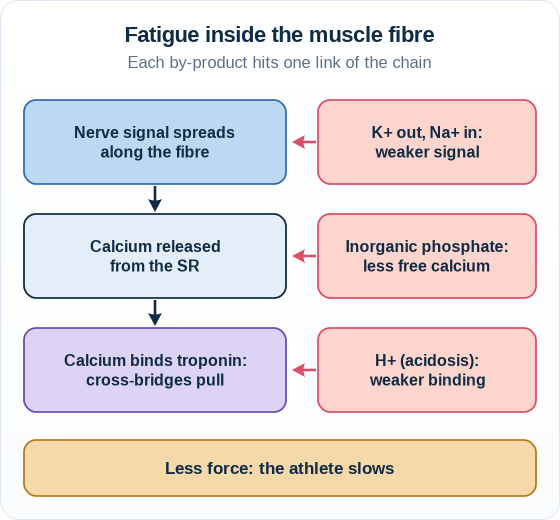
- K+ leaks out and Na+ builds up: the nerve signal weakens.
- Hydrogen ions (acidosis) and inorganic phosphate impair calcium handling and cross-bridges.
- Dehydration lowers stroke volume; hyperthermia sends blood to the skin.
3. Signs and nutrition
- Signs: physiological (lactate down, resting HR normal), symptomatic (less soreness), psychological.
- Replace fluid (about 1.25-1.5 × mass lost), refill glycogen early, protein for repair.
- Creatine and polyphenols can help, each with limits.
4. Techniques and sleep
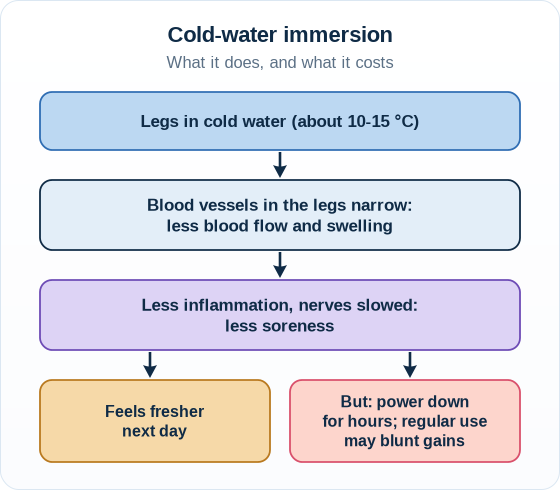
- Cold-water immersion: less soreness and swelling, but may blunt adaptation.
- Myofascial release and compression: short-term relief, mixed evidence.
- Sleep quality and amount drive recovery; training load and travel disturb it.
The contraction chain, and where each by-product of fatigue acts.
Cold-water immersion, from narrowed vessels to less soreness.
Key terms, one line each:
| Term | In one line |
|---|---|
| Fatigue | a fall in force or power despite effort |
| Acidosis | a build-up of hydrogen ions in muscle |
| Inorganic phosphate | by-product of PC breakdown that weakens contraction |
| Hyperthermia | core temperature too high |
| Cold-water immersion | sitting in cold water after exercise |
| Polyphenols | plant compounds that reduce oxidative stress |
IB-style questionEvaluate[4 marks]
A study with one basketball player found less soreness after cold-water immersion. Evaluate the conclusion that the method works.
Model answer plan
See the mark-by-mark plan — for / against / judgement, with marking guidance — in study mode.
Exam tips
- In fatigue answers write hydrogen ions, not lactic acid, for acidosis.
- Name the cause, the step of contraction it disrupts, then the effect on force.
- Give signs of recovery with their direction: reduced, back to normal, improved.
- For a one-participant study: small sample, risk of bias, no statistics.
- Overlapping SD bars: the difference may not be significant; a test such as a t-test is needed to be sure.
- Evaluate = strengths and limitations, then a judgement.