aımnova
DashboardMy LearningCrash CoursesStudy Plan

Aimnova site navigation

Stay in the loop

Get the latest study resources and updates

New features, study tips and exam insights — straight to your inbox.

IB Diploma

  • IB Past Papers
  • IB Study Notes
  • IB Question Bank
  • IB Mock Exams
  • IB Revision

IB Subjects

  • IB Math AA
  • IB Math AI
  • IB Economics
  • IB Business Management
  • IB Physics
  • IB Biology
  • View all IB subjects→

IB Past Papers

  • IB Math AA HL Past Papers
  • IB Math AA SL Past Papers
  • IB Math AI HL Past Papers
  • IB Math AI SL Past Papers
  • IB Economics HL Past Papers
  • IB Economics SL Past Papers
  • IB ESS Past Papers
  • View all past papers→

Study Resources

  • Study Notes
  • Question Bank
  • Mock Exams
  • Crash Courses
  • Flashcards
  • Revision Guide
  • Exam Skills
  • Command Terms
  • Grade Calculator
  • Exam Timetable 2027

Aimnova

  • Features
  • Pricing
  • For Teachers
  • For Schools
  • For Parents
  • About Us
  • Blog
  • Contact
aımnova

IB study, practice and feedback built around the real exam.

TermsPrivacyCookies·© 2026 Aimnova. All rights reserved.d9e1c61

Aimnova is not affiliated with or endorsed by the International Baccalaureate Organization (IB).

NotesSports, Exercise and Health Science HLTopic 1.3
Unit 1 · Communication · Topic 1.3

IB Sports, Exercise and Health Science HL — Transport

Transport

Higher Level students should use this topic hub as a map: start with the shared sub-topics, then follow the HL-only extensions and exam-skill links where this topic asks for deeper analysis.

Exam technique guidePractice questions

Key concepts in Transport

Start here: Most questions on this topic are about cardiac output and blood flow, then breathing in and out. Write the formula with units before any numbers, and name the exact muscle or vessel.

1. Heart and vessels

  • Two pumps in one: atria receive blood, ventricles push it out.
  • Arteries carry blood away from the heart, veins back; capillaries are one cell thick.
  • Pulmonary loop to the lungs; systemic loop to the body.
  • Blood carries nutrients, hormones, gases, heat and waste.

2. Cardiac output

  • Q = HR × SV: beats per minute times mL per beat, in L min⁻¹.
  • Trained athletes: same resting Q, bigger SV, lower resting heart rate.
  • In exercise a bigger share of Q goes to muscle and skin, less to the gut and kidneys.
  • Blood pressure is two numbers: systolic over diastolic.

3. Breathing

  • Air route: trachea, bronchi, bronchioles, alveoli; gases swap by diffusion.
  • In: diaphragm and external intercostals contract, volume up, pressure down.
  • Exercise: accessory muscles (scalenes, sternocleidomastoid) join; out is forced by internal intercostals and abdominals.
  • Minute ventilation = tidal volume × rate; tidal volume rises first, rate near maximum.

The double circuit and what the blood carries.
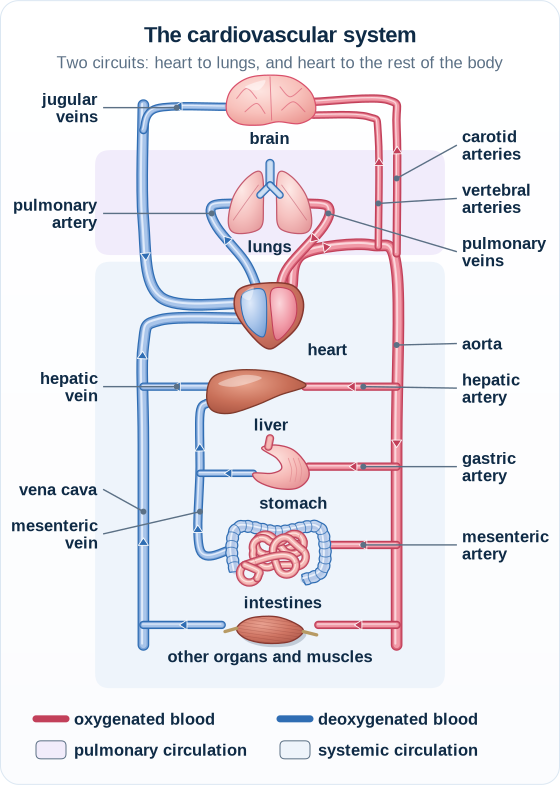
Map of the circulation: the heart in the middle, the pulmonary circuit up to the lungs, the systemic circuit to the brain, liver, stomach, intestines, other organs and muscles and back, with every named vessel labelled and oxygenated blood red, deoxygenated blood blue
The circulation as a map: both loops and every vessel the data booklet names.

Breathing in at rest and in exercise.
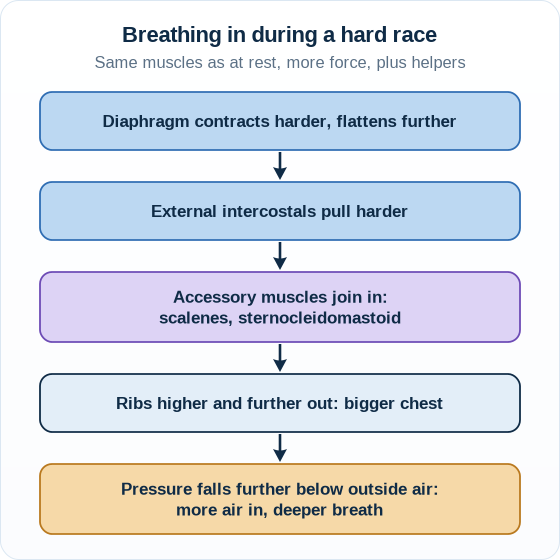
Chain from stronger diaphragm and intercostal contraction and accessory muscles to a bigger chest and deeper breath
Recap: breathing in during a hard race.

Inside My Learning

Turn these notes into practice

Try each question, reveal a clear model answer, and learn how to build your response.

  • 1.Calculate cardiac output for a heart rate of 160 bpm and a stroke volume of 120 mL. [2]
  • 2.Compare inspiration at rest with inspiration during exercise. [3]
  • 3.Explain why blood flow to the gut falls during a hard run. [2]
Claim your free topic

Key terms, one line each:

TermIn one line
Cardiac output (Q)volume of blood pumped per minute, HR × SV
Stroke volumeblood pumped by one ventricle per beat
Systolic pressurethe peak pressure as the ventricles contract
Tidal volumeair moved in or out with each breath
Vital capacitythe most air breathed out after the deepest breath in
Minute ventilationtidal volume × breathing rate, L min⁻¹

Inside My Learning

Turn these notes into practice

Try each question, reveal a clear model answer, and learn how to build your response.

  • 1.Which vessels carry blood away from the heart?
  • 2.Which muscles force air out in hard exercise?
  • 3.Tidal volume 2.5 L, rate 40 breaths min⁻¹: minute ventilation?
Claim your free topic
IB-style questionExplain[3 marks]

After a season of endurance training a rower's resting heart rate has fallen. Explain why his resting cardiac output is unchanged.

Model answer plan

See the mark-by-mark plan — for / against / judgement, with marking guidance — in study mode.

Claim your free topic →

Exam tips

  • Write the formula before the numbers, and divide mL by 1000 for L min⁻¹.
  • Define arteries and veins by direction, never by oxygen.
  • For breathing in, give the chain: muscles contract, volume up, pressure down, air in.
  • Name the exact muscle: external intercostals in, internal intercostals and abdominals out.
  • For redistribution, separate the share of cardiac output from the amount.

What you'll learn in Topic 1.3

  • 1.3.1 The cardiovascular system
  • 1.3.2 Cardiac output and blood flow
  • 1.3.3 The respiratory system
  • 1.3.4 Lung volumes in exercise
Suggested study order: Read the notes for each sub-topic below → test yourself with flashcards → attempt practice questions → review exam technique.

Study resources — 1.3 Transport

1.3.1

The cardiovascular system

Notes
1.3.2

Cardiac output and blood flow

Notes
1.3.3

The respiratory system

Notes
1.3.4

Lung volumes in exercise

Notes

Ready to study Transport?

Get expert practice questions with instant AI feedback, and a study planner tailored to your IB Sports, Exercise and Health Science HL exam date.

Start studying free

Topic 1.3 Transport forms a core part of Unit 1: Communication in IB Sports, Exercise and Health Science HL. Mastering these concepts will strengthen your understanding of connected topics across the syllabus and prepare you for exam questions that require analysis, evaluation, and real-world application.

Previous topic
1.2 Maintaining homeostasis
Next topic
2.1 Water and electrolyte balance
All Sports, Exercise and Health Science HL topics
Exam technique

Ready to practice?

Get AI-graded practice questions, mock exams, flashcards, and a personalised study plan — all aligned to your IB syllabus.

Start Studying Free

No credit card required · No time limit