Studying this at HL: At HL this network is the route for every environment response: blood sent to the skin in the heat, more red cells after altitude, plasma lost in sweat. Learn the route of the blood exactly here, because those answers all run along it.
The big idea: Every cell in your body is stuck where it is. It cannot go and fetch what it needs.
The delivery network: So the body runs a delivery network that reaches every cell instead. That network is the cardiovascular system — heart plus blood vessels plus blood.
Our example: Hana plays four quarters of basketball on a warm evening.
Everything in this micro is that one match, seen from the inside.
The pump
- The heart
- Pushes the blood, and keeps it moving one way
- Never stops for the whole match
The pipes
- Arteries, capillaries and veins
- Carry the blood out, do the swapping, bring it back
- Reach every muscle Hana uses
The load
- The blood itself
- A liquid with cells floating in it
- This is what actually carries the cargo
One network, but five different cargoes are moving in it at the same time: nutrients, hormones, gases, heat and waste.
Learn those five as a set.
Free preview
This is the free notes preview
You're reading the free notes. Aimnova Pro unlocks the full study experience — and you can try it with your first topic free to keep:
- FlashcardsLock in vocabulary and key terms with spaced repetition.
- Practice questionsAnswer exam-style questions and get instant AI marking.
- Mock exams & past-paper vaultSit full mocks and see exactly how examiners award marks.
- Personalised study planA daily plan built around your exam date and weak areas.
The heart looks like one organ. It works as two pumps side by side, and they never mix.
Two pumps, four chambers: The right pump sends blood to the lungs. The left pump sends it to the rest of the body. Each pump has two rooms, so the heart has four chambers in total.
Right side of the heart
- Takes in blood coming back from the body
- That blood is low in oxygen
- Sends it the short way — to the lungs
- Thinner wall, because the lungs are close
Left side of the heart
- Takes in blood coming back from the lungs
- That blood is oxygen-rich
- Sends it the long way — to the whole body
- Thickest wall in the heart, because it pushes furthest
Atrium in, ventricle out: Each side has a receiving room and a pumping room.
An atrium is the top room — blood arrives there. A ventricle is the bottom room — it pumps blood out. Two atria, two ventricles, four chambers.
Why blood cannot go backwards: Between the rooms, and at the exits, sit valves. They open one way only.
So when Hana's ventricles squeeze, nothing is pushed back the way it came. The blood has one route, and it is a loop.
There are three kinds of blood vessel, and the easiest way to keep them straight is by what they do, not what they look like.
Arteries
- Carry blood away from the heart
- Thick, stretchy, muscular walls
- Split into smaller and smaller branches
- Hana's aorta, leaving her left ventricle
Capillaries
- Where the swapping happens
- Walls only one cell thick
- So narrow that cells pass almost in single file
- Threaded through Hana's calf muscle
Veins
- Bring blood back to the heart
- Thinner walls, wider space inside
- Have valves, so blood cannot slide backwards
- Hana's vena cava, arriving at her right atrium
The one rule that never breaks: Arteries carry blood away. Veins bring it back.
That is about direction, not about oxygen. Get that straight now and the next section is easy.
Nothing is delivered in the big pipes: The aorta is a motorway. No cargo is dropped off there.
Everything Hana's muscles need crosses in the capillaries, because that is the only wall thin enough to pass through.
Stop wasting time on topics you know
Our AI identifies your weak areas and focuses your study time where it matters. No more overstudying easy topics.
Blood does not go round the body once and come back finished. It goes round twice, through two separate loops, and the heart sits in the middle of both.
This is called a double circulation.
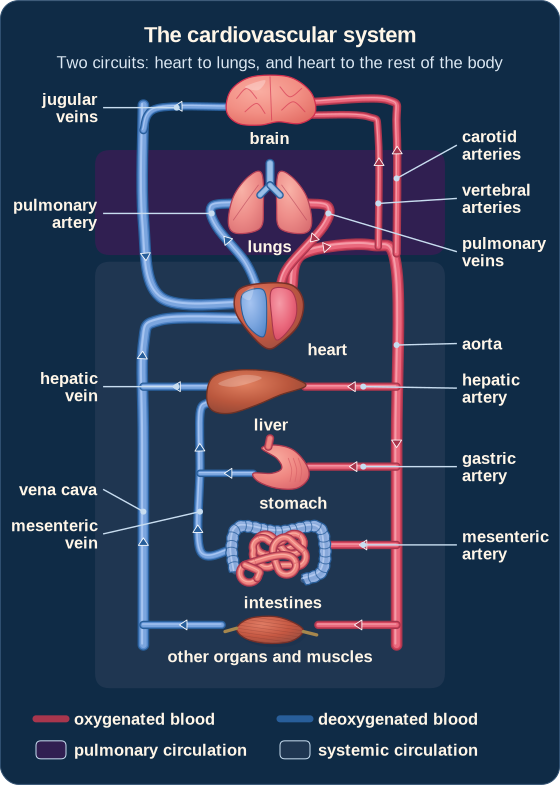
In the map below, red is oxygen-rich blood and blue is oxygen-poor. Watch the lungs: the pulmonary artery is the one artery that carries oxygen-poor blood, and the pulmonary veins are the only veins that carry oxygen-rich blood.
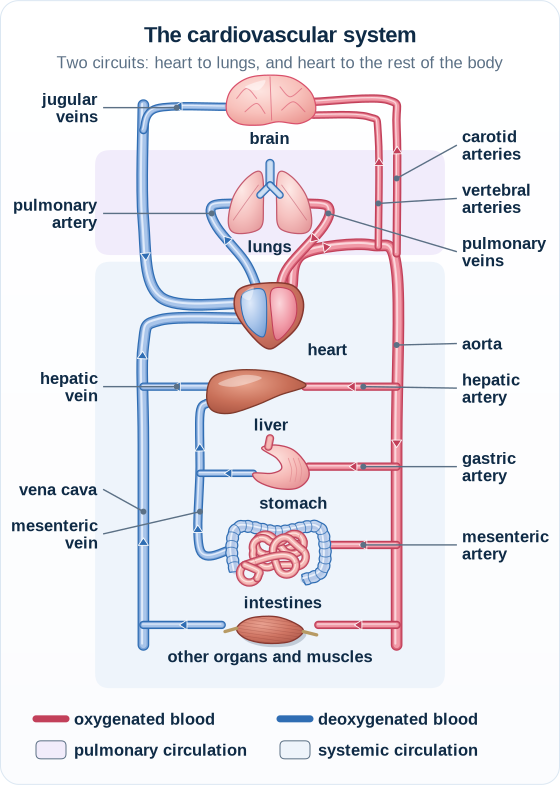
Pulmonary circuit
- Heart to lungs to heart
- Pulmonary just means "to do with the lungs"
- Right ventricle out, left atrium back in
- The short trip — it only has to reach the chest
Systemic circuit
- Heart to the rest of the body to heart
- Systemic means "to the body's systems"
- Left ventricle out, right atrium back in
- The long trip — brain, gut, skin, and Hana's legs
The classic trap: The pulmonary artery carries blood that is low in oxygen. The pulmonary vein carries blood that is oxygen-rich.
That is not a mistake. Arteries are named for going away from the heart. Everywhere else the oxygen pattern happens to match; here it does not.
While Hana is playing: Her heart pushes more blood round the same loop, and it sends a bigger share of it to her legs.
How much more, and what changes it, is the whole of the next micro. Here, just hold on to the shape of the loop.
Blood is mostly liquid with cells floating in it, and different parts of it carry different things.
That is why one network can run five cargoes at once.
Plasma
- The straw-coloured liquid, mostly water
- Dissolved nutrients, hormones and waste ride in it
- Warm water also carries heat very well
Red blood cells
- Packed with haemoglobin, which grabs oxygen
- This is how most oxygen travels
- There are more of them than any other cell
White cells and platelets
- White cells deal with infection
- Platelets clot a cut so blood is not lost
- Not transport, but they ride the same network
One line worth memorising: The cardiovascular system transports nutrients, hormones, gases, heat and waste.
Five words, in that order. A question that says state three substances transported by the blood is three free marks if you know the set.
See how examiners mark answers
Answer exam-style questions with model answers. Learn exactly what earns marks and what doesn't.
How this is tested — you trace the route of blood or name what the cardiovascular system carries. It comes up two ways:
Paper 1 — recall and data
- Paper 1A asks which vessel or chamber carries oxygen-rich blood
- Or what the blood transports
Paper 2 — explain and evaluate
- Paper 2 asks you to describe the route of oxygen to a working muscle
- Marks for each stage in the right order
Arteries and oxygen: Arteries carry blood away from the heart, not always oxygen-rich blood. The pulmonary artery carries blood low in oxygen.
Describe the route oxygen takes from the lungs to the leg muscles of a basketball player.
Model answer plan
See the answer broken into clear points, with guidance on how each point earns marks.
Exam tips
- Arteries: away from the heart. Veins: back to it. Capillaries: where exchange happens.
- The pulmonary vein carries oxygen-rich blood; the pulmonary artery carries blood low in oxygen.
- Five things transported: nutrients, hormones, gases, heat, waste.
- Name the left ventricle for blood leaving to the body, the right ventricle for blood to the lungs.