Given the weather: read the right branch
Question: the bus on a rainy day: There is a 30% chance of rain.
On rainy days, the bus has a 25% chance of being late.
Today, you know it is raining. What is the probability that the bus will be late?
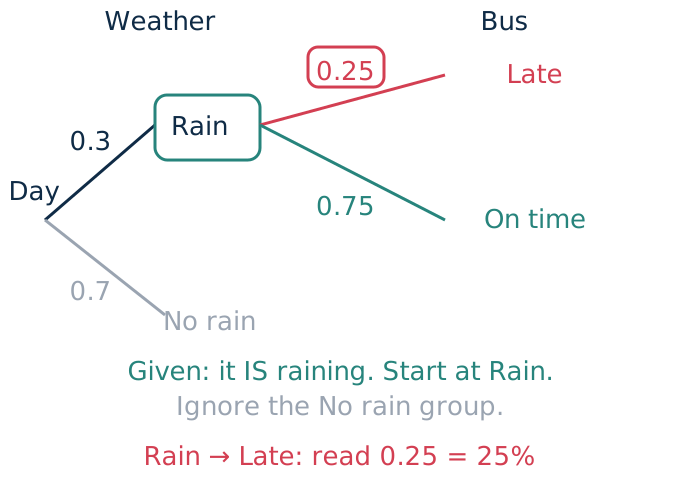
Answer: 25%: We look only at rainy days. The question tells us that the bus is late on 25% of those days.
So P(late | rain) = 0.25. The symbol | means “given that”.
Free preview
This is the free notes preview
You're reading the free notes. Aimnova Pro unlocks the full study experience — and you can try it with your first topic free to keep:
- FlashcardsLock in vocabulary and key terms with spaced repetition.
- Practice questionsAnswer exam-style questions and get instant AI marking.
- Mock exams & past-paper vaultSit full mocks and see exactly how examiners award marks.
- Personalised study planA daily plan built around your exam date and weak areas.
Start Studying Free Full access to Aimnova Pro · cancel anytime
We know she won. Did she roll a 6?
The game: roll first, then spin: Mia rolls a fair six-sided die.
• If she rolls a 6, she uses spinner X. It has a 1/2 chance of winning.
• If she rolls 1, 2, 3, 4 or 5, she uses spinner Y. It has a 1/5 chance of winning.
Question: Mia has won: You know Mia won, but you did not see her die roll.
What is the probability that she rolled a 6?
Look only at the winning games. What fraction of those started with a 6?
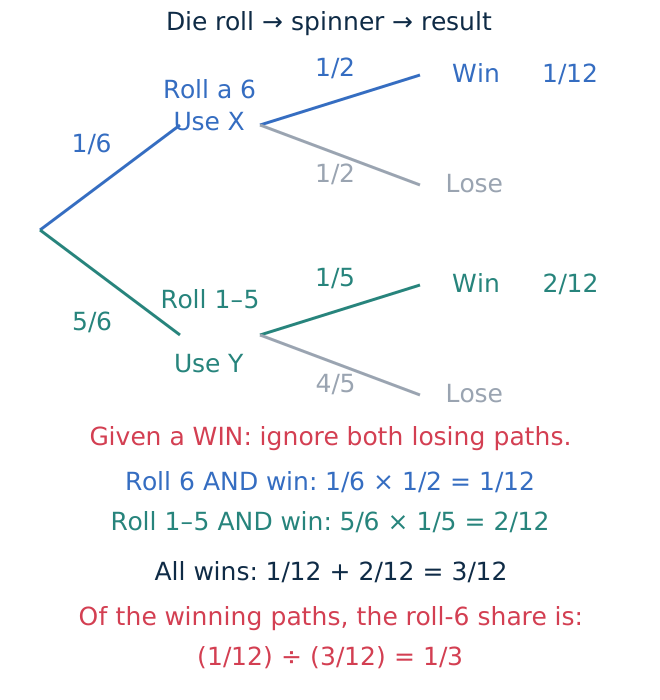
Answer: 1/3, about 33.3%: Win after a 6: 1/6 × 1/2 = 1/12.
All wins: 1/12 + 2/12 = 3/12.
So P(rolled a 6 | won) = (1/12) ÷ (3/12) = 1/3.
The | means “given that”. We divide by the chance of all wins, because we already know she won.
Which games do we count?: We already know Mia won, so ignore every game she lost.
She could have won after rolling a 6, or after rolling 1–5. Count both kinds of win in the total.
Answer = chance of “roll a 6 AND win” ÷ chance of any win.
Here that is (1/12) ÷ (3/12) = 1/3. So one third of the winning games started with a 6.
Practice with exam-style questions
Answer exam-style questions and get AI feedback that shows you exactly what examiners want to see in a full-marks response.
Try Practice FreeYour first topic is free to keep • No credit card required
Conditional probability from a table
Question: under-18 phone users: A phone shop surveys 200 customers, as shown in the table.
A customer is chosen at random. You are told they are under 18.
What is the probability that they use an iPhone?
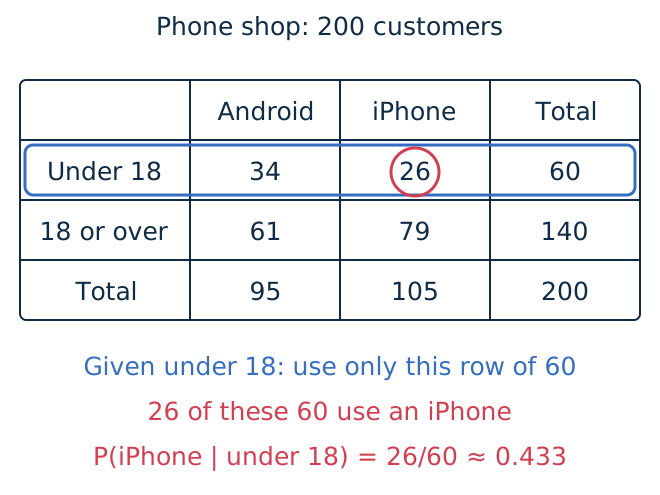
Answer: 26/60 ≈ 0.433: Look only at the under-18 row: 60 customers, including 26 iPhone users.
So the probability is 26 ÷ 60 ≈ 0.433, or 43.3%.
Music and Drama: how many do both?
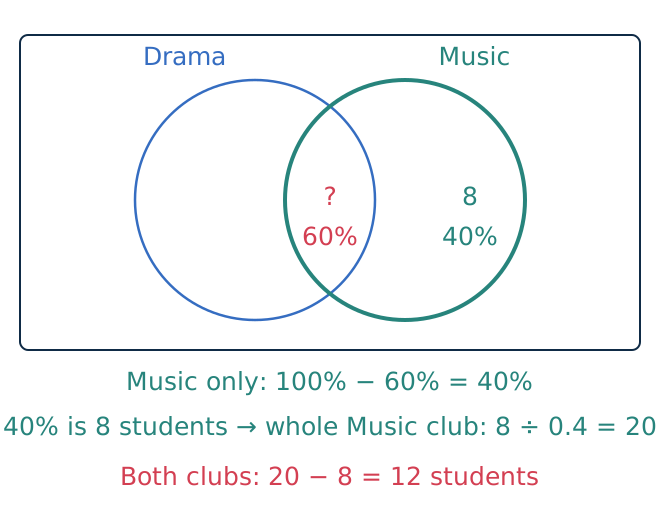
Question: 8 students are in the Music club only.
60% of the Music club also do Drama.
How many students do both Music and Drama?
Answer: 12 students
How many do both?
Step by step
- If 60% do both, the remaining 40% do Music only. These are the 8 students.
- Find the whole Music group: 40% = 0.4.
- Remove the 8 Music-only students.
Final answer
12 students do both Music and Drama.
Feeling unprepared for exams?
Get a clear study plan, practice with real questions, and know exactly where you stand before exam day. No more guessing.
Get Exam Ready FreeYour first topic is free to keep • No credit card required
The alarm rings — is there really smoke?
Picture a smoke alarm: A smoke alarm is meant to ring when there is smoke.
Sometimes it rings even though there is no smoke. That is a false alarm.
Information: 100 practice checks: A school carries out 100 practice checks on an alarm.
20 checks have smoke: the alarm rings in 18 of them.
80 checks have no smoke: the alarm still rings in 8 of them.
Question: One check is chosen at random.
You are told the alarm rang.
What is the probability that there was smoke?
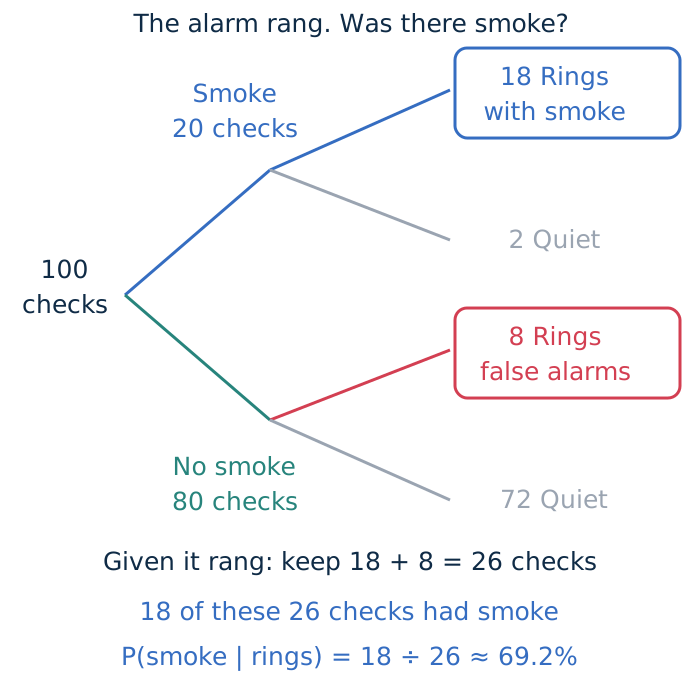
| What was really there? | Alarm rings | Alarm stays quiet | Total |
|---|---|---|---|
| Smoke | 18 | 2 | 20 |
| No smoke | 8 | 72 | 80 |
| Total | 26 | 74 | 100 |
The exam words, using this alarm: Positive means the alarm rings. Negative means it stays quiet.
False positive: it rings with no smoke — the 8 false alarms.
False negative: it stays quiet with smoke present — the 2 missed warnings.
Incorrect results: both mistakes together, so 8 + 2 = 10 out of 100, or 10%.
If the question asks for an expected number
The chance of an incorrect result is 10%. Find the expected number of incorrect results in 1000 similar checks.
Solution
- Multiply the number of checks by the probability of a mistake.
Final answer
100 incorrect results are expected.