What 'die wissenschaftliche Innovation' covers: Scientific innovation (die wissenschaftliche Innovation) is part of the theme Human ingenuity. Learn the words below as a deck, then use them in the reading and writing sections.
You need words to talk about
- inventions and technology
- research and artificial intelligence
- how science changes our lives
- your opinion about them
- die wissenschaftliche Innovation
- scientific innovation
- die Erfindung / erfinden
- invention / to invent
- der (technologische) Fortschritt
- (technological) advance / progress
- die Entdeckung / entdecken
- discovery / to discover
- die künstliche Intelligenz (KI)
- artificial intelligence (AI)
- die Forschung / forschen
- research / to research
- der Wissenschaftler / die Wissenschaftlerin
- scientist
- das Labor
- laboratory
- das Leben verbessern
- to improve life
- ein Problem lösen
- to solve a problem
- nachhaltig
- sustainable
- das Risiko / riskant
- risk / risky
- die Ethik
- ethics
| Useful expression (German) | English |
|---|---|
| Die künstliche Intelligenz verändert die Welt. | Artificial intelligence is changing the world. |
| Diese Erfindung kann echte Probleme lösen. | This invention can solve real problems. |
| Die wissenschaftliche Forschung rettet Leben. | Scientific research saves lives. |
| Man muss die Technik verantwortungsvoll nutzen. | We have to use technology responsibly. |
| Mich interessieren Fortschritte, die nachhaltig sind. | I'm interested in advances that are sustainable. |
Why this matters: This vocabulary turns up in every skill — a reading text about a new invention, a listening interview with a scientist, a Paper 1 article about technology, or your oral. Reusing the right topic words is how you score Criterion A (Language).
Free preview
Reading it is one thing — hearing it is another
You're reading the free notes. Aimnova Pro unlocks the full study experience — and you can try it with your first topic free to keep:
- Audio on every wordTap any vocabulary word or example to hear it read aloud in natural German.
- FlashcardsLock in vocabulary and key terms with spaced repetition.
- Practice questionsAnswer exam-style questions and get instant AI marking.
- Mock exams & past-paper vaultSit full mocks and see exactly how examiners award marks.
- Personalised study planA daily plan built around your exam date and weak areas.
Have something to say: Examiners reward developed ideas, not just vocabulary. Around scientific innovation, the common debates are: progress vs the risks of new technology, artificial intelligence replacing jobs, and the ethics of research. Take a position and back it up.
Opinion phrases (use these to introduce a view)
- Meiner Meinung nach… / Aus meiner Sicht… — In my opinion… / From my point of view…
- Mir scheint, dass… / Ich glaube, dass… — It seems to me that… / I think that…
- Das Wichtigste ist… — The most important thing is…
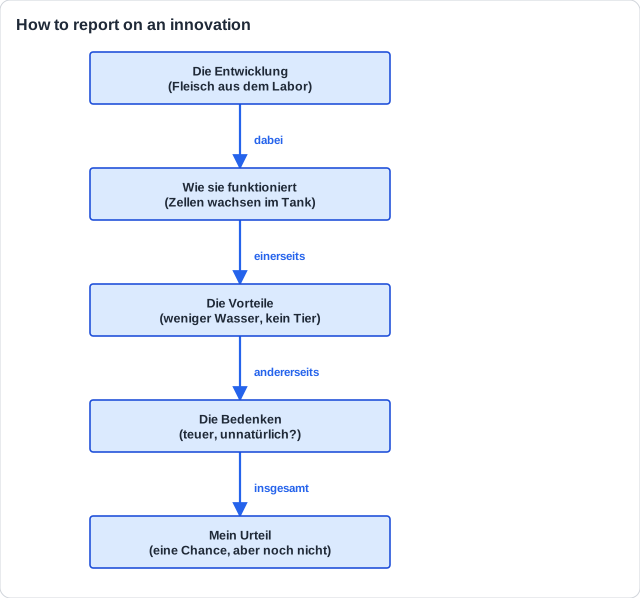
- Einerseits… andererseits… — On the one hand… on the other hand…
- Ich bin (völlig) einverstanden mit… — I (completely) agree with…
Risiken des Fortschritts (drawbacks)
- Manche Erfindungen können Arbeitsplätze vernichten.
- Die künstliche Intelligenz wirft Probleme der Ethik und des Datenschutzes auf.
- Nicht jede Innovation erreicht alle Menschen gleichermaßen.
Vorteile der Wissenschaft (benefits)
- Die medizinische Forschung rettet viele Leben.
- Die Technik kann der Umwelt helfen.
- Fortschritte lösen echte Probleme und verbessern das Leben.
Robots and space
- Forschungsroboter aus der Schweiz
- ein Astronaut bloggt von der Raumstation
- Wann kommen Roboter in unseren Alltag?
Food of the future
- Burger aus Mehlwürmern in der Mensa
- Fleisch aus dem Labor
- wie die Technik unsere Ernährung verändert
Inventors and ideas
- die Erfinder der Schweizer Schokolade
- eine Erfindung, die den Alltag verändert
- nachhaltig forschen, nachhaltig essen
Big questions behind this topic (IB guide, theme Human ingenuity)
- Wie beeinflussen Entwicklungen in Wissenschaft und Technik unser Leben?
- Sollte die Wissenschaft Grenzen haben?
- Würdest du Insekten oder Laborfleisch essen?
Link your ideas: Connectors lift your answer from a list into an argument: außerdem (besides), jedoch / aber (however), deshalb (therefore), obwohl (although). Use at least two or three in any written answer.
Stop wasting time on topics you know
Our AI identifies your weak areas and focuses your study time where it matters. No more overstudying easy topics.
Read like Paper 2: Here is a short blog — the kind of text Paper 2 (Reading) gives you. Then we'll do one exam question together.
How to read it
- Read it once just for the general idea; don't worry about every word.
- Tap the audio button to hear it.
- Tap Übersetzung anzeigen if you get stuck.
Eine Erfindung für Opa (1 von 3): Mein Großvater vergisst oft, seine Tabletten zu nehmen. Deshalb hatten meine Freundin Elif und ich letzten Herbst eine Idee für den Wettbewerb „Jugend forscht“: eine intelligente Pillendose.
Monatelang forschten wir nach dem Unterricht im Schullabor.
Eine Erfindung für Opa (2 von 3)
Die Dose piept, wenn es Zeit für die Medizin ist, und schickt eine Nachricht an die Familie, wenn sie nicht geöffnet wird. Am Anfang funktionierte fast nichts, und einmal wollten wir sogar aufgeben. Doch unsere Physiklehrerin ermutigte uns, aus jedem Fehler zu lernen.
Eine Erfindung für Opa (3 von 3)
Im Frühling gewannen wir den zweiten Platz in unserem Bundesland. Das Schönste ist aber, dass Opa seine Tabletten jetzt nie mehr vergisst. Ich habe gelernt, dass eine Erfindung nicht kompliziert sein muss, um ein echtes Problem zu lösen.
- die Tablette / die Medizin
- tablet / medicine
- der Wettbewerb
- the competition
- piepen
- to beep
- aufgeben
- to give up
- ermutigen
- to encourage
IB-style task — eine Frage aus Paper 2
Eine Frage, Schritt für Schritt
- The question — „Was macht die Pillendose dem Text zufolge, wenn sie nicht geöffnet wird?“
- Find it in the text. Look for „Die Dose piept“: „Die Dose piept, wenn es Zeit für die Medizin ist, und schickt eine Nachricht an die Familie, wenn sie nicht geöffnet wird.“
- The answer — Sie schickt eine Nachricht an die Familie.
Reading technique: For a „dem Text zufolge“ (according to the text) question, find the exact line that proves your answer — don't rely on memory or general knowledge.
Die Aufgabe — your task: Deine Klasse hat während der Wissenschaftswoche ein Forschungslabor besucht. Schreibe einen Bericht für die Schulwebsite.
Der Auftrag — what to do
- Beschreibe, was ihr gesehen und gelernt habt.
- Gib Empfehlungen für zukünftige Besuche.
- Schreibe zwischen 250 und 400 Wörtern.
Report structure — 4 steps
Factual title
A factual title with what and when. „Bericht: Besuch im Forschungslabor für erneuerbare Energien, 18. März“
Purpose
Say what the visit was for and who took part. „Ziel des Besuchs war es, … Teilgenommen haben 24 Schülerinnen und Schüler.“
Findings
What you found, with facts and figures, good and bad. „Die neuen Zellen produzieren 30 Prozent mehr Strom… dagegen…“
Recommendations
What should happen next time, then your name. „Wir empfehlen, …“
Title → Purpose → Findings → Recommendations
Modell: die 4 Schritte in ~90 Wörtern
Der fertige Bericht, Schritt für Schritt
- Bericht: Besuch im Forschungslabor für erneuerbare Energien, 18. März
- Ziel des Besuchs war es, der Klasse 10c zu zeigen, wie neue Solarzellen entwickelt werden. Teilgenommen haben 24 Schülerinnen und Schüler.
- Eine Forscherin erklärte, dass die neuen Zellen 30 Prozent mehr Strom produzieren. Danach durften wir selbst ein kleines Experiment durchführen. Die meisten fanden diesen Teil am spannendsten; die Vorträge waren dagegen oft zu technisch.
- Wir empfehlen, den Besuch jedes Jahr zu wiederholen, die Vorträge kürzer zu gestalten und mehr Zeit für Experimente einzuplanen. – Elif Demir, Klasse 10c
Warum es funktioniert — what makes it strong: A strong report does these things for each of the three Paper 1 criteria:
A — Language /12
- Passive: „entwickelt werden“
- Connectors: „danach“, „dagegen“
- Science vocabulary: „die Forscherin“, „das Experiment“, „die Solarzelle“
B — Message /12
- Task fully done: describes the visit AND recommends changes
- Findings backed with figures (24 students, 30 per cent)
C — Conceptual /6
- Report conventions: a factual title with the date
- Purpose, then findings, then recommendations
- Neutral tone: „wir“ for the class, no chatty greeting
See how examiners mark answers
Answer exam-style questions with model answers. Learn exactly what earns marks and what doesn't.
Hörverstehen — die Erfinderin Nora
Paper 2 tests listening (25 marks): you hear short clips, each played twice, and you never see the words. Read the questions first, then listen and reveal the answers.
Du hörst Nora, eine junge Designerin, ihre Erfindung beschreiben.
- Aus welchem Rohstoff stellte Nora ihr nachhaltiges Material her? (What raw material did Nora make her sustainable material from?)
- Was ist für Nora das Wichtigste an der Innovation? (What matters most to her about innovation?)
Hallo, ich heiße Nora und ich bin Designerin. Vor ein paar Jahren habe ich ein nachhaltiges Material erfunden, das aus Ananasblättern hergestellt wird, die auf dem Feld übrig bleiben. Früher wurden diese Blätter in den Müll geworfen, aber jetzt werden sie zu einer Art pflanzlichem Leder. Ich habe viel im Labor geforscht und am Anfang bin ich oft gescheitert. Für mich ist das Wichtigste an der Innovation, ein echtes Problem zu lösen und die Umwelt zu schützen.
Hi, I'm Nora and I'm a designer. A few years ago I invented a sustainable material made from pineapple leaves left over in the fields. Before, those leaves were thrown into the rubbish, but now they're turned into a kind of plant-based leather. I did a lot of research in the lab and at first I failed often. For me, the most important thing about innovation is solving a real problem and protecting the environment.
- Aus Ananasblättern, die auf dem Feld übrig bleiben.
- Ein echtes Problem zu lösen und die Umwelt zu schützen.
Listening technique: Read the question first, then listen for that one detail — you don't need to catch every word. In the real exam you hear each clip twice.