L'article — the magazine article: An article (un article) is written for a magazine, newspaper or website. It informs the general reader about a topic.
Key features
- It keeps the reader reading by being lively and engaging.
- It is part of Unit 2, Text Types (les types de textes).
- Unlike a letter or an email, it is not written to one named person: it speaks to a wide audience.
An article IS…
- un texte pour un magazine, un journal ou un site
- informatif mais vivant et agréable à lire
- écrit à la 3e personne pour le grand public
- coiffé d'un titre accrocheur (et parfois d'un chapeau)
An article is NOT…
- une lettre ou un courriel à une personne
- un salut **Salut !** ni une signature **Cordialement**
- une liste d'instructions à l'impératif
- un journal intime, écrit pour soi
Real tasks where it was an option
- After a report on repeating a year: your view (Nov 2020)
- Graffiti in your town judged negatively (May 2023)
- An AI documentary: its arguments and your view (Nov 2025)
- Is the driving licence a rite of passage? (May 2026)
Conventions the examiner checks
- Titre + chapeau + nom de l'auteur
- Paragraphs with examples and quotations
- Une phrase finale qui fait réfléchir
Traps that cost Criterion C
- No headline
- Writing to one person (a letter)
- Facts with no angle
Spot it in Paper 1: If the task says Écris un article pour le magazine / le site de ton lycée, the examiner is testing Criterion C (conceptual understanding) — they want the conventions of an article: a headline, an engaging opening, a general-reader tone and a rounded conclusion. No greeting, no sign-off.
Free preview
Reading it is one thing — hearing it is another
You're reading the free notes. Aimnova Pro unlocks the full study experience — and you can try it with your first topic free to keep:
- Audio on every wordTap any vocabulary word or example to hear it read aloud in natural French.
- FlashcardsLock in vocabulary and key terms with spaced repetition.
- Practice questionsAnswer exam-style questions and get instant AI marking.
- Mock exams & past-paper vaultSit full mocks and see exactly how examiners award marks.
- Personalised study planA daily plan built around your exam date and weak areas.
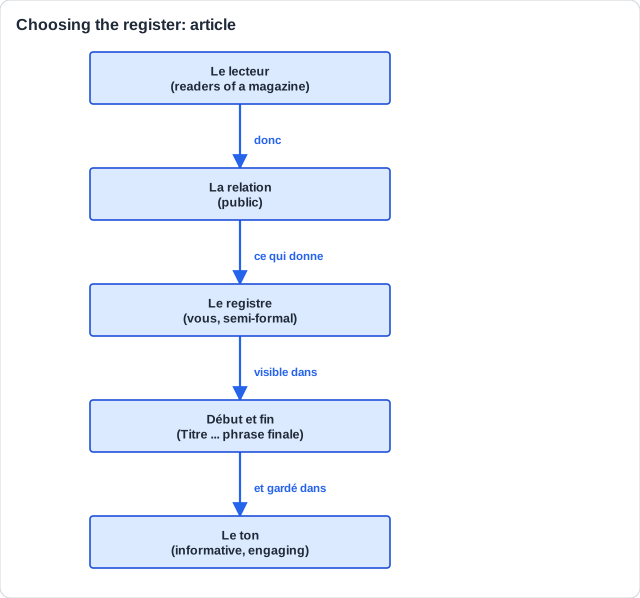
Informative but engaging: The register of an article is semi-formal: clear and informative, yet lively enough to keep a general reader interested.
How to sound like an article
- Write in the third person (les jeunes, on), not cher ami.
- You may quote people (…selon les experts).
- You may ask the reader a question, or open with a surprising fact.
- Never write Salut ! or Cordialement.
| Avoid (wrong register) | Use instead (article register) |
|---|---|
| Salut les amis ! (email greeting) | Les jeunes lisent de nouveau. (a headline) |
| Je t'écris pour te dire… (a letter) | De plus en plus d'adolescents… (3rd person) |
| Cordialement, Léa (sign-off) | En somme, lire rapproche les jeunes. (rounded close) |
| mdr c'est trop bien ! (slang/chat) | C'est un véritable phénomène de société. |
What gives an article its tone
- La 3e personne et on — On parle beaucoup des écrans… (the 3rd person / impersonal 'on')
- Une question au lecteur — Que se cache-t-il derrière ce phénomène ? (a question to the reader)
- Une citation — C'est passionnant, explique un expert. (a quotation)
- Un fait surprenant — Peu de gens savent que… (a surprising fact)
One register, all the way through: Pick the article register at the start and keep it for the whole text. Slipping into Salut ! or tu mid-way (as if writing to a friend) is the most common Criterion C error on an article.
Study smarter, not longer
Most students waste 40% of study time on topics they already know. Our AI tracks your progress and optimizes every minute.
Four moving parts: A good article has a clear shape. Learn these four parts and you'll never forget the headline or the conclusion — exactly what Criterion C rewards.
Article structure — 4 parts
Le titre (headline)
A short, catchy headline that names the topic. Les jeunes redécouvrent la lecture
Le chapeau / l'accroche (hook)
An opening line that hooks the reader: a question or a surprising fact. Que se cache-t-il derrière ce phénomène ?
Le corps (body)
Two or three developed points, each with an example, a statistic or a quotation. Connectors link them: d'une part… d'autre part…
La conclusion (rounded close)
A line that rounds off the topic. En somme, lire est redevenu un plaisir à partager. — no sign-off.
Titre → Chapeau (accroche) → Corps → Conclusion
Plan before you write: Jot the four parts down first (titre / accroche / 2 points / conclusion). Two developed points beat five undeveloped ones — that's how you score Criterion B (message).
See it in action: Here is a short model article. Read it once for the general idea — tap Voir la traduction if you get stuck — then read the callouts that point out each feature.
Les jeunes redécouvrent la lecture (1/2): Les jeunes redécouvrent la lecture. On parle beaucoup des écrans, mais peu de gens savent que les bibliothèques n'ont jamais été aussi fréquentées. Que se cache-t-il derrière ce phénomène ?
Les jeunes redécouvrent la lecture (2/2)
De plus en plus d'adolescents découvrent les livres grâce aux réseaux sociaux, où des milliers d'internautes partagent leurs coups de cœur chaque jour. C'est devenu une façon amusante d'échanger des histoires, explique une lycéenne. En somme, lire n'est plus perçu comme une corvée, mais comme un plaisir à partager.
- Le titre
- Les jeunes redécouvrent la lecture — short, present tense, names the topic and grabs attention.
- L'accroche
- Que se cache-t-il derrière ce phénomène ? — a question pulls the reader in; never a greeting.
- Le corps
- A developed point (social media spreading books) backed by a figure (des milliers d'internautes) — that develops the message.
- La citation
- …explique une lycéenne — a quotation makes an article feel real and lively.
- La conclusion
- En somme, lire n'est plus une corvée… — rounds off the topic; no Cordialement.
IB-style task — name the feature
Une question, étape par étape
- The line — Que se cache-t-il derrière ce phénomène ? Quelle est sa fonction dans l'article ?
- Look at where it sits. It comes right after the headline, before the body — that's the hook (l'accroche / le chapeau).
- The answer — C'est l'accroche : une question qui capte le lecteur et l'invite à lire la suite. Ce n'est ni un salut ni une signature.
Borrow the moves, not the words: Reuse the moves of this model in your own article — a question hook, a quoted voice, a En somme,… close — but with your own topic and wording. That is exactly what the examiner wants to see.
Practice with exam-style questions
Answer exam-style questions and get AI feedback that shows you exactly what examiners want to see in a full-marks response.
A toolkit for each part: Keep a handful of ready-made phrases for each part of an article. Slotting them in saves time in the exam and keeps the register right — straight Criterion A and C marks.
- De nos jours, de plus en plus de…
- Nowadays, more and more…
- Que se cache-t-il derrière… ?
- What lies behind…?
- Peu de gens savent que…
- Few people know that…
- Saviez-vous que… ?
- Did you know that…?
- D'une part… d'autre part…
- On the one hand… on the other hand…
- Il faut souligner que…
- It must be stressed that…
- Par exemple / Selon les experts…
- For example / According to experts…
- …, explique / affirme …
- '…', explains / states … (a quotation)
- En somme, / En définitive,…
- In short, / All in all,…
- Tout porte à croire que…
- Everything suggests that…
- Une chose est sûre :…
- One thing is certain:…
Connectors carry the message: Use at least two or three connectors (d'une part… d'autre part, cependant, par conséquent, en somme). They turn a list of facts into a flowing article — and lift your Criterion A mark.