What 'l'éthique' covers: Ethics (l'éthique) is part of the theme Sharing the Planet. Learn the words below as a deck, then use them in the reading and writing sections.
You need vocabulary to
- talk about right and wrong
- discuss moral dilemmas, honesty and responsibility
- argue both sides of a difficult choice
- l'éthique — la morale
- ethics — morality
- un dilemme (moral)
- a (moral) dilemma
- le bien et le mal
- right and wrong (good and evil)
- faire le bon choix / un choix difficile
- to make the right choice / a difficult choice
- l'honnêteté — (mal)honnête
- honesty — (dis)honest
- le respect (des autres) — respecter
- respect (for others) — to respect
- la responsabilité — assumer ses responsabilités
- responsibility — to take one's responsibilities
- la conscience — avoir la conscience tranquille
- conscience — to have a clear conscience
- mentir — un mensonge
- to lie — a lie
- c'est juste / injuste
- it's fair / unfair
- réfléchir avant d'agir
- to think before acting
- il est mal / interdit de…
- it is wrong / forbidden to…
- les valeurs (morales)
- (moral) values
| Useful expression (French) | English |
|---|---|
| J'ai vécu un vrai dilemme. | I faced a real dilemma. |
| Je savais ce qui était bien et ce qui était mal. | I knew what was right and what was wrong. |
| L'honnêteté compte plus que l'argent. | Honesty matters more than money. |
| Il faut assumer ses responsabilités. | You have to take responsibility. |
| Faire le bon choix, ce n'est pas toujours facile. | Making the right choice isn't always easy. |
Why this matters: This vocabulary turns up in every skill — a reading text on a moral dilemma, a listening interview about honesty, a Paper 1 opinion article, or your oral. Reusing the right topic words is how you score Criterion A (Language).
Free preview
Reading it is one thing — hearing it is another
You're reading the free notes. Aimnova Pro unlocks the full study experience — and you can try it with your first topic free to keep:
- Audio on every wordTap any vocabulary word or example to hear it read aloud in natural French.
- FlashcardsLock in vocabulary and key terms with spaced repetition.
- Practice questionsAnswer exam-style questions and get instant AI marking.
- Mock exams & past-paper vaultSit full mocks and see exactly how examiners award marks.
- Personalised study planA daily plan built around your exam date and weak areas.
Have something to say: Examiners reward developed ideas, not just vocabulary. Take a position and back it up — and remember that ethics questions usually have two sides.
The common debates around ethics
- Is a small lie ever acceptable?
- Does honesty always pay?
- How far are we responsible for others?
Opinion phrases (use these to introduce a view)
- À mon avis… / De mon point de vue… — In my opinion… / From my point of view…
- Il me semble que… / Je pense que… — It seems to me that… / I think that…
- Le plus important, c'est… — The most important thing is…
- D'un côté… de l'autre côté… — On the one hand… on the other hand…
- Je suis (tout à fait) d'accord avec… — I (completely) agree with…
Faire le mauvais choix (drawbacks)
- On ment pour éviter les problèmes.
- On ne pense qu'à son intérêt personnel.
- On perd la confiance des autres.
Faire le bon choix (benefits)
- On reste honnête et on respecte les autres.
- On assume ses responsabilités.
- On garde la conscience tranquille.
What we consume
- la fast fashion, la friperie éthique
- le commerce équitable
- réutiliser plutôt que jeter
Life and science
- le don d'organes
- les animaux dans les cirques
- les « robots tueurs »
Fair play
- le carton blanc du fair-play
- l'honnêteté au quotidien
- aider plutôt que gagner
Big questions behind this topic (IB guide, theme Sharing the planet)
- Quelles questions éthiques pose la vie moderne, et comment les résoudre ?
- Acheter moins cher justifie-t-il de mal payer ceux qui produisent ?
- Une machine peut-elle prendre une décision morale ?
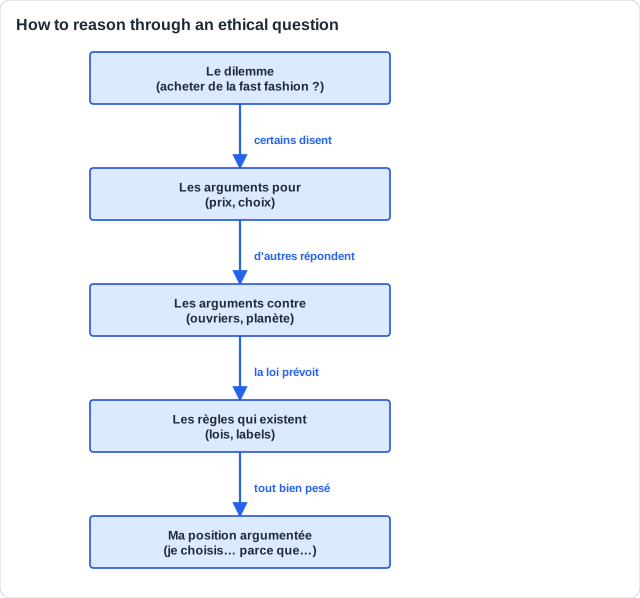
Link your ideas: Connectors lift your answer from a list into an argument: de plus (besides), cependant (however), par conséquent (therefore), bien que (although). Use at least two or three in any written answer.
Learn what examiners really want
See exactly what to write to score full marks. Our AI shows you model answers and the key phrases examiners look for.
Read like Paper 2: Here is a short blog, the kind of text Paper 2 (Reading) gives you. Read it once just for the general idea, then we'll do one exam question together.
How to read it
- Don't worry about every word.
- Tap the audio button to hear it.
- Tap Voir la traduction if you get stuck.
Le portefeuille — un vrai dilemme (1/3): La semaine dernière, j'ai trouvé un portefeuille dans la rue, avec de l'argent et une carte d'identité à l'intérieur.
Au début, j'ai hésité : personne ne m'avait vu, et j'aurais pu garder l'argent. C'était un vrai dilemme.
Le portefeuille — un vrai dilemme (2/3)
Mais au fond de moi, je savais ce qui était bien et ce qui était mal. Mes parents m'ont toujours appris que le respect des autres et l'honnêteté comptent plus que l'argent. Alors j'ai cherché l'adresse sur la carte et j'ai rapporté le portefeuille à son propriétaire.
Le portefeuille — un vrai dilemme (3/3)
Il était très ému. Je n'ai pas reçu de récompense, mais j'ai gardé ma conscience tranquille. Pour moi, faire le bon choix, c'est ça la vraie morale.
- un dilemme
- a dilemma
- ce qui est bien / mal
- what is right / wrong
- l'honnêteté
- honesty
- le respect des autres
- respect for others
- rapporter (un objet à son propriétaire)
- to return (an object to its owner)
- garder la conscience tranquille
- to keep a clear conscience
IB-style task — Vrai ou Faux, et justifie
Une question, étape par étape
- The statement — Le narrateur a gardé l'argent qu'il a trouvé. Vrai ou Faux ?
- Decide, then hunt for proof. Scan for what he did with the wallet: j'ai rapporté le portefeuille à son propriétaire.
- The answer — Faux. Justification : j'ai cherché l'adresse sur la carte et j'ai rapporté le portefeuille à son propriétaire. Copy the exact words that prove it — that quote is what earns the mark, not the word 'Faux' on its own.
Reading technique: For Vrai/Faux + justifiez, a tick alone scores zero — you must quote the exact words from the text that prove it. The same rule applies to selon le texte questions: find the line, don't rely on memory.
La tâche — your task: Dans ton lycée, copier un devoir ou tricher à un contrôle semble devenu banal. Beaucoup d'élèves honnêtes trouvent cela injuste.
Ce que tu écris — what you write: Écris une proposition au conseil de la vie lycéenne : présente une charte de l'honnêteté pour le lycée, explique comment la mettre en place et pourquoi elle est juste.
Écris entre 250 et 400 mots.
Proposition (proposal) structure — 4 steps
Titre + destinataire
A clear title that names the project, then who it is for. Proposition — Une charte de l'honnêteté — À l'attention du conseil de la vie lycéenne
Objectif
State the problem and what you want to achieve. Tricher semble banal… Nous proposons une charte pour…
Plan
List the concrete steps in order. D'abord, écrire la charte avec des élèves et des professeurs ; ensuite… ; enfin…
Justification
Explain why it is fair and worth it, with the conditional, and close politely. Une règle choisie ensemble serait plus respectée… Nous comptons sur votre soutien.
Titre + destinataire → Objectif → Plan → Justification
Modèle : les 4 étapes en ~95 mots
La proposition rédigée, étape par étape
- Proposition — Une charte de l'honnêteté pour notre lycée À l'attention du conseil de la vie lycéenne
- Objectif : Aujourd'hui, copier un devoir ou tricher à un contrôle semble banal pour beaucoup d'élèves. Nous proposons une charte pour rappeler que l'honnêteté est une valeur commune.
- Plan : d'abord, écrire la charte avec des élèves et des professeurs ; ensuite, la faire signer par chaque classe en septembre ; enfin, en discuter une fois par trimestre.
- Justification : Une règle choisie ensemble serait plus respectée qu'une sanction imposée. De plus, elle protégerait les élèves qui travaillent honnêtement. Nous comptons sur votre soutien.
Why it works: A strong proposal does this for each of the three Paper 1 criteria:
A — Language /12
- Range of structures: conditionnel serait, protégerait, faire + infinitif la faire signer
- Connectors: d'abord… ensuite… enfin, de plus
- Topic vocabulary, used accurately
B — Message /12
- Task fully done: presents the charter, HOW to set it up AND why it is fair
- Ideas developed with concrete steps (September signing, once a term)
C — Conceptual /6
- Proposal conventions: a clear title + the addressee (À l'attention de…)
- Headed parts in order: Objectif → Plan → Justification
- Formal register (vous) and the conditional to argue politely
Ready to ace Ethics?
You've seen the preview. Here's what you'll unlock:
Bite-Sized Study Notes
Full syllabus broken into chunks that stick
Exam Practice
See exactly how to score full marks
AI Feedback
Know exactly what examiners want
Smart Study Plan
Know exactly what to study next