Built-up and crowded: An urban area is where land is mostly covered by buildings and many people live in a small space.
The points to remember
- An urban area is a built-up area: land mostly covered by buildings and hard surfaces.
- It has a high population density: many people per square kilometre.
- It has many buildings close together: homes, offices, shops, factories.
- It has infrastructure: roads, railways, water and sewage pipes, power lines.
- Population density = number of people ÷ area (people per km²).
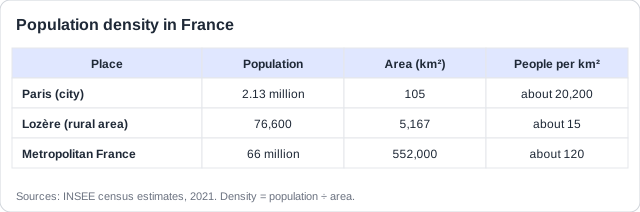
Calculate density: Density = people ÷ area. Paris: 2,133,111 ÷ 105.4 = about 20,200 people per km². Divide people by area, never area by people.
Real example: Paris packs 2.1 million people into 105 km², one of the highest densities in Europe. Almost every street has infrastructure under it: Metro lines, sewers and water mains.
Free preview
This is the free notes preview
You're reading the free notes. Aimnova Pro unlocks the full study experience — and you can try it with your first topic free to keep:
- FlashcardsLock in vocabulary and key terms with spaced repetition.
- Practice questionsAnswer exam-style questions and get instant AI marking.
- Mock exams & past-paper vaultSit full mocks and see exactly how examiners award marks.
- Personalised study planA daily plan built around your exam date and weak areas.
Why do people crowd together? Because being close makes many things easier: getting to work, buying and selling, meeting other people.
Five reasons to live close together
- Residential: homes, close to work and services.
- Productive: factories and offices, so jobs.
- Trade: markets, shops and ports, where goods are bought and sold.
- Cultural: museums, theatres, places of worship.
- Social: meeting friends and family, sport, leisure.
Residential
- Flats and houses for 2.1 million people.
Cultural
- The Louvre, the world's most visited museum.
Productive
- Offices and firms in and around the city.
Trade
- Shops, markets and Rungis, a giant food market.
Social
- Cafes, parks and sports grounds.
Remember it as: Live, make, trade, enjoy, meet.
Know your predicted grade
Take timed mock exams and get detailed feedback on every answer. See exactly where you're losing marks.
A rural area is the opposite of an urban one: few people spread over a large area.
Rural areas
- A rural area has a low population density.
- Its settlements are dispersed: farms, hamlets and villages spread out, with fields between.
- Much of the land is farmland, forest or wild land, not buildings.
- There is less infrastructure: fewer roads, pipes and services.
- Compare the two in one sentence: 'whereas'.
Urban area
- High population density
- Dense, built-up settlement
- Much infrastructure
Rural area
- Low population density
- Dispersed settlements
- Little infrastructure
Real example: Lozère, in the hills of southern France, has about 15 people per km². Its people live on farms and in small villages scattered across the land: dispersed settlement.
Small or large, a town, a city or a suburb counts as urban. But where does 'urban' begin? Each country decides.
Cities, towns, suburbs, and who counts them
- Cities, towns and suburbs are all classed as urban areas.
- A suburb is a lower-density area of homes at the edge of a city.
- Each country sets its own definition of urban: a minimum population, density or type of work.
- So urban figures from different countries are not always comparable.
- If a definition changes, a place can become 'urban' without anyone moving.
Sweden
- Urban: any built-up area
- of at least 200 people
India
- 5,000+ people, 400+ per km²
- and most men in non-farm work
Japan
- Urban: cities ('shi')
- of usually 50,000+ people
Real example: India counts a place as a town only if it has at least 5,000 people, at least 400 people per km², and three-quarters of its working men outside farming. So a large village of farmers stays 'rural', even if it is crowded.
Get feedback like a real examiner
Submit your answers and get instant feedback — what you did well, what's missing, and exactly what to write to score full marks.
How this comes up: Paper 2, Section A: a data table on two places, then outline two differences [2].
Figure 1 shows the population and area of Paris and of Lozère, a département in southern France.
With reference to Figure 1, outline two reasons why Paris is an urban area and Lozère is a rural area.
Model answer plan
See the mark-by-mark plan — for / against / judgement, with marking guidance — in study mode.