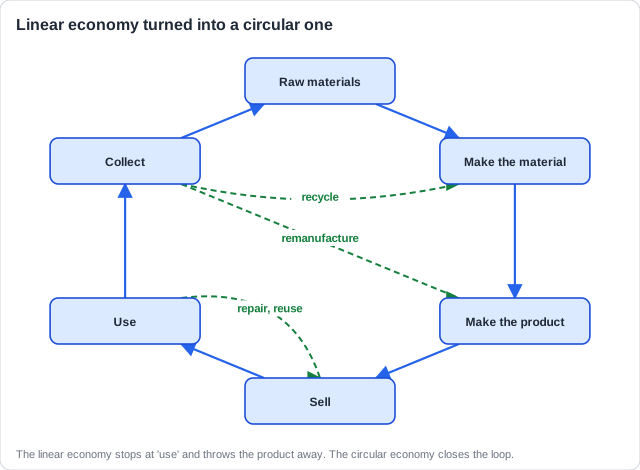
Close the loop: In a circular economy, nothing is simply thrown away: what one stage leaves becomes the input to another.
Linear v circular
- A linear economy is take, make, dispose: materials are used once and thrown away.
- A circular economy keeps products and materials in use for as long as possible.
- Principle 1: design out waste and pollution from the start.
- Principle 2: keep products and materials circulating at their highest value.
- Principle 3: regenerate nature: return nutrients to the soil, protect ecosystems.
- Waste becomes a resource for another process, as in natural cycles.
Real example: the round-the-world sailor Ellen MacArthur set up the Ellen MacArthur Foundation in 2010. It describes the circular economy with three principles: eliminate waste and pollution, keep products and materials in use, and regenerate nature.
Free preview
This is the free notes preview
You're reading the free notes. Aimnova Pro unlocks the full study experience — and you can try it with your first topic free to keep:
- FlashcardsLock in vocabulary and key terms with spaced repetition.
- Practice questionsAnswer exam-style questions and get instant AI marking.
- Mock exams & past-paper vaultSit full mocks and see exactly how examiners award marks.
- Personalised study planA daily plan built around your exam date and weak areas.
The circular economy is easiest to see by following one resource from beginning to end, and asking how it can come back instead of being thrown away.
Following a resource's path
- Follow one resource: extraction, manufacture, use, then recovery.
- At each stage ask: how can less be used, and how can it come back?
- The best recovery keeps the product whole; recycling breaks it down to material.
- A closed loop means the material returns as the same product, again and again.
Extract
- Bauxite rock is mined and turned into aluminium, using a lot of electricity.
Make
- The aluminium is rolled and shaped into a can, filled and sold.
Use
- The drink is drunk and the can goes in the recycling bin.
Recover
- The can is melted into a new can, back on the shelf in about 60 days.
Real example: aluminium can be recycled again and again without losing quality, and recycling it saves about 95% of the energy needed to make new aluminium. A can is a true closed loop.
Remember it as: Follow the resource: dig, make, use, bring back.
See how examiners mark answers
Answer exam-style questions with model answers. Learn exactly what earns marks and what doesn't.
Product recovery has several loops. The smaller the loop, the more value is kept.
Product recovery strategies
- Repair: fix it so its owner keeps using it.
- Reuse: pass it on or refill it, as it is.
- Refurbish / remanufacture: rebuild used products or parts to work like new.
- Recycle: break it down into material to make something new.
- Inner loops (repair, reuse) save the most energy and material; recycling is the last loop.
- Food and natural fibres follow the biological cycle: compost or digest, back to the soil.
Technical cycle
- Metals, plastics, electronics
- Repair, reuse, remanufacture
- Recycle last
Biological cycle
- Food, wood, cotton, paper
- Compost or digest
- Nutrients back to the soil
Real example: the first Repair Cafe was held in Amsterdam in 2009. Volunteers help people mend toasters, clothes and bikes for free, and there are now thousands around the world.
Use the right word: Reuse keeps the item whole; recycling breaks it down to material. Saying which one you mean shows you understand the loops.
Most waste is decided at the design stage. A circular economy designs products so they last, can be fixed, and can come apart at the end.
Designing out waste
- Durable: built to last for years, not months.
- Repairable: spare parts and manuals; parts that can be swapped easily.
- Easy to take apart: so materials can be separated for recycling.
- Recyclable or compostable materials, with no toxic substances that spoil recycling.
- New business models: renting, sharing, leasing, taking products back.
- Industrial symbiosis: one firm's waste is another firm's raw material.
Last
- Durable materials
- Long guarantees
Fix
- Spare parts
- Swappable modules
Return
- Easy to take apart
- Take-back schemes
Real example: the clothing company Patagonia repairs its customers' clothes and, through Worn Wear, buys back used Patagonia clothing to clean and sell again, keeping it in use for longer.
Study smarter, not longer
Most students waste 40% of study time on topics they already know. Our AI tracks your progress and optimizes every minute.
The circular economy is called holistic because it manages waste by changing the whole system that makes it.
A holistic view, and its limits
- Holistic: it looks at the whole system, every stage of a product's life, not just the bin.
- It links environment, economy and society: jobs, costs and resources together.
- Limits: not everything can be recycled; recycled material needs a market.
- Limits: needs new design, investment and a change in culture and habits.
- Limits: recycling and remanufacture still use energy; jobs in old industries may be lost.
- Recycling rates level off when these limits are reached.
Strengths
- Less landfill and fewer resources
- Less energy and emissions
- New jobs in repair
Limits
- Needs markets and redesign
- Habits slow to change
- Costs and old jobs lost
Real example: in 2022 Coca-Cola set a goal of selling a quarter of its drinks in refillable or returnable bottles by 2030. In 2024 it dropped the goal: changing a whole supply system is much harder than adding a recycling bin.
When recycling stops rising: Asked why a recycling rate levelled off? Give a limit: only some waste is recyclable, there is a limited market, habits are hard to change further, or facilities are full. Do not explain why it rose.
How this comes up: Paper 2, Section B (b): explain [7], with a named product's path from manufacture to recovery.
Many cities now aim to become 'circular'.
Using the path of a named product, explain how the principles of a circular economy can make the management of solid domestic waste more sustainable.
Model answer plan
See the mark-by-mark plan — for / against / judgement, with marking guidance — in study mode.