Harm at every stage: Waste causes harm long before it reaches a bin: making the goods has impacts too.
Making, treating, managing
- Waste has impacts at three stages: making goods, treating waste and managing it.
- Making goods uses resources and energy and releases greenhouse gases.
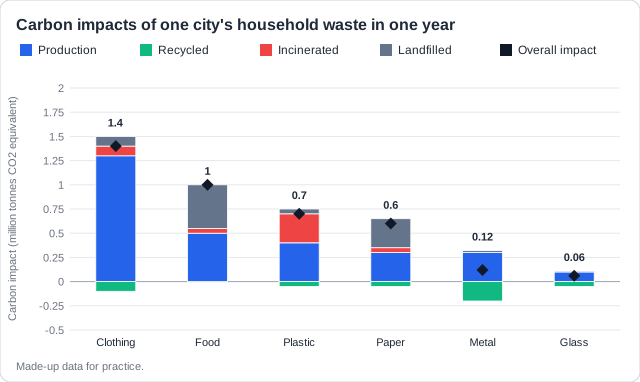
- For many goods the production stage has the biggest carbon impact.
- Landfill and incineration add to the impact; recycling lowers it (a bar below zero).
- Overall impact = production + landfill + incineration - savings from recycling.
- Metal has a lower overall impact than paper: metal is recycled more; paper is landfilled and rots.
Real example: when Scotland measured the carbon impact of its 2018 household waste, clothing came out highest of all, about 1.6 million tonnes of CO2 equivalent, mostly from making the clothes in the first place.
Read what differs: Explaining why metal's overall impact is lower than paper's? If their production bars are equal, production is not the reason: look at recycling and landfill.
Free preview
This is the free notes preview
You're reading the free notes. Aimnova Pro unlocks the full study experience — and you can try it with your first topic free to keep:
- FlashcardsLock in vocabulary and key terms with spaced repetition.
- Practice questionsAnswer exam-style questions and get instant AI marking.
- Mock exams & past-paper vaultSit full mocks and see exactly how examiners award marks.
- Personalised study planA daily plan built around your exam date and weak areas.
Each way of treating waste has its own impacts. The papers often ask you to compare two of them.
Impacts of treating waste
- Landfill: rotting waste gives off methane and leachate, a toxic liquid, and takes up land.
- Incineration: releases CO2 and toxic gases, leaves toxic ash, but cuts volume and makes electricity.
- Open dumps and burning: smoke, rats and mosquitoes, blocked drains and floods.
- Discarded plastic: litter, enters rivers and seas, eaten by animals or tangles them.
- Comparing two methods? Give an impact of each, or only one mark counts.
Plastic thrown away
- Fills landfill space
- Washes into rivers and seas
- Eaten by animals or tangles them
- Litter spoils beaches and tourism
Plastic incinerated
- Releases CO2 and toxic gases
- Leaves toxic ash for landfill
- Volume much smaller
- Heat can make electricity
Real example: in the USA in 2022, landfills were the third-largest human source of methane: about 14% of the total, from food, paper and garden waste rotting without oxygen.
Remember it as: Landfill rots, incineration burns, dumping spreads.
Feeling unprepared for exams?
Get a clear study plan, practice with real questions, and know exactly where you stand before exam day. No more guessing.
Waste and people: Social impacts are the effects on people: their health, safety, income and quality of life.
Social impacts
- Health: smoke, toxic metals and disease near dumps, landfills and burning sites.
- Safety: badly managed dumps can collapse onto homes.
- Jobs and income: millions of waste pickers earn a living sorting waste, often unprotected.
- Quality of life: smell, noise, pests, lower house prices, lost tourism.
- The poorest people usually live closest to the waste.
Real example: on 11 March 2017 part of the Koshe dump in Addis Ababa, Ethiopia, collapsed onto the homes of families who lived and worked on it, killing 115 people.
Environmental or social?: Environmental impacts harm ecosystems (soil, water, air, wildlife). Social impacts harm people. Say which one you are giving.
Good management cuts these impacts. A seven-mark question asks how management protects soil, water or wildlife: each strategy, linked to the harm it stops, earns a mark.
Managing waste to cut the harm
- Reduce, reuse, recycle: fewer toxins and less plastic reach the soil.
- Sort out hazardous items (batteries, fluorescent lamps, tyres, spray cans) before landfill.
- Lined landfills stop leachate soaking into soil and groundwater.
- Incineration breaks down some toxins; composting returns nutrients to the soil.
- Laws, fines and education make people use proper collection points.
- Fewer toxins protect the soil organisms that keep soil fertile.
Collect
- EU law makes shops that sell batteries take old ones back free of charge
Sort
- Collected batteries are sorted by type, such as lead, nickel-cadmium or lithium
Recover
- Recycling plants recover the metals in closed systems
Protect
- Lead, cadmium and mercury stay out of landfills, soil and groundwater
Seven marks, seven links: Each paragraph: one strategy, then how it keeps toxins or plastic out of the soil, water or wildlife.
Memorize terms 3x faster
Smart flashcards show you cards right before you forget them. Perfect for definitions and key concepts.
Somebody else's waste: The impacts of waste are often felt far from where it was made.
Impacts in another place
- Waste is often shipped from high-income to low-income countries.
- Old electronics are sent as second-hand goods; many are broken and become e-waste.
- Plastic sent 'for recycling' is often burnt or dumped where it lands.
- People who did not make the waste suffer its impacts: environmental injustice.
- Rules: the Basel Convention (1989) controls shipping hazardous waste; plastic was added in 2021.
Real example: at Agbogbloshie, workers burnt cables to get the copper out. The smoke released lead and dioxins; a 2019 study found high levels in local chicken eggs. Much of the e-waste came from Europe and North America. The site was demolished in 2021.
Environmental injustice: Rich consumers get the goods; poorer communities far away get the smoke, toxins and health risks. That unfair sharing of harm is environmental injustice.
How this comes up: Paper 2, Section A: a short Describe on how two ways of treating waste differ in their impacts.
A city in Brazil sends all its food waste to landfill. Its neighbour composts its food waste.
Describe how the environmental impacts of landfilled and composted food waste would differ.
Model answer plan
See the mark-by-mark plan — for / against / judgement, with marking guidance — in study mode.