Nine ways nature matters: Natural capital is valued for many reasons, not only money. The guide names nine kinds of value; how much a place is worth depends on all of them together.
The points to remember
- Aesthetic: its beauty, which people enjoy and travel to see.
- Cultural: part of a group's traditions, identity, food, art or medicine.
- Economic: it can be sold or earns money, e.g. fish, timber, tourism.
- Environmental (ecological): it supports other life, e.g. habitat, pollination, flood control.
- Health: medicines, clean air and water, and calm green places.
- Intrinsic: worth existing in its own right, whatever its use to people.
- Social, spiritual and technological: recreation and jobs; sacred places; ideas and power for inventions.
Remember it as: Money is only one of nine: beauty, culture, health, nature, rights, people, faith and ideas count too.
| Value | Real example |
|---|---|
| Aesthetic | Coral colours draw about 2 million visitors a year |
| Cultural | Sea Country of Aboriginal and Torres Strait Islander peoples |
| Economic | Tourism and fishing: about A$6.4 billion a year (2017) |
| Environmental | Nursery for fish; breaks waves before they hit the coast |
| Health | Sea sponges and corals tested as sources of new medicines |
| Intrinsic | Thousands of species with a right to exist |
| Social | About 64,000 jobs; diving and fishing clubs |
| Spiritual | Sacred sites and stories of the Traditional Owners |
| Technological | Glowing coral proteins used as markers in research |
Real example: the Great Barrier Reef has all nine values. A 2017 study put its economic value at about A$6.4 billion a year and 64,000 jobs, but most people would not sell it for any price.
Free preview
This is the free notes preview
You're reading the free notes. Aimnova Pro unlocks the full study experience — and you can try it with your first topic free to keep:
- FlashcardsLock in vocabulary and key terms with spaced repetition.
- Practice questionsAnswer exam-style questions and get instant AI marking.
- Mock exams & past-paper vaultSit full mocks and see exactly how examiners award marks.
- Personalised study planA daily plan built around your exam date and weak areas.
Questions also ask you to sort values into two groups: what nature does for us, and what it is worth in itself.
Use value and intrinsic value
- Instrumental (use) value: what nature does for people, e.g. income, food, medicine.
- Intrinsic value: nature matters in itself; it has a right to exist (biorights).
- The two are not exclusive: one species or place can have both at once.
- Other credited words: scientific value (research), existence and future value.
- Different people stress different values, so they value the same place differently.
Instrumental (use) value
- Fish and timber sold
- Tourists pay to visit
- Medicines and clean water
Intrinsic value
- A right to exist
- Native species and wild places
- Valued even if never used
Real example: reef sharks on the Great Barrier Reef bring divers who pay for trips, an instrumental value, and they also have a right to exist and keep the reef's food web in balance. One animal, both kinds of value.
Name the value, not just an example: 'It is a carbon sink' or 'it gives habitat' is an example. Write the value: 'environmental value, because it is a carbon sink'. For each value, also name the resource that gives it.
Feeling unprepared for exams?
Get a clear study plan, practice with real questions, and know exactly where you stand before exam day. No more guessing.
Measure what people value: Values are opinions, so the way to find them is to ask people. A survey of your school shows which ecosystem services people care about most. Below, Hillcrest School surveys its woodland.
Planning a values survey
- Choose the ecosystem services to ask about, e.g. clean air, beauty, habitat, timber.
- Use closed questions with a scale (1-5) so answers can be counted and compared.
- Ask a large, mixed sample: students of every year, teachers, other staff, parents.
- Pilot it first, keep wording neutral, and keep it anonymous.
- Show results as a bar chart of mean scores, then compare groups.
- Limits: a small or one-sided sample, and people giving the answer that sounds right.
Services
- Six services of the woodland next to the school: clean air, beauty, a place to relax, habitat, timber and firewood, outdoor science lessons
Questions
- 'How much do you value the woodland for clean air?' scored 1 (no value) to 5 (very high)
Sample
- 120 people: 20 students from each of five year groups, plus 20 staff
Results
- Clean air scored highest (4.6), timber lowest (1.8): people value it far more for health and beauty than for money
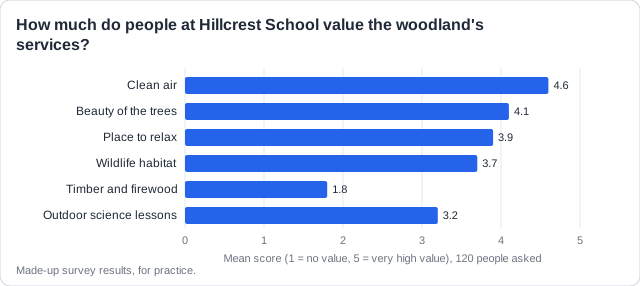
Link each service to a value: Clean air is a health value, beauty an aesthetic value, timber an economic value, lessons a scientific or social value.
How this comes up: Paper 2, Section B (a): four values, each with the resource that provides it, [1] each.
The Daintree Rainforest in Queensland, Australia, is about 180 million years old. In 2021 it was handed back to its Traditional Owners, the Eastern Kuku Yalanji people.
Outline four different values provided by the resources of a tropical rainforest.
Model answer plan
See the mark-by-mark plan — for / against / judgement, with marking guidance — in study mode.