Nothing is endless: All resources are finite, even those that renew.
The points to remember
- All resources are finite: Earth has a fixed amount of every material.
- Even renewable resources have a limit: how fast they are replaced.
- Humanity uses about 1.7 Earths of resources a year: we take more than nature replaces.
- So any resource can run short if it is used faster than it is replaced.
Remember it as: Renewable means 'replaced', not 'endless'.
Real example: in 2025 Earth Overshoot Day fell on 24 July. From then until December, people were using up stocks: fish, forests, groundwater, and the atmosphere's room for carbon dioxide.
Free preview
This is the free notes preview
You're reading the free notes. Aimnova Pro unlocks the full study experience — and you can try it with your first topic free to keep:
- FlashcardsLock in vocabulary and key terms with spaced repetition.
- Practice questionsAnswer exam-style questions and get instant AI marking.
- Mock exams & past-paper vaultSit full mocks and see exactly how examiners award marks.
- Personalised study planA daily plan built around your exam date and weak areas.
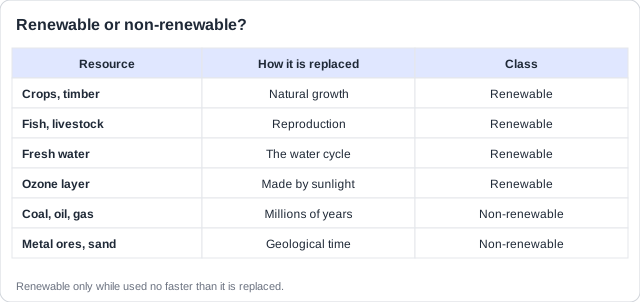
Classify a resource by whether, and how, it is replaced as fast as it is used.
Renewable or non-renewable
- Renewable resources are replaced as fast as they are used.
- Some renew by natural growth or reproduction: food crops, timber, fish, livestock.
- Others renew by recurring processes: fresh water (the water cycle), ozone (made by sunlight).
- Non-renewable resources form over millions of years: coal, oil, gas, metal ores, sand.
- Once used, non-renewables are gone on a human timescale.
Real example: Scotland has both. Its wind, renewed by the weather every day, now makes most of its electricity; its North Sea oil and gas took millions of years to form, and the fields are running down.
Old words: Some older books call water and soil 'replenishable'. Today's term is renewable through recurring processes.
Practice with exam-style questions
Answer exam-style questions and get AI feedback that shows you exactly what examiners want to see in a full-marks response.
Renewable, but not for ever: If a renewable resource is used beyond its regeneration rate, its use becomes unsustainable and it becomes non-renewable.
When renewable becomes non-renewable
- Use a renewable resource faster than its regeneration rate and the stock shrinks.
- Its use becomes unsustainable, and it becomes a non-renewable resource.
- Fish: catch more than the stock's regrowth and it collapses.
- Water: pump more than rain refills and the aquifer or lake dries.
- Fossil groundwater, stored for thousands of years, barely refills: it is effectively non-renewable.
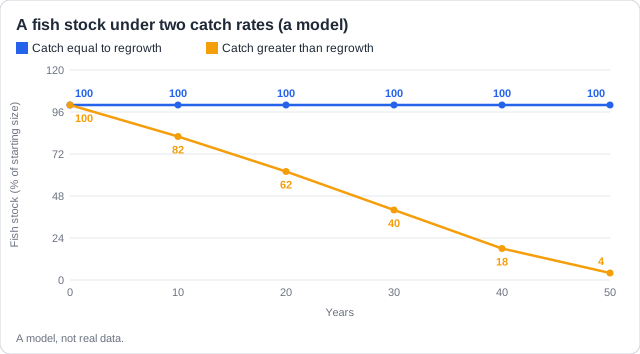
Real example: for centuries the Grand Banks gave huge catches of cod. Factory trawlers caught more than the stock could replace, and in 1992 it collapsed and Canada banned cod fishing. Over 30 years later the stock has still not fully recovered.
How this comes up: Paper 2, Section B (a): four marks, four linked points, with a named example.
Atlantic cod were once caught in huge numbers on the Grand Banks off Newfoundland, Canada.
Outline how a renewable resource can become a non-renewable resource, using a named example.
Model answer plan
See the mark-by-mark plan — for / against / judgement, with marking guidance — in study mode.