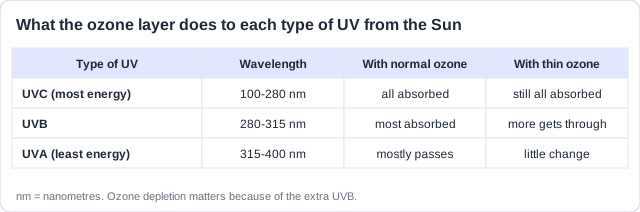
Thinner shield, more UVB: The ozone layer is a shield that absorbs most UVB. When ODSs thin it, more UVB gets through to the ground, where it harms people, plants and animals.
The points to remember
- Ozone absorbs most UVB; all UVC is absorbed, even when ozone is thin.
- Less ozone means less UVB absorbed, so more UVB reaches the surface.
- Depletion has thinned ozone over the whole Earth, not just at the poles.
- UVB has high energy: it damages DNA in skin, eyes, leaves and algae.
- Say the chain: less ozone, more UVB, a named effect on life. 'More UV' alone is not enough.
Real example: at Lauder, in New Zealand, scientists measured the summer ozone falling through the 1990s. By the summer of 1998-99, the peak sunburning UV was about 12% stronger than at the start of the decade.
Free preview
This is the free notes preview
You're reading the free notes. Aimnova Pro unlocks the full study experience — and you can try it with your first topic free to keep:
- FlashcardsLock in vocabulary and key terms with spaced repetition.
- Practice questionsAnswer exam-style questions and get instant AI marking.
- Mock exams & past-paper vaultSit full mocks and see exactly how examiners award marks.
- Personalised study planA daily plan built around your exam date and weak areas.
Ozone has thinned everywhere, but the biggest losses happen over the poles every spring. These areas of very low ozone are called ozone holes.
The points to remember
- The ozone hole is an area of very low ozone (below 220 DU) over a pole, in the stratosphere.
- It appears every spring: over the Antarctic in September and October.
- In winter, the polar vortex traps very cold air (below -78 °C) over the pole.
- Polar stratospheric clouds form in the cold; on them, chlorine from ODSs is turned into active forms.
- When sunlight returns in spring, the active chlorine destroys ozone very fast.
- By December the air warms, the vortex breaks up and the hole closes until next spring.
- The Arctic is warmer, so its holes are smaller and less frequent.
Winter: dark and cold
The polar vortex traps air over the Antarctic. It cools below -78 °C and polar stratospheric clouds form.
Spring: sunlight returns
In September the Sun rises again. Chlorine freed on the clouds destroys ozone fast.
Summer: the hole closes
By December the air warms, the vortex breaks up and ozone-rich air flows back in.
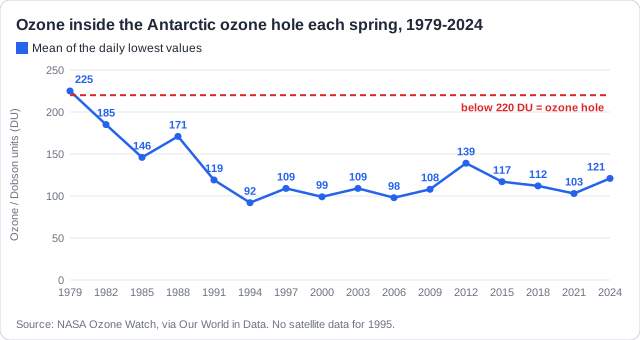
Real example: in 2006 the Antarctic ozone hole averaged 26.6 million km² in September and October, larger than the whole of North America.
See how examiners mark answers
Answer exam-style questions with model answers. Learn exactly what earns marks and what doesn't.
UVB and human health: Extra UVB damages the DNA in skin and eye cells. This causes mutations, which can lead to cancer, and harms the immune system.
The points to remember
- Sunburn: skin burns faster under strong UVB.
- Skin cancer, including melanoma: UVB causes mutations in skin cells.
- Cataracts and other eye damage, which can lead to blindness.
- Premature ageing of the skin: wrinkles and spots.
- A weaker immune system, so the body fights infections and cancer less well.
Remember it as: Skin, eyes, defences: burn, cancer, cataracts, ageing, a weak immune system.
Real example: Punta Arenas, in southern Chile, is one of the cities closest to the Antarctic ozone hole. When the hole passed over it in spring, some UVB wavelengths were more than 20 times stronger than on normal days, and local doctors recorded more cases of sunburn. Health officials warned people to cover up.
Humans only, when asked: If a question asks about human health, give effects on people: melanoma, sunburn, cataracts. Effects on plants or plankton do not count there.
UVB also damages the DNA and the photosynthesis of other living things. On land and in the sea, the damage to producers passes up the food chain.
The points to remember
- Phytoplankton photosynthesise less and are damaged, so ocean productivity falls.
- Phytoplankton are the base of the food web: less food for krill, then fish, penguins, seals, whales.
- Plants: damaged leaves, smaller leaves, less photosynthesis and growth; lower crop yields.
- Animals: DNA damage kills eggs and larvae, e.g. of frogs and toads; zooplankton and krill die.
- So biodiversity can fall as sensitive species decline.
- Not global warming: thinner ozone does not warm the planet.
Thin ozone
- More UVB reaches the sea surface.
Phytoplankton
- phytoplankton: less photosynthesis.
Krill
- krill: less food.
Predators
- Penguins, seals, whales: less food.
Real example: in the spring of 1990, scientists on a ship in the Bellingshausen Sea, off Antarctica, measured phytoplankton under the ozone hole. As the ozone thinned, their photosynthesis fell. They estimated that the ozone hole cut primary production there by at least 6-12%.
Not global warming: Never say that ozone depletion or extra UV causes global warming: they are separate problems.
Study smarter, not longer
Most students waste 40% of study time on topics they already know. Our AI tracks your progress and optimizes every minute.
How this comes up: Paper 2, Section A: identify two consequences for life of ozone depletion [2], one impact on humans or on plants [1], or how less ozone affects living organisms [2].
Over Antarctica, the ozone hole reaches its largest size every September and October.
Identify two possible consequences for life on Earth of the depletion of stratospheric ozone.
Model answer plan
See the mark-by-mark plan — for / against / judgement, with marking guidance — in study mode.