Useful gases with a hidden cost: ozone-depleting substances (ODSs) are gases people made for useful jobs: cooling, spraying, putting out fires, killing pests. High in the stratosphere, they release chlorine or bromine, which destroy ozone.
The points to remember
- ODSs are man-made gases that release chlorine or bromine in the stratosphere.
- CFCs: coolants in fridges and air conditioners, spray cans (aerosols), foam.
- Halons: fire extinguishers. Methyl bromide: a pesticide sprayed into soil.
- Carbon tetrachloride: a cleaning solvent. HCFCs: replacement coolants that still destroy some ozone.
- Name a real chemical in answers (CFCs, halons): 'ODSs' alone, or HFCs, gets no credit.
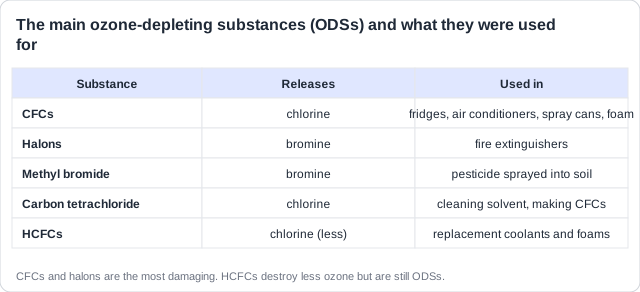
Real example: in 1928 the chemist Thomas Midgley made the first CFCs for fridges. They were not poisonous and did not burn, so by the 1970s they were in fridges, air conditioners and millions of hairspray and deodorant cans.
Name the chemical and its use: 'ODSs' alone is too vague, and HFCs are not ODSs. Write, for example: 'CFCs used as coolants in fridges' or 'halons used in fire extinguishers'.
Free preview
This is the free notes preview
You're reading the free notes. Aimnova Pro unlocks the full study experience — and you can try it with your first topic free to keep:
- FlashcardsLock in vocabulary and key terms with spaced repetition.
- Practice questionsAnswer exam-style questions and get instant AI marking.
- Mock exams & past-paper vaultSit full mocks and see exactly how examiners award marks.
- Personalised study planA daily plan built around your exam date and weak areas.
CFCs do no harm near the ground. The damage starts years later, high in the stratosphere, where UV light breaks them apart. Chlorine then acts as a catalyst.
The points to remember
- CFCs are very stable, so they last for decades and drift up to the stratosphere.
- There, strong UV light breaks the CFC apart and frees a chlorine atom.
- The chlorine atom breaks an ozone molecule into ordinary oxygen.
- Then the chlorine is released again, so it can break another ozone molecule.
- Chlorine is a catalyst: one atom can destroy about 100,000 ozone molecules.
- Bromine (from halons and methyl bromide) works the same way, and is even more destructive.
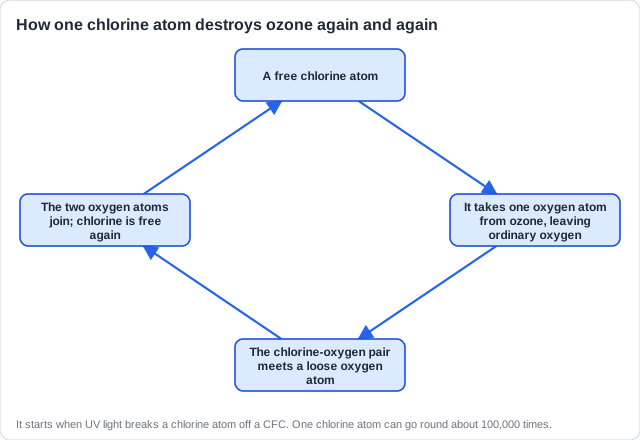
Remember it as: UV frees the chlorine, chlorine breaks the ozone, chlorine is freed again.
Real example: in 1974 the chemists Mario Molina and Sherwood Rowland showed that CFCs reach the stratosphere and release chlorine that could destroy ozone. Many companies said they were wrong. In 1995 the two scientists won the Nobel Prize in Chemistry for this work.
Know your predicted grade
Take timed mock exams and get detailed feedback on every answer. See exactly where you're losing marks.
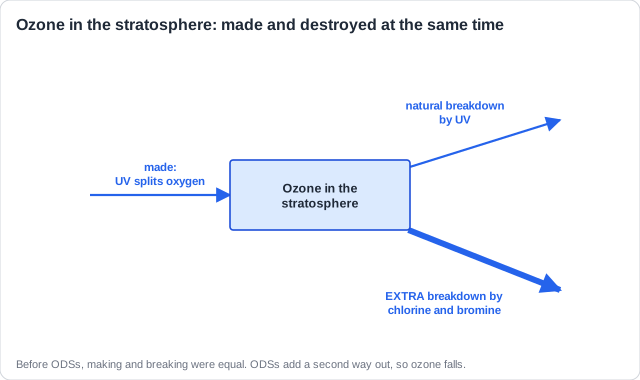
A balance that tipped: Ozone in the stratosphere is always being made and broken down. For millions of years the two rates were equal, an equilibrium. ODSs speed up the breaking, so the balance tips.
The points to remember
- Ozone is made (UV splits oxygen) and broken down (UV splits ozone) at the same time.
- For millions of years the two rates were equal: an equilibrium, so the amount of ozone stayed steady.
- ODSs add an extra way of breaking ozone down, on top of the natural one.
- Now destruction is faster than formation, so the balance tips: the amount of ozone falls.
- Cut the ODSs and the balance tips back: formation wins and ozone recovers.
Real example: at Halley research station in Antarctica, British scientists Joe Farman, Brian Gardiner and Jonathan Shanklin had measured ozone every spring since 1957. In 1985 they reported that spring ozone had fallen from about 300 Dobson units (DU) in the 1960s to under 200 DU by 1984.
Ozone depletion does not cause global warming: Thinner ozone lets in more UV, but that does not warm the planet. They are separate problems. The only link: CFCs are also greenhouse gases, so cutting them helped the climate too.
Most ODSs were banned by 2010, yet ozone is still thinner than in 1980. Human activity keeps affecting ozone because of the gases already released and a few still being released. Each gas has a long lifetime.
The points to remember
- Long lifetimes: CFCs released decades ago are still in the air: a time lag before recovery.
- Chlorine and bromine are removed from the stratosphere very slowly.
- Old equipment still leaks CFCs: fridges, air conditioners, foam in buildings.
- Illegal production and a black market: some factories still make banned CFCs.
- HCFCs are weaker ODSs but still destroy ozone; and some countries do not comply fully.
- Climate change cools the stratosphere, which can make polar ozone loss worse in some years.
Already up there
- CFC-11 lasts about 52 years in the air.
- CFC-12 lasts about 102 years.
Still leaking
- Old fridges, air conditioners and building foam.
- Illegal factories and a black market.
Still allowed
- HCFCs: weaker ODSs, phased out only by 2030-2040.
- Nitrogen oxides from fertilizers and burning fuel: not controlled.
Real example: in 2018 scientists found that CFC-11, banned since 2010, was rising again in the air. The extra gas came mostly from eastern China, where some factories were still using it to make foam insulation. After China cracked down, emissions fell again by 2019.
'Continue' means now: In a question on how human activity continues to affect ozone, explain why the damage goes on today: long lifetimes, leaks, illegal use, HCFCs. Without these points, answers are capped.
Get feedback like a real examiner
Submit your answers and get instant feedback — what you did well, what's missing, and exactly what to write to score full marks.
How this comes up: Paper 2, Section A: name one chemical that caused a fall in ozone on a graph [1]. Section B (b) [7]: explain how human activity continues to affect ozone: the gases, the chain, and why it goes on.
The Antarctic ozone hole was discovered in 1985, and most ozone-depleting substances were banned by 2010. Yet the hole still appears every spring.
Explain how human activities have affected, and continue to affect, ozone in the stratosphere.
Model answer plan
See the mark-by-mark plan — for / against / judgement, with marking guidance — in study mode.