Plants on land stand on soil: Soil is the medium for plant growth on land. It holds the plant up and supplies its water, air for its roots and almost all its nutrients.
The points to remember
- Soil is the foundation of land ecosystems: plants grow in it, and almost every land food chain starts with plants.
- It anchors roots, so plants stay upright and are not blown or washed away.
- It holds air in its pores, so roots get the oxygen they need to respire.
- It is a store of water and of almost all the nutrients a plant needs.
- It is a seed bank: seeds wait in it until conditions let them grow.
- Carbon is the exception: plants take it from the air, as carbon dioxide.
Remember it as: Soil holds the plant, its water, its food and its seeds; the air gives the carbon.
Real example: in the 1930s Dust Bowl, drought and ploughing left the soil of the US Great Plains bare, and wind blew the topsoil away in huge dust storms. Without it crops failed, and many farm families had to leave.
Name the job, then say why it matters: Not just 'soil holds water'. Write 'soil stores water in its pores, which roots take up between rains'.
Free preview
This is the free notes preview
You're reading the free notes. Aimnova Pro unlocks the full study experience — and you can try it with your first topic free to keep:
- FlashcardsLock in vocabulary and key terms with spaced repetition.
- Practice questionsAnswer exam-style questions and get instant AI marking.
- Mock exams & past-paper vaultSit full mocks and see exactly how examiners award marks.
- Personalised study planA daily plan built around your exam date and weak areas.
Soil works like a sponge. The tiny spaces between its particles, its pores, fill with water after rain and release it slowly to the roots.
The points to remember
- Rain soaks into the soil and is held in its pores and on the surface of its particles.
- Roots draw on this stored water between rains, so plants keep growing in dry spells.
- Water also carries the dissolved nutrients into the roots.
- Soils with more humus and fine particles hold more water than coarse, sandy soils.
- Too much water fills the pores, so roots run short of oxygen (waterlogging).
Remember it as: Soil is the plant's water tank between rains.
Real example: in dry Burkina Faso, farmer Yacouba Sawadogo revived an old method: zaï pits, small holes filled with compost. They catch the rain and hold it in the soil, so millet and trees grow where the land was bare.
Water and air share the same pores: A soil full of water has no room for air, so roots cannot respire. A good growing soil holds water but also drains, leaving air in the larger pores.
Study smarter, not longer
Most students waste 40% of study time on topics they already know. Our AI tracks your progress and optimizes every minute.
The soil is the plant's food store: Plants make their own sugars, but they need mineral nutrients from the soil to build everything else. The three they need most are nitrogen, phosphorus and potassium: N, P and K, the letters printed on every bag of fertilizer.
The points to remember
- Soil stores almost all the nutrients a plant needs; the key ones are N, P and K.
- Nitrogen (N), as nitrate: builds proteins and chlorophyll, so leaves and stems grow.
- Phosphorus (P), as phosphate: for roots, seeds and moving energy around the cell.
- Potassium (K): controls water balance, helps flowers, fruit and resisting disease and drought.
- Smaller amounts of calcium, magnesium, sulfur and iron are needed too.
- Nutrients come from weathered rock and decomposed dead matter; crops take them away, so farmers add fertilizer.
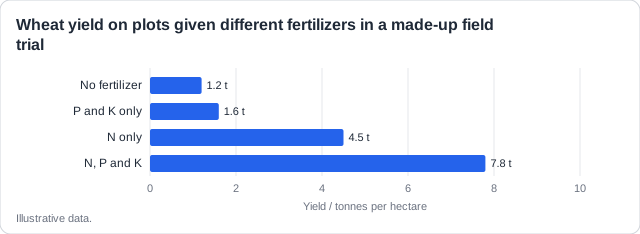
Remember it as: N for leaves, P for roots, K for water and fruit.
Real example: at Rothamsted in England, the Broadbalk wheat field has been farmed since 1843 with the same fertilizer on each strip. The strip that never gets fertilizer still grows wheat, but far less than strips given N, P and K.
A tree can weigh many tonnes, yet the soil around it hardly gets lighter. Most of the tree is made of carbon, and that carbon comes from the air, by photosynthesis.
The points to remember
- A plant's dry mass is about half carbon, yet almost none of it comes from the soil.
- Leaves take in carbon dioxide from the air and turn it into sugars by photosynthesis.
- Soil gives the plant water and mineral nutrients; the air gives it the carbon.
- So soil supplies almost all essential nutrients: carbon is the exception.
Real example: in the 1640s the Flemish scientist Jan van Helmont grew a willow in a pot of weighed soil for five years. The tree gained about 74 kg, but the soil lost only about 57 g: the tree's mass did not come from the soil.
The exception is carbon: Soil supplies water and almost all essential nutrients. If a question asks what the soil does NOT supply, the answer is carbon: plants take it from the atmosphere as carbon dioxide.
Practice with exam-style questions
Answer exam-style questions and get AI feedback that shows you exactly what examiners want to see in a full-marks response.
Seeds waiting in the dark: Soil holds a seed bank. The seeds are dormant until light, water or a disturbance wakes them.
The points to remember
- A seed bank is the store of living, dormant seeds buried in the soil.
- Seeds can wait for years; disturbance, light or water wakes them up.
- After a fire, a flood or ploughing, plants regrow from the seed bank, so the ecosystem recovers faster.
- Losing the topsoil (erosion) means losing the seed bank too.
Remember it as: Disturb the soil, open the bank.
Real example: in Flanders, Belgium, poppy seeds had lain dormant in the soil for years. When shells churned up the fields in the First World War, the seeds were brought to the light, and red poppies covered the battlefields.
Link the seed bank to recovery: Say what the seed bank does for the ecosystem: after a disturbance, plants regrow from it, so plant cover and food chains return faster.
How this comes up: Paper 2, Section B (a): outline four ways soil supports plants [4]. Four different jobs, each linked to growth.
In 2021 a wildfire burned the plants on a hillside in Greece. Within months, grasses and shrubs were growing again from the bare soil.
Outline four ways in which the soil supports this regrowth.
Model answer plan
See the mark-by-mark plan — for / against / judgement, with marking guidance — in study mode.