Same place, new matter: A transfer moves matter. A transformation changes it into something else, inside the soil. Transformations can change one part of the soil, or the whole soil system.
The points to remember
- A transformation changes what the matter is: its chemistry, its form or its state.
- Rock becomes clay, leaves become humus, ammonium becomes nitrate, dissolved salt becomes a crust.
- Some change one component (leaves into humus); some change the whole soil (salinization).
- Others: respiration by soil life, freeze-thaw of soil water, compaction of the pores.
- In the exam, name it, say what changes into what, and keep it within the soil.
Remember it as: Transfer = moves. Transformation = changes.
Changes one component
- Leaves decomposed into humus
- Rock weathered into clay
- Ammonium turned into nitrate
Changes the whole soil
- Salinization of a field
- Compaction of the pores
- Thawing of frozen ground
Real example: Ukraine's black earth, or chernozem, formed over thousands of years as grass roots died and were decomposed into thick humus. That slow transformation made it one of the most fertile soils in the world.
Free preview
This is the free notes preview
You're reading the free notes. Aimnova Pro unlocks the full study experience — and you can try it with your first topic free to keep:
- FlashcardsLock in vocabulary and key terms with spaced repetition.
- Practice questionsAnswer exam-style questions and get instant AI marking.
- Mock exams & past-paper vaultSit full mocks and see exactly how examiners award marks.
- Personalised study planA daily plan built around your exam date and weak areas.
Dead leaves, roots and animals are the soil's food. Detritivores and decomposers break them down into humus and simple nutrients that plants can use again.
The points to remember
- Detritivores such as earthworms break dead leaves into small pieces.
- Decomposers (fungi, bacteria) break them down into humus and inorganic nutrients.
- Their respiration turns the organic matter into carbon dioxide and water.
- Warmth, moisture and air speed it up; cold, waterlogged or acidic soil slows it.
- Ploughing lets in air and speeds decomposition, so tilled soils lose organic matter.
Leaf falls
- A dead leaf lands on the O horizon.
Shredded
- Earthworms and woodlice eat it and break it into tiny pieces.
Decomposed
- Fungi and bacteria digest the pieces and respire, releasing carbon dioxide.
Humus and nutrients
- What is left is humus, and nutrients such as ammonium and phosphate.
Real example: in the warm, wet rainforest of Malaysia, a fallen leaf can disappear within a few months. In the cold boreal forest of northern Canada, pine needles take many years to rot, so a thick layer of needles builds up on the ground.
Memorize terms 3x faster
Smart flashcards show you cards right before you forget them. Perfect for definitions and key concepts.
Soil starts as rock. Weathering breaks the rock down where it lies, and some of its minerals are changed into new ones, such as clay.
The points to remember
- Weathering breaks down or dissolves rock where it is, adding mineral matter to soil.
- Physical: freeze-thaw, heating and cooling, roots prising cracks open.
- Chemical: rain water with carbon dioxide (a weak acid) dissolves or alters minerals.
- Biological: lichens, roots and microbes release acids that break the rock down.
- Some minerals become clay: a new substance, so weathering is a transformation.
Physical
- Water freezes in cracks and expands by about 9%.
- Repeated, the rock splits apart.
Chemical
- Rain water absorbs carbon dioxide and becomes a weak acid.
- It dissolves limestone and turns some minerals into clay.
Biological
- Lichens and roots release acids onto the rock.
- Roots grow into cracks and widen them.
Real example: on Hawaii's Big Island, new lava flows are bare black rock. Rain, warmth, lichens and ferns weather the surface, and within a few hundred years the oldest flows carry a soil deep enough for forest.
Nutrients do not stay in one form. Bacteria change nitrogen from one compound to another, which decides how much plants can use. This is nutrient cycling.
The points to remember
- Nitrogen fixation: bacteria turn nitrogen gas into ammonium.
- Ammonification: decomposers turn the nitrogen in dead matter into ammonium.
- Nitrification: bacteria turn ammonium into nitrate, the form most plants take up.
- Denitrification: in waterlogged, airless soil, bacteria turn nitrate back into nitrogen gas.
- Carbon and phosphorus also change form in soil: nutrient cycling.
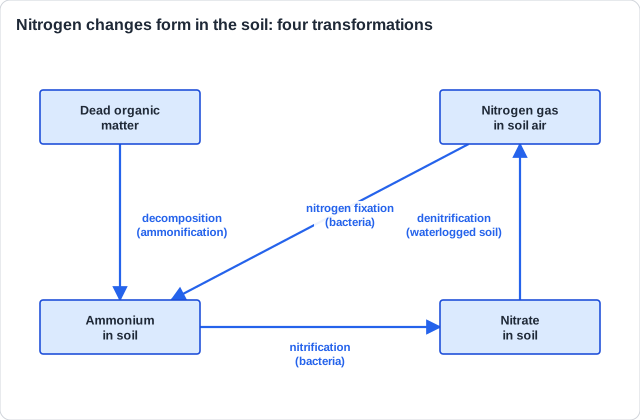
Real example: farmers sow clover, peas or beans because bacteria living in swellings on their roots fix nitrogen from the air. Ploughed in, they leave the soil richer in nitrogen for the next crop, with less fertiliser needed.
Know your predicted grade
Take timed mock exams and get detailed feedback on every answer. See exactly where you're losing marks.
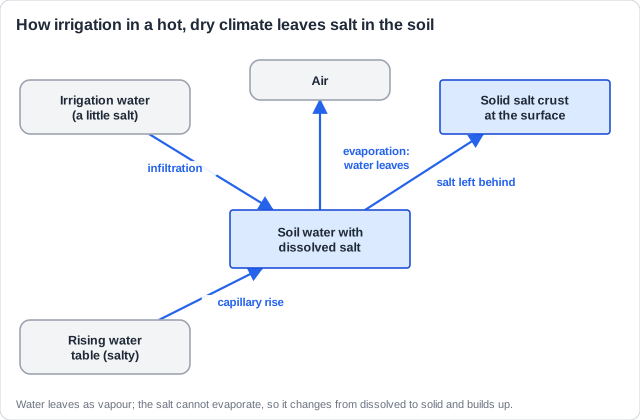
Salinization changes the whole soil. It happens where farmers irrigate in a hot, dry climate.
The points to remember
- Irrigation water carries a little dissolved salt; some groundwater carries a lot.
- In a hot, dry climate much of the water evaporates from the soil surface.
- The salt cannot evaporate, so it is left behind and turns from dissolved to solid.
- Over-watering raises the water table; salty water then rises by capillary action and evaporates too.
- Year after year the salt builds up: a white crust on the soil.
Real example: in Australia's Murray-Darling Basin, clearing deep-rooted trees and heavy irrigation raised the water table, bringing ancient salt up to the surface. Large areas of farmland in the basin are now affected by salt.
A crust is a change of form: Salt dissolved in soil water turning into a solid crust is a transformation. Evaporation of soil water (liquid to vapour) is one too.
Salty soil grows smaller crops. To explain why, say what the salt does to the soil and to the plants.
The points to remember
- Sodium and chloride ions take the place of nutrients such as potassium and phosphorus.
- Salty soil water makes it hard for roots to take up water, so crops wilt even in wet soil.
- Salt above their tolerance kills decomposers and soil animals: less nutrient cycling.
- Over-watering also leaches nutrients, waterlogs the soil and cuts its air supply.
- So yield falls as salinity rises: an inverse relationship.
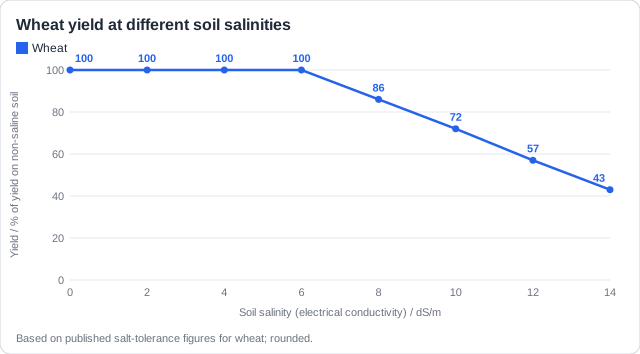
Reading the graph: above 6 dS/m, as soil salinity increases, wheat yield decreases. That is an inverse (negative) relationship. At 10 dS/m the field gives only 72% of a normal crop.
Two traps: State the relationship in the right direction: 'as salinity rises, yield falls', not 'as yield falls, salinity rises'.
In an explain question, 'salinization' alone is not an explanation: say how the salt lowers fertility.
Get feedback like a real examiner
Submit your answers and get instant feedback — what you did well, what's missing, and exactly what to write to score full marks.
How this comes up: Paper 1 case study: explain how irrigation has reduced soil fertility [3]. Three linked steps, using the resource booklet.
In south-west Punjab, India, farmers have irrigated wheat and rice from canals and tube wells for decades. Summers are very hot and the water table has risen under many fields.
Explain how irrigation has reduced soil fertility in this region.
Model answer plan
See the mark-by-mark plan — for / against / judgement, with marking guidance — in study mode.