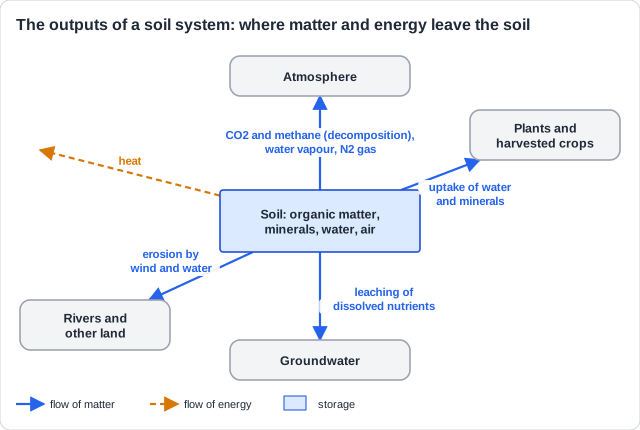
What leaves the soil: Soil is a system with inputs and outputs. Outputs are the matter and energy that leave it: to the air, to plants, to groundwater, or carried away across the land.
The points to remember
- An output is matter or energy leaving the soil system.
- Decomposition loses dead organic matter as carbon dioxide (and methane in waterlogged soil).
- Uptake by roots takes water and minerals; harvesting carries them away.
- Leaching washes dissolved nutrients out to groundwater; erosion carries soil away.
- Evaporation, denitrification and heat lose water, nitrogen and energy to the air.
- Do not give flows that stay inside the soil (nitrification, capillary rise): they are not outputs.
Remember it as: Up to the air, into plants, down to groundwater, away by erosion.
Real example: in an apple orchard in Kent, England, the trees take up water and minerals, and each autumn the apples are picked and sold, carrying those minerals away. Fallen leaves rot, releasing carbon dioxide, and winter rain leaches nitrate down towards the groundwater.
Free preview
This is the free notes preview
You're reading the free notes. Aimnova Pro unlocks the full study experience — and you can try it with your first topic free to keep:
- FlashcardsLock in vocabulary and key terms with spaced repetition.
- Practice questionsAnswer exam-style questions and get instant AI marking.
- Mock exams & past-paper vaultSit full mocks and see exactly how examiners award marks.
- Personalised study planA daily plan built around your exam date and weak areas.
Some outputs go up into the air. Decomposers and roots respire, soil water evaporates, and denitrification turns nitrate into a gas. The gases diffuse out through the air spaces in the soil.
Outputs to the atmosphere
- Carbon dioxide: from respiration by decomposers and roots.
- Methane: from decomposition in waterlogged soil with no air.
- Water vapour: from evaporation of soil water.
- Nitrogen gas: from denitrification.
- Heat: energy lost from the warm soil; soil particles blown away by wind.
The output (the substance)
- Carbon dioxide
- Methane
- Water vapour
- Nitrogen gas
The process behind it
- Respiration
- Decomposition without air
- Evaporation
- Denitrification
Real example: on a cold morning, the compost heaps of a community garden in Berlin steam. Decomposers inside are respiring: the heap loses heat, water vapour and carbon dioxide to the air.
Name the substance: Asked for an output to the atmosphere, write 'carbon dioxide' or 'water vapour'. 'Respiration' or 'evaporation' is the process, not the output.
Know your predicted grade
Take timed mock exams and get detailed feedback on every answer. See exactly where you're losing marks.
Other outputs go down or into plants. Water percolating through the soil carries dissolved nutrients out by leaching; roots take nutrients up, and the harvest carries them away.
Outputs downwards and into plants
- Leaching carries dissolved nutrients (nitrate, potassium) below the roots and into groundwater.
- Heavy rain soon after fertiliser is spread washes it off or down: fertilise in drier weeks.
- Uptake: roots take water and minerals out of the soil store into the plant.
- Harvesting removes those nutrients from the field for good; so does grazing.
- Mining or digging soil out is an output too. Drainage and percolation = leaching: count it once.
Leaching
- Nitrate and potassium washed below the roots.
- Ends up in groundwater and rivers.
Uptake
- Roots absorb water and minerals.
- They leave the soil store for the plant.
Harvest
- Grain, fruit or leaves are taken away.
- Their nutrients never return to the field.
Real example: in England's Nitrate Vulnerable Zones, most farmers may not spread nitrogen fertiliser in autumn and early winter. Heavy winter rain and few growing crops would leach it straight into the groundwater.
Timing matters: Farmers add fertiliser when little rain is due, so it is not washed off or leached before the crop can absorb it.
Erosion is the output that removes the soil itself. Water and wind carry topsoil away, and with it the organic matter and nutrients it holds.
The points to remember
- Erosion is soil carried away by water or wind.
- Steeper slopes lose more soil: water runs off faster and carries more.
- Other factors: heavy rain, strong wind, bare soil with no plant cover, ploughing.
- Forest protects soil: roots bind it, the canopy breaks the force of raindrops, litter covers it.
- Trees slow the wind and help water infiltrate, so less runs off.
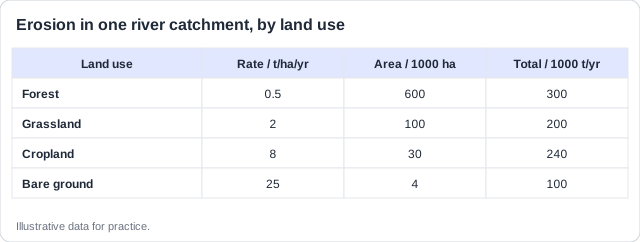
- Total loss = rate x area: a big forest can lose the most in total at a low rate.
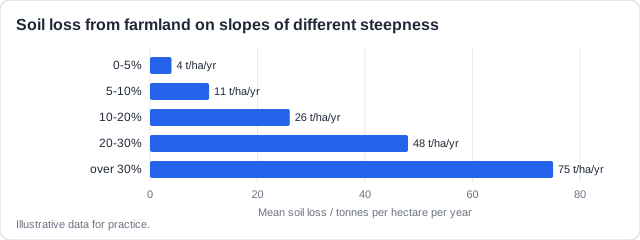
Rate and total are not the same. The rate is the loss from each hectare; the total is the rate multiplied by the area. A land use with a low rate can still lose the most soil if it covers most of the land.
Real example: in the 1920s farmers ploughed up millions of hectares of grassland on the US Great Plains for wheat. When drought hit in the 1930s, the bare soil blew away in huge dust storms: the Dust Bowl. On 'Black Sunday', 14 April 1935, one storm turned day into night.
Get feedback like a real examiner
Submit your answers and get instant feedback — what you did well, what's missing, and exactly what to write to score full marks.
Outputs are natural, and inputs normally replace them. When people speed the outputs up, the soil runs down: soil degradation.
The points to remember
- Outputs change the soil (fewer nutrients, less organic matter), even when the soil stays put.
- Erosion is different: the soil itself is lost.
- People speed up outputs: clearing forest, overgrazing, monoculture, ploughing, over-watering.
- Faster outputs than inputs lead to degradation of productive soil.
- Soil forms very slowly, so lost topsoil is not replaced in a human lifetime.
- Degraded soil means less food, muddy rivers, fewer soil species and less carbon stored.
- Building over soil seals it under concrete: it is lost to farming for good.
Cleared
- Most of the highland forest has been burnt and cleared for rice, cassava and cattle.
Bare
- Fields lie bare between crops and grassland is burnt each year, so roots no longer hold the red soil.
Washed away
- Heavy rain cuts huge gullies called lavaka, and rivers such as the Betsiboka run red.
Poorer
- The topsoil, its humus and its nutrients are gone, so yields fall.
Say how, not just what: 'Overgrazing' or 'deforestation' alone earns no mark. Say what it does: 'grazing removes the grass, so bare soil is washed away by rain'.
How this comes up: Paper 2, Section A: describe how deforestation can lead to soil erosion [3]. Three linked steps: what the trees did, what changes, what happens to the soil.
In Côte d'Ivoire, large areas of rainforest have been cleared to plant cocoa.
Describe how deforestation can result in soil erosion.
Model answer plan
See the mark-by-mark plan — for / against / judgement, with marking guidance — in study mode.