aimnova.
DashboardMy LearningPaper MasteryStudy Plan

Aimnova site navigation

Stay in the loop

Get the latest study resources and updates

New features, study tips and exam insights — straight to your inbox.

IB Diploma

  • IB Past Papers
  • IB Study Notes
  • IB Question Bank
  • IB Mock Exams
  • IB Revision

IB Subjects

  • IB Math AA
  • IB Math AI
  • IB Economics
  • IB Business Management
  • IB Physics
  • IB Biology
  • View all IB subjects→

IB Past Papers

  • IB Math AA HL Past Papers
  • IB Math AA SL Past Papers
  • IB Math AI HL Past Papers
  • IB Math AI SL Past Papers
  • IB Economics HL Past Papers
  • IB Economics SL Past Papers
  • IB ESS Past Papers
  • View all past papers→

Study Resources

  • Study Notes
  • Question Bank
  • Mock Exams
  • Flashcards
  • Revision Guide
  • Exam Skills
  • Command Terms
  • Grade Calculator
  • Exam Timetable 2026

Aimnova

  • Features
  • Pricing
  • For Teachers
  • For Schools
  • For Parents
  • About Us
  • Blog
  • Contact
aimnova.

AI-powered study platform for smarter revision, past-paper analysis and examiner-style feedback.

TermsPrivacyCookies·© 2026 Aimnova. All rights reserved.4d879c2

Aimnova is not affiliated with or endorsed by the International Baccalaureate Organization (IB).

NotesESSTopic 4.4Eutrophication: the sequence of impacts
Back to ESS Topics
4.4.66 min read

Eutrophication: the sequence of impacts

IB Environmental Systems and Societies • Unit 4

Your first topic is free to keep

Know exactly what to write for full marks

Practice with exam questions and get AI feedback that shows you the perfect answer — what examiners want to see.

Start Free

Contents

  • The sequence, step by step
  • Hypoxia, anoxia and dead zones
  • The systems model and its positive feedback
  • Drawing the model yourself
  • Exam-style question
One change leads to the next: An algal bloom does not stay a bloom. The algae die, bacteria break them down, and the bacteria use up the oxygen that fish need. Learn it as a chain: each step causes the next.

The points to remember

  • Excessive growth of phytoplankton: an algal bloom.
  • The bloom shades the water, so rooted water plants die; algae live only days, so they die in huge numbers too.
  • High rates of decomposition: bacteria break down the dead matter.
  • The bacteria cause rapid consumption of dissolved oxygen.
  • Oxygen falls to hypoxia (very low) and then anoxia (none).
  • Aquatic life that depends on dissolved oxygen dies: fish, crabs, worms.
Remember it as: Bloom, doom, decay, no air, no life.
The chain of seven boxes, each arrow leading to the next: extra nitrates and phosphates enter the water; phytoplankton grow fast; less light reaches the bottom and water plants die; algae and plants die in huge numbers; bacteria decompose the dead matter; dissolved oxygen falls, hypoxia then anoxia; fish and other animals die
Each arrow is one link of the chain: one link, one mark.

Example (SL): the Gulf of Mexico. Each spring the Mississippi floods carry fertiliser into the Gulf. Blooms follow in May, the dead algae sink, and by July bacteria have used up the oxygen in the bottom water over thousands of square kilometres.

Free preview

This is the free notes preview

You're reading the free notes. Aimnova Pro unlocks the full study experience — and you can try it with your first topic free to keep:

  • FlashcardsLock in vocabulary and key terms with spaced repetition.
  • Practice questionsAnswer exam-style questions and get instant AI marking.
  • Mock exams & past-paper vaultSit full mocks and see exactly how examiners award marks.
  • Personalised study planA daily plan built around your exam date and weak areas.
Start Studying Free Full access to Aimnova Pro · cancel anytime

The end of the chain has its own words. Hypoxia comes first; anoxia can follow. A dead zone is the result.

The points to remember

  • Hypoxia: dissolved oxygen below about 2 mg per litre.
  • Fish swim away if they can; crabs, clams and worms on the bottom cannot, so they die.
  • With no oxygen, bacteria decompose without air and make hydrogen sulphide (rotten-egg smell).
  • Many dead zones are seasonal: worst in summer, when warm water holds less oxygen.
  • Tolerant species such as some jellyfish survive, so biodiversity falls.
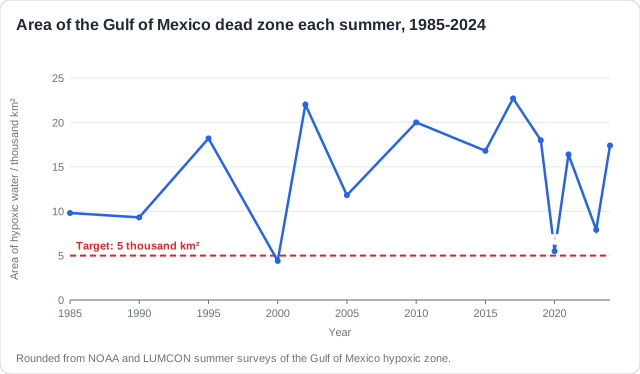
Line graph of the area of the Gulf of Mexico dead zone each summer, 1985-2024, in thousand square kilometres: 9.8 in 1985, 22 in 2002, a record 22.7 in 2017, 5.5 in 2020 and 17.4 in 2024. A dashed line marks the target of 5 thousand square kilometres
The Gulf of Mexico dead zone each summer: far above the target in most years.

Reading the graph (SL). The dead zone covered a record 22 700 km² in 2017, about the size of Wales. It was smallest in 2020 (5500 km²), when a hurricane stirred oxygen back into the water. The target of 5000 km² has almost never been met.

Reading oxygen data: In a table of oxygen by month, the lowest value is usually in July or August. Link it to the chain: spring nutrients, bloom, decomposition, oxygen falls.

Study smarter, not longer

Most students waste 40% of study time on topics they already know. Our AI tracks your progress and optimizes every minute.

Try Smart Study FreeYour first topic is free to keep • No credit card required

A systems model shows the same chain, plus the arrows that loop back. Those loops are positive feedback.

The same seven-box chain with two red loop arrows marked with a plus sign. One goes from fish and other animals die back up to algae and plants die, labelled more dead matter. The other goes from bacteria decompose the dead matter back up to phytoplankton grow fast, labelled releases more nitrate and phosphate
The model: the chain, plus two loops that feed it.

The points to remember

  • Loop 1: more nutrients > more death > more decomposition > more nutrients released.
  • Loop 2: less oxygen > more animals die > more decomposition > even less oxygen.
  • Positive feedback amplifies the change, pushing the system away from its equilibrium.
  • Past a tipping point, the lake settles in a new equilibrium: algae dominate, few species.
  • Also: dead water plants mean less oxygen made, less food for herbivores, less shelter.
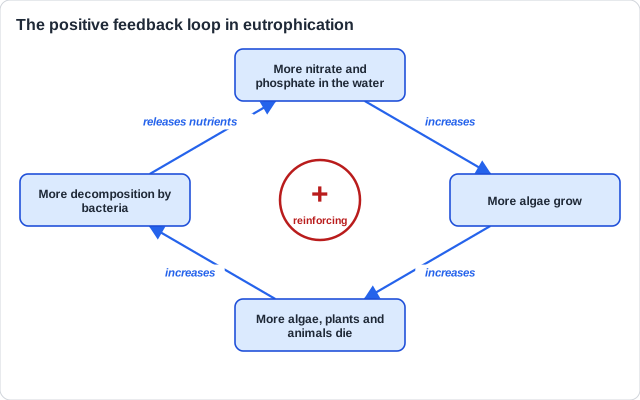
Loop diagram with four boxes in a circle and a plus sign in the middle: more nitrate and phosphate in the water increases more algae grow; that increases more algae, plants and animals die; that increases more decomposition by bacteria; which releases nutrients back to the first box
The guide's loop: each step increases the next, so the loop is positive.
Close the loop: A list of boxes in a line is a chain, not feedback. For full marks, an arrow must lead back to an earlier box, so a change promotes more of the same change.

The papers ask you to draw this model. Build it in five moves. Here it is built for Lake Erie's western basin in August.

Model, step 1: three boxes joined by arrows: extra nitrates and phosphates enter the water; phytoplankton grow fast, an algal bloom; less light reaches the bottom, water plants die
Start at the top: the input, then the bloom.
1

The input

Draw a box at the top: phosphate from farms enters along the Maumee River.

2

The bloom

Add an arrow down to a box: the bloom, a green scum seen from space.

3

The chain

Keep going down, one box per change: shade, death, decomposition, low oxygen, dead fish.

4

Loop back

Arrow from decomposition up to the bloom: it releases phosphate. Arrow from dead fish up to dead matter.

5

Label it

Put + on each loop and write: positive feedback, towards a tipping point.

Boxes and arrows: Write a change in each box ('oxygen falls'), not a single word ('oxygen'). Every arrow means 'leads to'. Two loops, both marked +, are better than one.

Practice with exam-style questions

Answer exam-style questions and get AI feedback that shows you exactly what examiners want to see in a full-marks response.

Try Practice FreeYour first topic is free to keep • No credit card required
How this comes up: Paper 2 Section A asks how nutrient pollution affects food production from a named sea [4]; Section B can ask you to draw and explain the model [7].
IB-style questionExplain[4 marks]

Nutrients carried by the Mississippi River into the Gulf of Mexico have created a dead zone where brown shrimp and fish are caught.

Explain how nutrient pollution could impact aquatic food production in the Gulf of Mexico.

Model answer plan

See the mark-by-mark plan — for / against / judgement, with marking guidance — in study mode.

Claim your free topic

Try an IB Exam Question — Free AI Feedback

Test yourself on Eutrophication: the sequence of impacts. Write your answer and get instant AI feedback — just like a real IB examiner.

Give one named example of a persistent organic pollutant (POP). [1 mark]

Related ESS Topics

Continue learning with these related topics from the same unit:

4.1.1What drives the water cycle
4.1.2The water cycle as a system
4.1.3Where the world's water is stored
4.1.4Flows in the water cycle
View all ESS topics

Practice with flashcards

Spaced repetition flashcards for Eutrophication: the sequence of impacts

Improve your exam technique

Command terms, paper structure, and mark-scheme tips for ESS

Previous
4.4.5Eutrophication: the cause
Next
Eutrophication and ecosystem services4.4.7

20 questions to test your understanding

Reading is just the start. Students who tested themselves scored 82% on average — try IB-style questions with AI feedback.

Start FreeView All ESS Topics