How much oxygen the waste will eat: Biochemical oxygen demand (BOD) is a measure of how much dissolved oxygen microorganisms need to decompose the organic material in water.
The points to remember
- BOD = the dissolved oxygen that microorganisms need to decompose the organic matter in water.
- Units: mg of oxygen per litre of sample, used over 5 days at 20 °C.
- It is an indirect measure of organic matter: it measures the oxygen used, not the waste itself.
- High BOD = lots of organic matter (sewage, manure, food waste) = oxygen falls fast.
- Low oxygen kills fish and insects that need it: mayfly larvae and trout go first.
- Clean rivers have a low BOD, a few mg per litre; raw sewage has a BOD of hundreds.
Remember it as: More rotting waste, more hungry bacteria, less oxygen for fish.
Real example: in 1912 a Royal Commission in the UK set the '20/30' standard for sewage works: treated effluent should have a BOD of no more than 20 mg per litre and no more than 30 mg per litre of suspended solids. Many countries still use similar limits.
Indirect, not direct: BOD does not measure the organic matter itself; it measures the oxygen used to break it down. That is why it is called an indirect measure.
Free preview
This is the free notes preview
You're reading the free notes. Aimnova Pro unlocks the full study experience — and you can try it with your first topic free to keep:
- FlashcardsLock in vocabulary and key terms with spaced repetition.
- Practice questionsAnswer exam-style questions and get instant AI marking.
- Mock exams & past-paper vaultSit full mocks and see exactly how examiners award marks.
- Personalised study planA daily plan built around your exam date and weak areas.
You measure oxygen twice, five days apart, and incubate the sample in between. The steps below are shown on the River Wandle, London, below a sewer overflow.
The points to remember
- Take water samples at several points along the river: above, at and below the source.
- Fill two sealed bottles from each sample: measure dissolved oxygen in one now.
- Measure oxygen with an oxygen probe, a test kit or a titration (Winkler method).
- Keep the other bottle sealed, in the dark, at 20 °C, for 5 days.
- Measure its oxygen again: BOD = oxygen at the start − oxygen after 5 days.
- Repeat at intervals (e.g. each month) and compare sites and dates.
Sample
Bottles filled above the overflow, at it, and 500 m below.
Measure now
Oxygen probe in the first bottle from each site: 9.6 mg/L above the overflow.
Incubate
Second bottle sealed, in a dark box at 20 °C, for 5 days.
Measure again
Above the overflow: 7.8 mg/L, so BOD = 1.8 mg/L.
Why dark, sealed, 20 °C and 5 days
- Dark: algae cannot photosynthesise, so no oxygen is added; the fall is only what was used.
- Sealed: no oxygen gets in from the air.
- 20 °C and 5 days: everyone uses the same conditions, so results can be compared.
Get feedback like a real examiner
Submit your answers and get instant feedback — what you did well, what's missing, and exactly what to write to score full marks.
Calculating BOD is a subtraction. Comparing sites then shows where organic waste enters a river.
How to calculate it
- Write the formula first: BOD = DO at the start − DO after 5 days.
- Use the same units throughout: mg of oxygen per litre (mg/L).
- A bigger fall in oxygen = a higher BOD = more organic matter.
- Along a river, BOD peaks at the source and falls downstream as the waste is broken down and diluted.
Worked example: At the River Wandle overflow, the oxygen was 9.2 mg/L at the start and 3.6 mg/L after 5 days. BOD = 9.2 − 3.6 = 5.6 mg/L, three times the 1.8 mg/L above the overflow.
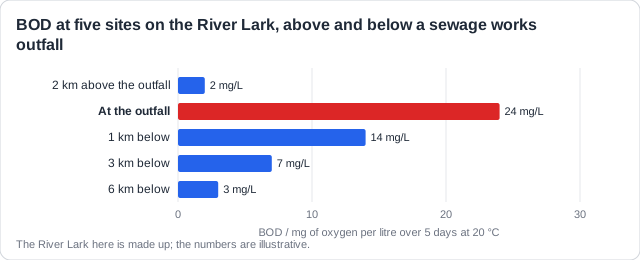
Reading it: BOD jumps from 2 to 24 mg/L at the outfall, so organic waste enters there. It falls to 3 mg/L 6 km downstream, as decomposers use up the waste: the river is recovering.
BOD is useful, but it has limits. A question may ask for one disadvantage: give a real limit of the method, not a vague complaint.
Disadvantages of BOD
- Slow: results take at least 5 days.
- Measures only biodegradable organic pollution: metals, plastics and pathogens are missed.
- Toxins in the sample can kill the microorganisms, so the BOD reads too low.
- Indirect: it does not name the pollutant or show the damage to wildlife.
- A snapshot: it shows only the moment the sample was taken.
These do NOT score: 'It is not accurate', 'it does not identify the source of the pollution' and 'it is expensive' are not accepted. Say what BOD cannot measure, or why its result can be wrong or late.
BOD
- Indirect: oxygen used by decomposers
- A number that compares sites
- Misses toxins, metals, pathogens
- Takes 5 days
Biotic index
- Indirect: the animals living there
- Shows the effect on wildlife
- Shows weeks of conditions
- Needs skill to identify animals
Real example: a factory releasing toxic chemicals into the River Wandle could kill the bacteria in a BOD sample. The BOD would then read low, as if the water were clean.
Learn what examiners really want
See exactly what to write to score full marks. Our AI shows you model answers and the key phrases examiners look for.
How this comes up: Paper 1: describe a method that could be used to monitor BOD on a named river [3].
The River Lea flows through farmland north of London. Anglers report fewer fish below a pig farm.
Describe a method that could be used to monitor biochemical oxygen demand (BOD) on the River Lea.
Model answer plan
See the mark-by-mark plan — for / against / judgement, with marking guidance — in study mode.