A safe area in the sea: A marine protected area (MPA) limits what people may do there. In a no-take zone nothing may be caught at all.
The points to remember
- MPAs are set up by law, with powers to enforce them: patrols and fines.
- Some ban all fishing (no-take zones); others allow only small-scale or traditional fishing.
- Many are zoned: a no-take core, a buffer zone and open sea around them.
- About 8% of the ocean is in MPAs, but under 3% is fully protected.
- Countries agreed in 2022 to protect 30% of land and sea by 2030.
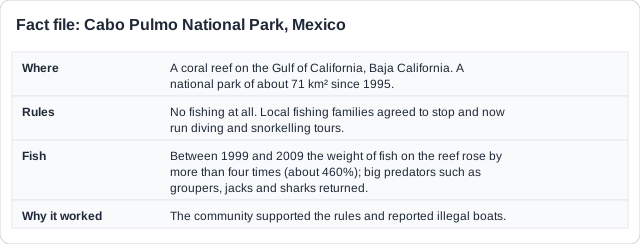
Example (SL): Cabo Pulmo, Mexico. In 1995 local fishing families asked for their reef to be protected, and stopped fishing. Within ten years the weight of fish had risen more than four times, and the families now earn a living from diving tourists.
Free preview
This is the free notes preview
You're reading the free notes. Aimnova Pro unlocks the full study experience — and you can try it with your first topic free to keep:
- FlashcardsLock in vocabulary and key terms with spaced repetition.
- Practice questionsAnswer exam-style questions and get instant AI marking.
- Mock exams & past-paper vaultSit full mocks and see exactly how examiners award marks.
- Personalised study planA daily plan built around your exam date and weak areas.
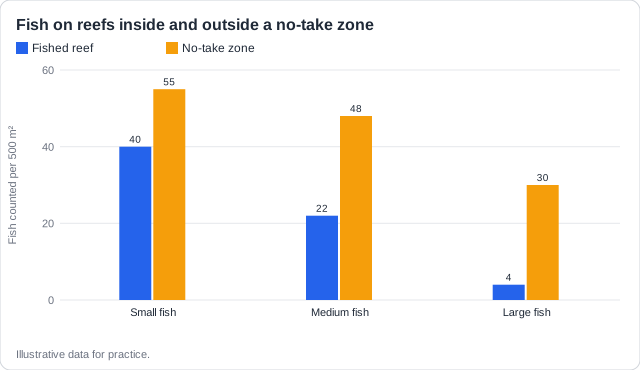
Inside an MPA, fish are no longer removed, so the whole food chain can rebuild.
The points to remember
- Fish live longer and grow larger; big, old females lay far more eggs.
- Top predators (groupers, sharks) return, keeping the food chain in balance.
- Habitats such as coral, seagrass and kelp recover from trawling and anchors.
- More species survive, so biodiversity and the ecosystem's resilience rise.
- Threatened species, such as turtles and dugongs, get a sanctuary.
Example (SL): Goat Island, New Zealand. Protected since 1975, this reserve near Leigh became full of large snapper and rock lobsters. They ate the sea urchins that had stripped the rocks bare, and the kelp forest grew back: a whole food chain restored.
Study smarter, not longer
Most students waste 40% of study time on topics they already know. Our AI tracks your progress and optimizes every minute.
An MPA does not only help the fish inside it. It also helps the wider sea, including the areas where people still fish.
The points to remember
- Spawning grounds: fish can breed there undisturbed.
- Shelter and nurseries: young fish grow up safely in its reefs, seagrass or mangroves.
- Spillover: as numbers rise, adult fish swim out across the boundary, where they can be caught.
- Larvae drift out: eggs and larvae from the big fish inside restock the fished sea around.
- So catches around the MPA can be kept at a sustainable yield.
Remember it as: Protect the nursery, fish the overflow.
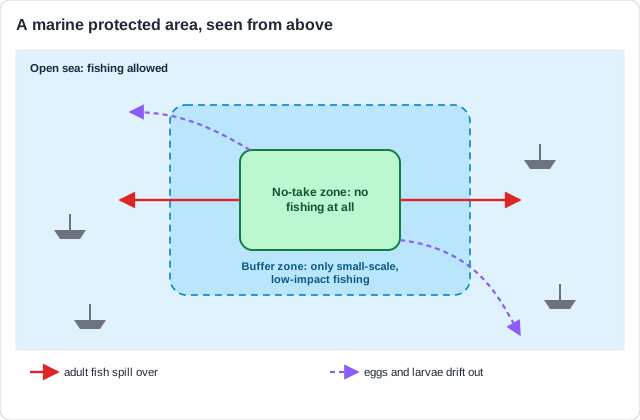
Example (SL): Apo Island, the Philippines. Since 1982 the islanders have kept about a tenth of their reef as a no-take zone. The number of big fish inside rose many times over, and fishers now catch more just outside its edge.
MPAs do not always work. Questions ask you to weigh their benefits against their limits.
Benefits
- Nursery and breeding grounds; stocks recover.
- Spillover raises catches outside.
- Ecotourism jobs: diving, snorkelling.
- Mangroves and seagrass store carbon.
- Healthy reefs protect coasts from storms.
- A duty to protect species for the future.
Limits
- Fishing moves to the areas around.
- Needs patrols; illegal boats still fish.
- Fishers lose income and food at first.
- Bureaucracy, many stakeholders.
- Cannot stop warming and bleaching.
- Tourists can bring pollution.
The points to remember
- An MPA works best with local support, enforcement and help for fishers to find other income.
- A 'paper park' exists by law but is not patrolled, so it protects little.
- Some stocks may be too low to recover, and global threats ignore the boundary.
Example (SL): the Chagos Archipelago. Britain made this Indian Ocean area a no-take MPA in 2010, bigger than France. With only one patrol boat for most of the time, illegal fishing boats hunting sharks were still caught inside it.
Practice with exam-style questions
Answer exam-style questions and get AI feedback that shows you exactly what examiners want to see in a full-marks response.
How this comes up: Paper 1 asks to what extent MPAs would benefit marine ecosystems and people, using a resource booklet [6]. Paper 2 can ask how MPAs help fish stocks or food chains.
Belize's barrier reef is a World Heritage Site. About 3000 fishers catch lobster and conch, tourism is the largest industry, and since 1987 the Hol Chan Marine Reserve has protected part of the reef.
To what extent would more marine protected areas benefit marine ecosystems and people in Belize?
Model answer plan
See the mark-by-mark plan — for / against / judgement, with marking guidance — in study mode.